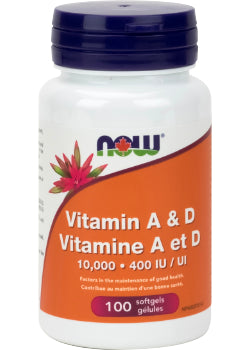
VITAMIN D3 FROM NOW FOODS SUPPORTS STRONG BONES.Now Foods A&D is essential for the maintenance of healthy epithelial tissue, which is found in the eyes, skin, respiratory system, GI & urinary tracts and bone health.Vitamin A is also required for red blood cell production and overall immune function. It serves to enhance the immune response in epithelial tissues, like skin and mucous membranes, making them more resistant to infection. Vitamin D promotes calcium absorption and calcium transport to bones. [SOFTGELS]
1 softgel contains:
Vitamin A (as Retinyl Palmitate) 10, 000 IU
Vitamin D3 (as Cholecalciferol) (from Lanolin) 400 IU
Non-Medicinal Ingredients:
Soybean Oil, Softgel Capsule (gelatin, glycerin, water), Corn Oil
Important Information:
Contains no: sugar, salt, starch, yeast, wheat, gluten, milk, egg, shellfish or preservatives
Dosage
As a dietary supplement, take one softgel daily, preferably with meals. Consider taking this product in combination with NOW Omega-3 Fish Oils, Advanced Gamma-E and Zinc.
Since 1968 NOW has been a leader in the natural products industry. NOW Foods is an award-winning and highly respected manufacturer of vitamins, minerals, dietary supplements and natural foods. Now Foods brings you over 1600 Natural Foods, Supplements, Sports Nutrition and Personal Care Products. NOW supplements are high quality products at affordable prices.
Vitamin A
Vitamin A is a nutrient in the body that can be found in two many forms. When it is being stored for later use, vitamin A is found in a form called retinol. The active form of vitamin A is called retinal, and is used in the retina (the back of our eye) for both low light, and colour vision. These two forms are easily converted back and forth between them as the body requires. Oxidized vitamin A is called retinoic acid, and cannot be converted back to the other forms in the body. Interestingly, although humans cannot synthesize vitamin A directly, the liver can convert certain types of
carotenoids, such as beta-carotene, into retinol as required.
Vitamin A and Vision
In the retina of the eye, retinal binds to two different
protein
types called rods (rhodopsin), and cones (iodopsin). These proteins line the back of the eye in vast numbers, like the pixels of your computer screen. When these pigment molecules are exposed to light, enzymatic reactions occur that trigger the optic nerve to send a signal to the visual centre of the brain. The brain then processes the pattern of these reactions to produce the image we see in our minds. Interestingly, iodopsin is required to see colour, and rhodopsin is needed to see black and white, and for night vision. Vitamin A deficiency often initially presents with poor night vision or night blindness as one of the first symptoms. As deficiency progresses, colour vision may suffer as well.
Immune Effects
Vitamin A is also required for red blood cell production and overall immune function. It serves to enhance the immune response in epithelial tissues, like skin and mucous membranes, making them more resistant to infection. Some current research has been exploring the use of extremely high doses of vitamin A for treatment of cell growths and HIV, but severe toxic side effects have prevented further human trials.
Deficiency
In most of the world, deficiency in vitamin A is uncommon, but it is extremely common in developing countries, particularly Southeast Asia and Africa. When these deficiencies occur, they primarily affect the eye, causing dryness, night blindness or total blindness. Vitamin A deficiency can also result in growth retardation, and has been found to be associated with a variety of female reproductive system concerns. It is believed that this is due to its function in the development of mucous membranes. Individuals with amenorrhea, menorrhagia, cervical dysplasia, fibrocystic breasts, interstitial cystitis, and vaginitis will all benefit from either oral supplementation or topical applications of vitamin A.
Vitamin D
Although at one time 400IU was considered appropriate for supplementation, many health care practitioners are now recommending 1000-4000IU/day, with doses as high as 10,000IU/day still being considered safe and necessary depending on the condition and assuming you are under the supervision of a healthcare provider.
It is fair to say that we are only just beginning to understand the immense difference that vitamin D can make in terms of everyday health and disease prevention.
Vitamin D plays an integral role in bone health, promoting our absorption of both calcium and
phosphorus. For this reason, it is commonly used in the prevention and treatment of osteoporosis.
We are understanding more and more the importance that vitamin D is playing in supporting immune function. Vitamin D has the ability to modulate the immune response, rather than simply strengthen it. In cases of immune dysregulation (autoimmune disorders,
psoriasis
) it serves to balance the response, therefore decreasing the dangerous over-reaction to our own cells and tissues that is seen in many of these conditions. Research studying the use of vitamin D in influenza and various respiratory tract infections, has also showed some promising results. It is now considered one of the top supplements to use during cold and flu season to ward off the offending viruses and bacterium. Vitamin D deficiencies have been associated with an increased risk of influenza, as well as the common cold. The fat soluble vitamin has been shown to dramatically stimulate the expression of potent anti-microbial peptides, which exist in neutrophils, monocytes, natural killer cells, and in epithelial cells lining the respiratory tract. These cells play a major role in protecting the lung from infection.
Vitamin D has heart protective effects, as well. It has been shown to lower
high blood pressure
and is useful in the prevention of cardiovascular disease. Vitamin D is also being used in the management of Type II diabetes, as it has been shown to be involved in insulin secretion and glucose tolerance. Many mental disorders are now being correlated with vitamin D deficiency and supplementation is proving beneficial for many individuals suffering from depression, schizophrenia, seasonal effective disorder, manic/bipolar disorder and autism.
Vitamin D deficiency is considered less than 50 ng/ml of 25(OH)D, which is the active form of vitamin D in our bodies. Deficiency can occur with inadequate sun exposure, inadequate dietary intake, kidney or liver disease, and alcoholism. Elderly, dark-skinned, and obese populations, as well as those with fat malabsorption syndromes or inflammatory bowel disease, are also said to be at greater risk. Vitamin D deficiency causes rickets in children, leading to weak and deformed bones. In adults, deficiency can lead to osteomalacia, and osteoporosis, dental problems, muscle weakness and tooth decay.
When supplementing with Vitamin D, be sure to look for D3 (cholecalciferol) as it is significantly more efficient at raising 25(OH)D levels than the other form of D, D2 (ergocalciferol).
Carefully SelectedShips to the U.S.Wellness EssentialsTrusted Brands
Product Details
Vitamin A
Vitamin A is a nutrient in the body that can be found in two many forms. When it is being stored for later use, vitamin A is found in a form called retinol. The active form of vitamin A is called retinal, and is used in the retina (the back of our eye) for both low light, and colour vision. These two forms are easily converted back and forth between them as the body requires. Oxidized vitamin A is called retinoic acid, and cannot be converted back to the other forms in the body. Interestingly, although humans cannot synthesize vitamin A directly, the liver can convert certain types of
carotenoids, such as beta-carotene, into retinol as required.
Vitamin A and Vision
In the retina of the eye, retinal binds to two different
protein
types called rods (rhodopsin), and cones (iodopsin). These proteins line the back of the eye in vast numbers, like the pixels of your computer screen. When these pigment molecules are exposed to light, enzymatic reactions occur that trigger the optic nerve to send a signal to the visual centre of the brain. The brain then processes the pattern of these reactions to produce the image we see in our minds. Interestingly, iodopsin is required to see colour, and rhodopsin is needed to see black and white, and for night vision. Vitamin A deficiency often initially presents with poor night vision or night blindness as one of the first symptoms. As deficiency progresses, colour vision may suffer as well.
Immune Effects
Vitamin A is also required for red blood cell production and overall immune function. It serves to enhance the immune response in epithelial tissues, like skin and mucous membranes, making them more resistant to infection. Some current research has been exploring the use of extremely high doses of vitamin A for treatment of cell growths and HIV, but severe toxic side effects have prevented further human trials.
Deficiency
In most of the world, deficiency in vitamin A is uncommon, but it is extremely common in developing countries, particularly Southeast Asia and Africa. When these deficiencies occur, they primarily affect the eye, causing dryness, night blindness or total blindness. Vitamin A deficiency can also result in growth retardation, and has been found to be associated with a variety of female reproductive system concerns. It is believed that this is due to its function in the development of mucous membranes. Individuals with amenorrhea, menorrhagia, cervical dysplasia, fibrocystic breasts, interstitial cystitis, and vaginitis will all benefit from either oral supplementation or topical applications of vitamin A.
Vitamin D
Although at one time 400IU was considered appropriate for supplementation, many health care practitioners are now recommending 1000-4000IU/day, with doses as high as 10,000IU/day still being considered safe and necessary depending on the condition and assuming you are under the supervision of a healthcare provider.
It is fair to say that we are only just beginning to understand the immense difference that vitamin D can make in terms of everyday health and disease prevention.
Vitamin D plays an integral role in bone health, promoting our absorption of both calcium and
phosphorus. For this reason, it is commonly used in the prevention and treatment of osteoporosis.
We are understanding more and more the importance that vitamin D is playing in supporting immune function. Vitamin D has the ability to modulate the immune response, rather than simply strengthen it. In cases of immune dysregulation (autoimmune disorders,
psoriasis
) it serves to balance the response, therefore decreasing the dangerous over-reaction to our own cells and tissues that is seen in many of these conditions. Research studying the use of vitamin D in influenza and various respiratory tract infections, has also showed some promising results. It is now considered one of the top supplements to use during cold and flu season to ward off the offending viruses and bacterium. Vitamin D deficiencies have been associated with an increased risk of influenza, as well as the common cold. The fat soluble vitamin has been shown to dramatically stimulate the expression of potent anti-microbial peptides, which exist in neutrophils, monocytes, natural killer cells, and in epithelial cells lining the respiratory tract. These cells play a major role in protecting the lung from infection.
Vitamin D has heart protective effects, as well. It has been shown to lower
high blood pressure
and is useful in the prevention of cardiovascular disease. Vitamin D is also being used in the management of Type II diabetes, as it has been shown to be involved in insulin secretion and glucose tolerance. Many mental disorders are now being correlated with vitamin D deficiency and supplementation is proving beneficial for many individuals suffering from depression, schizophrenia, seasonal effective disorder, manic/bipolar disorder and autism.
Vitamin D deficiency is considered less than 50 ng/ml of 25(OH)D, which is the active form of vitamin D in our bodies. Deficiency can occur with inadequate sun exposure, inadequate dietary intake, kidney or liver disease, and alcoholism. Elderly, dark-skinned, and obese populations, as well as those with fat malabsorption syndromes or inflammatory bowel disease, are also said to be at greater risk. Vitamin D deficiency causes rickets in children, leading to weak and deformed bones. In adults, deficiency can lead to osteomalacia, and osteoporosis, dental problems, muscle weakness and tooth decay.
When supplementing with Vitamin D, be sure to look for D3 (cholecalciferol) as it is significantly more efficient at raising 25(OH)D levels than the other form of D, D2 (ergocalciferol).
🌿
Daily Wellness
Easy to add to your everyday health routine.
✅
Carefully Selected
Chosen with quality and customer needs in mind.
💊
Simple to Use
Designed for convenient daily supplementation.
🚚
Ships to the U.S.
Fast, reliable shipping to U.S. customers.
Choosing a selection results in a full page refresh.