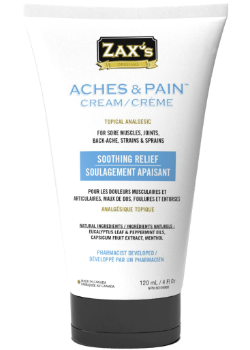
Aches and Pain cream by Zax supports sore muscles and joints with a natural, proprietary formula. Pharmacist developed, Zax products are formulated with natural ingredients that are paraben free. This non-greasy, non-staining formula offers a balance between cooling and warmth so it is tough on all types of pain while being gentle on skin. Zax is a family-owned, Canadian company that offers a range of all natural skincare and first-aid products. [CREAM]
Ingredients:
Oil of Wintergreen (Methyl Salicylate) 10.5%
Menthol 5%
Eucalyptus Leaf Oil 1%
Capsicum Frustescens Fruit Extract 0.13%
Non-medicinal Ingredients:
Water (eau), Butyrospermum Parkii (Shea Butter) Extract, Carpylic/capric triglyceride, Caprylyl Glycol, Camphor, Carbomer copolymer, Ceteareth-20, Cetearyl Alchohol, Cetyl Alcohol, Glycerin, Mentha piperita (Peppermint) oil, Phenoxyethanol, Polysorbate 20, Sorbic acid, Xanthan gum.
Important Information:
Store in an air tight, light resistant container at room temperature. See below for more information.
Dosage
Adults and adolescents 12 years or older – Apply thinly and evenly to affected area up to 3-4 times per day. Rub and/or massage into skin until solution vanishes.
Zax’s Original is a Canadian, family-owned company that provides a holistic approach to first-aid. Their products are made with natural ingredients and are pharmacist developed alongside their team of leading chemists and botanists. Their first product was a bruise treatment and they now offer products to aid in itchy skin, scars, windburn, rosacea or facial redness, hyperpigmentation and dark or age spots, under eye bags and dark circles; as well as heel spurs, plantar fasciitis, bug bites, aches and pains, and much more. All of their formulas are natural and paraben free.
ACHES & PAIN CREAM FROM ZAX'S ORIGINAL
Cautions / Warnings & Known adverse Reactions:
Call a Poison Control centre immediately if overdose or accidental ingestion occurs. Consult a health care professional prior to use if pregnant, breastfeeding or if you are taking anticoagulant medications. Keep out of the reach of children. Stop use and consult a health care professional if symptoms worsen, or re-occur after a few days. Stop use and get medical help right away if you experience pain, swelling or blistering. Stop use if headache and/or redness occur. Stop use if hypersensitivity/allergy, rashes and/or burning discomfort occur.
Muscle/ Joint Injury
By: Naturopathic Doctor (N.D.)
Recovery from joint and muscle injury can be a long process. But with the correct supplements & massage or chiropractic treatment, you can be back on track in no time flat...
Your cartilage acts as a living shock absorber that cushions and protects your bones from damage during the daily stresses of living, working, and playing. But, unfortunately due to age or even injury, the human body is sometimes unable to regenerate damaged soft tissue fast enough to keep your cartilage, ligaments, and tendons supple and flexible.
The result can be pain and swelling. The pain and swelling we know as arthritis occurs when these supporting tissues degenerate, allowing bone to rub against bone, which as anyone who has osteoarthritis will tell you, causes pain.
Muscles and joints can become injured whenever the body is in motion. It often occurs when doing strenuous or repetitive activities, like sports or working on an assembly line. Sprains refer to damage to a tendon or ligament. Tendons hold bone and muscle together. Ligaments hold bones together. Sprains cause sharp pain and rapid swelling of the area. Strains refer to overworking a muscle. It causes muscle cramps, localized pain during movement, swelling and loss of mobility. Another joint injury is bursitis, a swelling of the fluid-filled sac inside the joint. It usually causes localized pain on movement of the joint and swelling.
MAINTAINING JOINT HEALTH WITH GLUCOSAMINE
When scientists first began studying glucosamine and chondroitin in the 1970s, they were amazed that no only did the subjects experience less pain, but also - and more importantly- their formerly degenerating cartilage had begun to repair itself. When they took a closer look at the way glucosamine and chondroitin were actually working to reduce pain and repair cartilage, they found that both of them were extremely important for normal joint health.
They found that glucosamine and chondroitin are both building blocks for the molecules that make up tendons, ligaments, bones, and synovial fluid. They also supply a very important molecule called "proteo-glycans", a substance in joint cartilage. The problem they found was that with age, the ability to regenerate and restore joint structure begins to fail, often due to a decrease in the natural production of glucosamine sulfate in the body. This deficiency causes the production of new joint and connective tissue to slow, causing it to both weaken. The result is pain and stiffness.
A deficiency in either glucosamine or chondroitin may lead to osteoarthritis, which is a break down of joint structure that manifests itself as stiffness (especially after periods of rest), creaking and cracking joints, as well as pain.
In osteoarthritis, the cartilage that covers the surfaces of bones in the joints becomes damaged, which allows bone to rub directly against bone. The synovial fluid eventually becomes thinner, which reduces its ability to cushion impact. Glucosamine makes healthy synovial fluid thick and gelatinous. Without it, your ligaments and tendons would fray, and your cartilage would degenerate.
Though glucosamine may take several months to bring relief from pain, some may have results in as little as a month. In any case, the results are worth the wait. When studies show that prescription arthritis drugs and antinflammatories can actually contribute to the further degeneration of connective tissue, glucosamine and chondroitin offer a safe and effective natural alternative.
Conventional treatment of muscle and joint injury involves the use of anti-inflammatories and pain relievers. They take away the acute symptoms but do not help to heal the injured tissue. The use of such medications may make an individual return to activity too quickly, predisposing the area to re-injury.
First aid for muscle and joint injuries is easily remembered by the acronym RICE, Rest, Ice, Compression and Elevation. Immediately after the injury raise the area above the heart and apply ice for up to 20 minutes. Apply ice every 4 hours for 2 days. Only use heat after the initial swelling has subsided. Use a splint or sling to immobilize the area. Go to the hospital if there is significant swelling or if joint activity is compromised.
To prevent injuries include stretching in your warm up and cool down activities. Poultices made of goldenseal,
fenugreek, flaxseed powder, turmeric or mustard can be used. They help to decrease swelling, decrease bruising and relax tense muscles.
Horse chestnut
seed gel can be applied topically for the same purpose.
To provide the body with the raw materials for tissue repair eat sufficient amounts of
protein
or use a protein supplement. Eat, or drink the juices of, raw fruits and vegetables including
beets, garlic and radishes. They are packed with vitamins, minerals and
enzymes. Drink at least 2L of filtered water to flush waste products from the damaged area.
To prevent muscle and joint injury eat
chromium
rich foods such as nutritional yeast, lobster and cheese. This ensures a steady supply of blood sugar to working muscles. Eat wheat germ because it contains octacosanol, which prevents strains by increasing muscle oxygenation, and
vitamin E, which heals tissue. Eat oats because they contain the connective tissue supporting nutrient, silica.
What you can do to help maintain Muscle/ Joint Injury:
- Use ice to reduce inflammation
- Get the appropriate treatment from a chiropractor, massage therapist or physiotherapist
- Continue with moderate exercise. Train "around" the injury
- Take supplements to support joint repair like glucosamine, chondroitin, or
collagen
- Eat plenty of vegetables; the nutrients in them will help to speed up the healing process
- Use the homeopathic remedy
arnica
or traumeel; they are effective alternatives to conventional NSAIDS
- Take
antioxidants
to reduce the damage inflammation does to the joint
- Take MSM to control inflammation & to reduce pain; it is clinically proven
Carefully SelectedShips to the U.S.Wellness EssentialsTrusted Brands
Product Details
ACHES & PAIN CREAM FROM ZAX'S ORIGINAL
Cautions / Warnings & Known adverse Reactions:
Call a Poison Control centre immediately if overdose or accidental ingestion occurs. Consult a health care professional prior to use if pregnant, breastfeeding or if you are taking anticoagulant medications. Keep out of the reach of children. Stop use and consult a health care professional if symptoms worsen, or re-occur after a few days. Stop use and get medical help right away if you experience pain, swelling or blistering. Stop use if headache and/or redness occur. Stop use if hypersensitivity/allergy, rashes and/or burning discomfort occur.
Muscle/ Joint Injury
By: Naturopathic Doctor (N.D.)
Recovery from joint and muscle injury can be a long process. But with the correct supplements & massage or chiropractic treatment, you can be back on track in no time flat...
Your cartilage acts as a living shock absorber that cushions and protects your bones from damage during the daily stresses of living, working, and playing. But, unfortunately due to age or even injury, the human body is sometimes unable to regenerate damaged soft tissue fast enough to keep your cartilage, ligaments, and tendons supple and flexible.
The result can be pain and swelling. The pain and swelling we know as arthritis occurs when these supporting tissues degenerate, allowing bone to rub against bone, which as anyone who has osteoarthritis will tell you, causes pain.
Muscles and joints can become injured whenever the body is in motion. It often occurs when doing strenuous or repetitive activities, like sports or working on an assembly line. Sprains refer to damage to a tendon or ligament. Tendons hold bone and muscle together. Ligaments hold bones together. Sprains cause sharp pain and rapid swelling of the area. Strains refer to overworking a muscle. It causes muscle cramps, localized pain during movement, swelling and loss of mobility. Another joint injury is bursitis, a swelling of the fluid-filled sac inside the joint. It usually causes localized pain on movement of the joint and swelling.
MAINTAINING JOINT HEALTH WITH GLUCOSAMINE
When scientists first began studying glucosamine and chondroitin in the 1970s, they were amazed that no only did the subjects experience less pain, but also - and more importantly- their formerly degenerating cartilage had begun to repair itself. When they took a closer look at the way glucosamine and chondroitin were actually working to reduce pain and repair cartilage, they found that both of them were extremely important for normal joint health.
They found that glucosamine and chondroitin are both building blocks for the molecules that make up tendons, ligaments, bones, and synovial fluid. They also supply a very important molecule called "proteo-glycans", a substance in joint cartilage. The problem they found was that with age, the ability to regenerate and restore joint structure begins to fail, often due to a decrease in the natural production of glucosamine sulfate in the body. This deficiency causes the production of new joint and connective tissue to slow, causing it to both weaken. The result is pain and stiffness.
A deficiency in either glucosamine or chondroitin may lead to osteoarthritis, which is a break down of joint structure that manifests itself as stiffness (especially after periods of rest), creaking and cracking joints, as well as pain.
In osteoarthritis, the cartilage that covers the surfaces of bones in the joints becomes damaged, which allows bone to rub directly against bone. The synovial fluid eventually becomes thinner, which reduces its ability to cushion impact. Glucosamine makes healthy synovial fluid thick and gelatinous. Without it, your ligaments and tendons would fray, and your cartilage would degenerate.
Though glucosamine may take several months to bring relief from pain, some may have results in as little as a month. In any case, the results are worth the wait. When studies show that prescription arthritis drugs and antinflammatories can actually contribute to the further degeneration of connective tissue, glucosamine and chondroitin offer a safe and effective natural alternative.
Conventional treatment of muscle and joint injury involves the use of anti-inflammatories and pain relievers. They take away the acute symptoms but do not help to heal the injured tissue. The use of such medications may make an individual return to activity too quickly, predisposing the area to re-injury.
First aid for muscle and joint injuries is easily remembered by the acronym RICE, Rest, Ice, Compression and Elevation. Immediately after the injury raise the area above the heart and apply ice for up to 20 minutes. Apply ice every 4 hours for 2 days. Only use heat after the initial swelling has subsided. Use a splint or sling to immobilize the area. Go to the hospital if there is significant swelling or if joint activity is compromised.
To prevent injuries include stretching in your warm up and cool down activities. Poultices made of goldenseal,
fenugreek, flaxseed powder, turmeric or mustard can be used. They help to decrease swelling, decrease bruising and relax tense muscles.
Horse chestnut
seed gel can be applied topically for the same purpose.
To provide the body with the raw materials for tissue repair eat sufficient amounts of
protein
or use a protein supplement. Eat, or drink the juices of, raw fruits and vegetables including
beets, garlic and radishes. They are packed with vitamins, minerals and
enzymes. Drink at least 2L of filtered water to flush waste products from the damaged area.
To prevent muscle and joint injury eat
chromium
rich foods such as nutritional yeast, lobster and cheese. This ensures a steady supply of blood sugar to working muscles. Eat wheat germ because it contains octacosanol, which prevents strains by increasing muscle oxygenation, and
vitamin E, which heals tissue. Eat oats because they contain the connective tissue supporting nutrient, silica.
What you can do to help maintain Muscle/ Joint Injury:
- Use ice to reduce inflammation
- Get the appropriate treatment from a chiropractor, massage therapist or physiotherapist
- Continue with moderate exercise. Train "around" the injury
- Take supplements to support joint repair like glucosamine, chondroitin, or
collagen
- Eat plenty of vegetables; the nutrients in them will help to speed up the healing process
- Use the homeopathic remedy
arnica
or traumeel; they are effective alternatives to conventional NSAIDS
- Take
antioxidants
to reduce the damage inflammation does to the joint
- Take MSM to control inflammation & to reduce pain; it is clinically proven
🌿
Daily Wellness
Easy to add to your everyday health routine.
✅
Carefully Selected
Chosen with quality and customer needs in mind.
💊
Simple to Use
Designed for convenient daily supplementation.
🚚
Ships to the U.S.
Fast, reliable shipping to U.S. customers.
Choosing a selection results in a full page refresh.