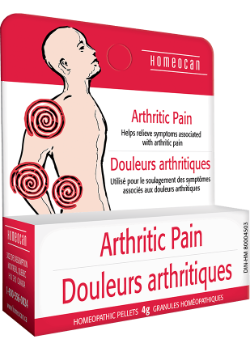
Quick and effective. Homeocan’s Arthritic pain combination pellets is a homeopathic medicine composed among others Arnica Montana. It is specially and naturally formulated to help relieve joint, arthritic or rheumatic pain and stiffness. Easy to carry everywhere, this tube of pellets is equipped with a very practical format. Arthritic pain pellets from Homeocan can relieve you naturally Arthritic pain combination pellets is a homeopathic medicine composed among others Arnica Montana. It is suggested to take 3 pellets and let them dissolve under the tongue 3 times daily and reduce intake with improvement or as directed by a healthcare practitioner. [PELLETS]
Contains:
Causticum 6X
Colchicum autumnale 4X
Benzoicum acidum 3X
Apis mellifica 6X
Arnica montana 7X
Natrum carbonicum 4X
Non-medicinal ingredients:
Lactose, Saccharose
Important Information:
Do not use if seal is broken. For adults only. Keep out of reach of children. Consult a healthcare practitioner before use if you are pregnant or nursing or if symptoms persist or worsen after 72 hours. Do not exceed recommended dosage. Keep at room temperature.
Dosage
Let 3 pellets dissolve under the tongue 3 times daily and reduce intake with improvement or as directed by a healthcare practitioner. To be taken away from meals.
Why Choose Homeocan Therapeutics?
Homeocan Therapeutics is a well-known Canadian brand specializing in homeopathic remedies. Their wide range of popular products includes homeopathic pellets to support allergies, sleep, immune health and stress and topical products like traumacare and arnica gel. Homeocan is trusted in providing safe and effective alternatives to conventional medicine.
RHEUMATOID ARTHRITIS
By: Articles by a Naturopathic Doctor and a Holistic Nutritionist
This autoimmune condition causes swollen, painful joints that can severely restrict one’s ability to live a full life. Fortunately, there are natural ways to help …
Rheumatoid arthritis (RA) is the second most common type of arthritis found in adults. It usually affects women between the ages of 25 and 50, however there is a juvenile form that can affect children. The first joints to be affected are usually the fingers and toes. Other susceptible joints are the wrists, ankles, knees and spine. Unlike Osteoarthritis, rheumatoid arthritis often affects most joints symmetrically (on both sides of the body).
The affected joints become red and swollen, causing stiffness and reduced function. Over time the joints degrade, resulting in pain and further inflammation.
What Causes RA?
The cause of rheumatoid arthritis is unknown but heredity does seem to play a role. It is an autoimmune condition, in which the body attacks its own joint tissues. This causes joint damage and erosion over time. Symptoms of rheumatoid arthritis come and go. The amount of joint destruction is variable and joint pain can move around the body. Attacks can be triggered by viral infections, food sensitivities, or stress. For more information, please see our Autoimmune Disease article.
Signs And Symptoms
Swelling and redness of the joints along with the popular joint pain and stiffness is the most common indication of rheumatoid arthritis. The swelling and inflammation can contribute to joint deformities over a period of time creating protrusions which interfere with proper functioning of the joint. There are symptoms that those with rheumatoid arthritis experience which are not always visible or felt at the site of the joint which include: poor appetite, fatigue, a low-grade fever and weight loss. Often, RA will affect both sides of the body, for example, both the left and right ankles. In some cases, the disease can affect other organs like the heart, eyes and lungs. Many people with RA will have blood work that is positive for rheumatoid factor (RF), and has high C-Reactive
Protein
(CRP) levels.
Conventional Treatment
There are many strong drugs currently used to treat RA, and each has a variety of side effects. Common medications include: methotrexate, sulfasalazine, infliximab, and leflunomide. Most are targeted at reducing the immune response in the body, and thus can actually increase the risk of infections. Some drugs are also known to deplete vitamins and minerals. Individuals taking medication for this condition should consult their health professional about these interactions.
Food Sensitivities
Avoid consuming any foods that you are sensitive to. It is estimated that at least 10 percent of arthritis sufferers are sensitive to the nightshade family (green peppers, eggplant, potatoes and tomatoes). They contain a substance called solanine that interferes with the muscle’s enzyme system, causing pain. Other common food sensitivities are diary, wheat/gluten, corn, and soy. A digestive enzyme can be supplemented to ensure that food is broken down properly in the gut, although this won’t always solve the problem. See our Leaky Gut article for more information.
Diet
There are a number of different dietary approaches to RA. Most people’s diets cause their tissues to be acidic. In order to buffer the acid in the tissues, essential minerals are stripped from the body, including those in the joints. An Alkaline Diet will help to prevent worsening of symptoms and maintain a proper mineral balance in the joints. See the Acid/Alkali Balance article for more information. In addition to an alkaline diet the following foods can be increased to help reduce symptoms of RA: pineapple, ginger, turmeric, sulphur containing foods such as eggs, garlic and onions, fibre such as flax seeds and ocean fish for their essential fatty acids. All of these foods contain substances that can help to reduce inflammation in the body. Iron from supplemental sources may aggravate arthritis, see our Iron article for dietary sources. Fluoride in drinking water disrupts
collagen
and can contribute to arthritis. Drinking plenty of filtered water can help to flush toxins out of the water and promote healthy joint fluid. See our Joint Health article for more information.
Topical Treatments For RA
Topically,
juniper
or St. John’s Wort oil can be rubbed into the joints to help reduce pain and relieve stiffness. Topical application of MSM has also been shown to help relieve arthritis pain. Joint creams and tablets with homeopathic remedies like rhus-t, arnica, and sulphur may also be helpful. Hydrotherapy with hot compresses or baths can also provide symptomatic relief. Alternating hot and cold treatments can help to bring down swelling and clear away some of the toxic build-up.
Supplements For Reducing RA
Adding
Fish Oil
is a great way to help reduce inflammation in the body and provide essential fatty acids for joint repair.
Curcumin,
Bromelain, and
Boswelia
can all help to reduce the underlying inflammation that is triggering joint degredation. Devil’s Claw is particularly successful at reducing inflammation in degenerative conditions. Glucosamine and Chondroitin work well together to help provide the body with the building blocks required for joint repair.
Vitamin C, and
collagen
can also provide essential building blocks for repair. There are a number of combination products that provide several of the above recommendations into a single product to help make supplementing easy
Carefully SelectedShips to the U.S.Wellness EssentialsTrusted Brands
Product Details
RHEUMATOID ARTHRITIS
By: Articles by a Naturopathic Doctor and a Holistic Nutritionist
This autoimmune condition causes swollen, painful joints that can severely restrict one’s ability to live a full life. Fortunately, there are natural ways to help …
Rheumatoid arthritis (RA) is the second most common type of arthritis found in adults. It usually affects women between the ages of 25 and 50, however there is a juvenile form that can affect children. The first joints to be affected are usually the fingers and toes. Other susceptible joints are the wrists, ankles, knees and spine. Unlike Osteoarthritis, rheumatoid arthritis often affects most joints symmetrically (on both sides of the body).
The affected joints become red and swollen, causing stiffness and reduced function. Over time the joints degrade, resulting in pain and further inflammation.
What Causes RA?
The cause of rheumatoid arthritis is unknown but heredity does seem to play a role. It is an autoimmune condition, in which the body attacks its own joint tissues. This causes joint damage and erosion over time. Symptoms of rheumatoid arthritis come and go. The amount of joint destruction is variable and joint pain can move around the body. Attacks can be triggered by viral infections, food sensitivities, or stress. For more information, please see our Autoimmune Disease article.
Signs And Symptoms
Swelling and redness of the joints along with the popular joint pain and stiffness is the most common indication of rheumatoid arthritis. The swelling and inflammation can contribute to joint deformities over a period of time creating protrusions which interfere with proper functioning of the joint. There are symptoms that those with rheumatoid arthritis experience which are not always visible or felt at the site of the joint which include: poor appetite, fatigue, a low-grade fever and weight loss. Often, RA will affect both sides of the body, for example, both the left and right ankles. In some cases, the disease can affect other organs like the heart, eyes and lungs. Many people with RA will have blood work that is positive for rheumatoid factor (RF), and has high C-Reactive
Protein
(CRP) levels.
Conventional Treatment
There are many strong drugs currently used to treat RA, and each has a variety of side effects. Common medications include: methotrexate, sulfasalazine, infliximab, and leflunomide. Most are targeted at reducing the immune response in the body, and thus can actually increase the risk of infections. Some drugs are also known to deplete vitamins and minerals. Individuals taking medication for this condition should consult their health professional about these interactions.
Food Sensitivities
Avoid consuming any foods that you are sensitive to. It is estimated that at least 10 percent of arthritis sufferers are sensitive to the nightshade family (green peppers, eggplant, potatoes and tomatoes). They contain a substance called solanine that interferes with the muscle’s enzyme system, causing pain. Other common food sensitivities are diary, wheat/gluten, corn, and soy. A digestive enzyme can be supplemented to ensure that food is broken down properly in the gut, although this won’t always solve the problem. See our Leaky Gut article for more information.
Diet
There are a number of different dietary approaches to RA. Most people’s diets cause their tissues to be acidic. In order to buffer the acid in the tissues, essential minerals are stripped from the body, including those in the joints. An Alkaline Diet will help to prevent worsening of symptoms and maintain a proper mineral balance in the joints. See the Acid/Alkali Balance article for more information. In addition to an alkaline diet the following foods can be increased to help reduce symptoms of RA: pineapple, ginger, turmeric, sulphur containing foods such as eggs, garlic and onions, fibre such as flax seeds and ocean fish for their essential fatty acids. All of these foods contain substances that can help to reduce inflammation in the body. Iron from supplemental sources may aggravate arthritis, see our Iron article for dietary sources. Fluoride in drinking water disrupts
collagen
and can contribute to arthritis. Drinking plenty of filtered water can help to flush toxins out of the water and promote healthy joint fluid. See our Joint Health article for more information.
Topical Treatments For RA
Topically,
juniper
or St. John’s Wort oil can be rubbed into the joints to help reduce pain and relieve stiffness. Topical application of MSM has also been shown to help relieve arthritis pain. Joint creams and tablets with homeopathic remedies like rhus-t, arnica, and sulphur may also be helpful. Hydrotherapy with hot compresses or baths can also provide symptomatic relief. Alternating hot and cold treatments can help to bring down swelling and clear away some of the toxic build-up.
Supplements For Reducing RA
Adding
Fish Oil
is a great way to help reduce inflammation in the body and provide essential fatty acids for joint repair.
Curcumin,
Bromelain, and
Boswelia
can all help to reduce the underlying inflammation that is triggering joint degredation. Devil’s Claw is particularly successful at reducing inflammation in degenerative conditions. Glucosamine and Chondroitin work well together to help provide the body with the building blocks required for joint repair.
Vitamin C, and
collagen
can also provide essential building blocks for repair. There are a number of combination products that provide several of the above recommendations into a single product to help make supplementing easy
🌿
Daily Wellness
Easy to add to your everyday health routine.
✅
Carefully Selected
Chosen with quality and customer needs in mind.
💊
Simple to Use
Designed for convenient daily supplementation.
🚚
Ships to the U.S.
Fast, reliable shipping to U.S. customers.
Choosing a selection results in a full page refresh.