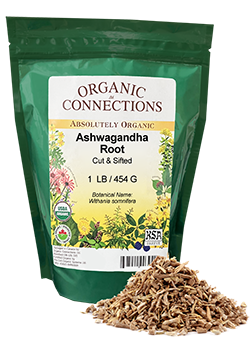
Ashwagandha (Withania somnifera), also known as Indian ginseng is one of the most well-known and widely used Ayurvedic herb. The root of the Ashwagandha plant is the most commonly used part in Western herbal remedies and is known for its restorative and vitality promoting benefits, supporting an energetic and rejuvenating sense of wellbeing. Organic Connections sources only organic ashwagandha roots to bring to you high quality, pesticide free ashwagahda root that has been cut and sifted, making it ideal for brewing a cup of tea, added to food, or directly consumed. [CUT & SIFTED]
Contains:
Organic Ashwagandha Root
Important Information:
Store in a cool, dry, dark place. Keep out of reach of children. Not for use in pregnancy except under the supervision of a qualified healthcare practitioner.
Dosage
Taken internally as a tea. Can be made into a personalized herbal combination
Certified Organic Loose Herbal Teas & Remedies
Organic Connections makes quality food supplements including: Organic ground Cinnamon powder, both Ceylon and Cassia and Organic Slippery Elm Bark powder to provide fibre and support intestinal health. Organic Connections believes in quality, natural and organic ingredients to provide the best in natural health.
Ashwaghanda
By: Naturopathic Doctor ( N.D.)
Ashwagandha can help you beat stress, sexual dysfunction,
autoimmune disease, arthritis and even cell growrhs...
Ashwagandha (Withania somnifera) is an Ayurvedic herb also known as Indian
ginseng
(although it is not strictly a member of the
ginseng
family) that has been traditionally used as an adrenal and nervous system tonic, an adaptogen, and an immune modulator. In Ayurveda, it is classified as a rasayana (rejuvenation) herb, meaning that it can promote physical and mental health, rejuvenate the body in debilitated conditions and increase longevity.
Current research has implicated Ashwagandha for the treatment of an incredible variety of conditions including: anxiety, sexual dysfunction, neurologically degenerative conditions (Alzheimer's and Parkinson's), autoimmune diseases, and arthritis.
Ashwagandha as an Adaptogen
Ashwagandha has active constituents called withanolides, chemicals that resemble human steroid (stress and sex) hormones. This gives them the potential to supplement these hormones in the body in cases of insufficient production or to compete with excess levels produced. This means that supplementation can help normalize hormone levels, whether high or low. In addition to the effects of the withanolides, supplementation of ashwagandha prevents the depletion of
vitamin C
in the body.
vitamin C
is required by the adrenal gland for the production of hormones, such as cortisol and sex hormones. Ashwagandha has also been studied for its ability to increase sexual functioning and physical endurance. This may also be due to Ashwagandha's support of the adrenal gland, as
testosterone
is produced in the adrenals and is responsible for libido and muscle growth. This herb has also been found to improve semen quality with supplementation.
Immune System Modulation and Neuroprotection
Ashwagandha also modulates the immune system, helping to promote underactive immune response and reduce overactive immune responses like those in autoimmune diseases. Because of its anti-inflammatory effects, Ashwagandha has also been studied for its ability to protect joint cartilage in cases of rheumatoid and
osteoarthritis. Due to its neuroprotective effects, Ashwagandha is also used in cases of Alzheimer's and Parkinson's diseases as well. In addition, this herb has been established as an effective treatment for anxiety in several studies in the last few years.
How can I take Ashwagandha?
Ashwagandha can be purchased as raw herb, liquid extract or tincture and encapsulated herb. The root is the part of the plant that is used medicinally, although some of the anti-cell growth research involves use of the leaf extract. This herb can be found alone or in combination formulas for the treatment of a variety of conditions. Dosing varies depending on the condition and particular study, but it has been safely supplemented between 1-2g daily of root extract. When Ashwagandha is found in a tea form, it can be safely taken by up to 3 cups a day (using 1-6g of whole herb). As a liquid or tincture, it can be dosed at between 2 and 4ml three times daily. Dosing for leaf extract has not yet been established as the research is still quite new in this area.
Important Information
Pregnant women should not use Ashwagandha because it may increase the risk of miscarriage. Do not use if you suffer from hypertension. Ashwagandha may also increase the effect of sedative and anti-anxiety medication. Do not use if you are taking digoxin as there is a potential for interaction.
Ashwagandha– Quick Facts
Parts Used
· Root Or Leaf.
Applications
· Stress-Related Illnesses, Autoimmune Conditions, Sexual Dysfunction, Neurologic Conditions, Arthritis
Optimum Dosage
· There Is No Standard Dose Although Generally It Is Used Between 1 And 2 Grams Daily. 3 Cups Of Tea Per Day, Or 2-4ml Of Tincture Three Times Daily. (Clinical Doses May Be Higher As Recommended By Your Practitioner).
Works Well With
· Vitamin C, Vitamin B5, Other Immunomodulating Herbs
Important Information
· Do Not Use Ashwagandha With Sedatives Or Anti-Anxiety Medications.
· Do Not Use If You Are Pregnant, Suffer From Hypertension, Or If You Are Taking Digoxin.
Carefully SelectedShips to the U.S.Wellness EssentialsTrusted Brands
Product Details
Ashwaghanda
By: Naturopathic Doctor ( N.D.)
Ashwagandha can help you beat stress, sexual dysfunction,
autoimmune disease, arthritis and even cell growrhs...
Ashwagandha (Withania somnifera) is an Ayurvedic herb also known as Indian
ginseng
(although it is not strictly a member of the
ginseng
family) that has been traditionally used as an adrenal and nervous system tonic, an adaptogen, and an immune modulator. In Ayurveda, it is classified as a rasayana (rejuvenation) herb, meaning that it can promote physical and mental health, rejuvenate the body in debilitated conditions and increase longevity.
Current research has implicated Ashwagandha for the treatment of an incredible variety of conditions including: anxiety, sexual dysfunction, neurologically degenerative conditions (Alzheimer's and Parkinson's), autoimmune diseases, and arthritis.
Ashwagandha as an Adaptogen
Ashwagandha has active constituents called withanolides, chemicals that resemble human steroid (stress and sex) hormones. This gives them the potential to supplement these hormones in the body in cases of insufficient production or to compete with excess levels produced. This means that supplementation can help normalize hormone levels, whether high or low. In addition to the effects of the withanolides, supplementation of ashwagandha prevents the depletion of
vitamin C
in the body.
vitamin C
is required by the adrenal gland for the production of hormones, such as cortisol and sex hormones. Ashwagandha has also been studied for its ability to increase sexual functioning and physical endurance. This may also be due to Ashwagandha's support of the adrenal gland, as
testosterone
is produced in the adrenals and is responsible for libido and muscle growth. This herb has also been found to improve semen quality with supplementation.
Immune System Modulation and Neuroprotection
Ashwagandha also modulates the immune system, helping to promote underactive immune response and reduce overactive immune responses like those in autoimmune diseases. Because of its anti-inflammatory effects, Ashwagandha has also been studied for its ability to protect joint cartilage in cases of rheumatoid and
osteoarthritis. Due to its neuroprotective effects, Ashwagandha is also used in cases of Alzheimer's and Parkinson's diseases as well. In addition, this herb has been established as an effective treatment for anxiety in several studies in the last few years.
How can I take Ashwagandha?
Ashwagandha can be purchased as raw herb, liquid extract or tincture and encapsulated herb. The root is the part of the plant that is used medicinally, although some of the anti-cell growth research involves use of the leaf extract. This herb can be found alone or in combination formulas for the treatment of a variety of conditions. Dosing varies depending on the condition and particular study, but it has been safely supplemented between 1-2g daily of root extract. When Ashwagandha is found in a tea form, it can be safely taken by up to 3 cups a day (using 1-6g of whole herb). As a liquid or tincture, it can be dosed at between 2 and 4ml three times daily. Dosing for leaf extract has not yet been established as the research is still quite new in this area.
Important Information
Pregnant women should not use Ashwagandha because it may increase the risk of miscarriage. Do not use if you suffer from hypertension. Ashwagandha may also increase the effect of sedative and anti-anxiety medication. Do not use if you are taking digoxin as there is a potential for interaction.
Ashwagandha– Quick Facts
Parts Used
· Root Or Leaf.
Applications
· Stress-Related Illnesses, Autoimmune Conditions, Sexual Dysfunction, Neurologic Conditions, Arthritis
Optimum Dosage
· There Is No Standard Dose Although Generally It Is Used Between 1 And 2 Grams Daily. 3 Cups Of Tea Per Day, Or 2-4ml Of Tincture Three Times Daily. (Clinical Doses May Be Higher As Recommended By Your Practitioner).
Works Well With
· Vitamin C, Vitamin B5, Other Immunomodulating Herbs
Important Information
· Do Not Use Ashwagandha With Sedatives Or Anti-Anxiety Medications.
· Do Not Use If You Are Pregnant, Suffer From Hypertension, Or If You Are Taking Digoxin.