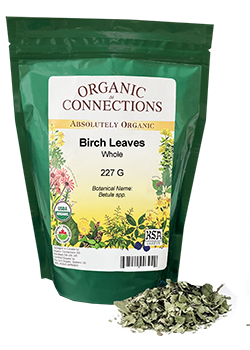
The birch tree is a large tree of the Betula genus and is known for it’s white bark. The leaves of the birch tree contain vitamin c, and is one of the main reasons they’re often used in herbal medicine to support kidney and bladder health. Organic Connections follows organic growing practices and uses the whole leaf. You can either crush the leaf to make your own combinations with other herbs such as uva ursi, or to make a tea on its own or with cranberry and green tea. [WHOLE]
Contains:
Whole Organic Birch Leaves (Betula pendula)
Important Information:
Store in a cool, dry place. Keep out of reach of children.
Dosage
Make your own herbal combinations, or make a tea
Certified Organic Loose Herbal Teas & Remedies
Organic Connections makes quality food supplements including: Organic ground Cinnamon powder, both Ceylon and Cassia and Organic Slippery Elm Bark powder to provide fibre and support intestinal health. Organic Connections believes in quality, natural and organic ingredients to provide the best in natural health.
Birch
By: Naturopathic Doctor (N.D.)
Good for the urinary tract, and joints...
The birch tree (Betula spp.) is sought after for its wood, bark, leaves and sap. Birch wood was favoured by the First Nations of North America for canoe building because of its light weight and flexibility. In Britain, the leaves were used to treat rheumatism and headaches, and the springtime sap was thought to be beneficial for the kidneys and bladder.
Birch sap was used by pioneers in North America as a springtime tonic, a gargle for sore throats, and a wash for skin conditions. Current applications for birch do not differ much from traditional uses.
Skincare
Because of its anti-inflammatory constituents, birch is sometimes added to cosmetic products to help reduce inflammation and redness. It also helps to regulate cell reproduction as in cell growth cases. Using birch extracts directly on the skin helps to bypass the limited absorption in the digestive tract.
Medicinal Properties of Birch
Birch sap contains chemicals that act as a diuretic, making it useful for urinary tract infections when combined with other herbs. Birch leaves contain salicylates (like aspirin), and therefore exhibit anti-inflammatory and pain relieving properties. Therapeutically birch leaves have been used for joint pain taken both internally as tea, and used as an external rub. Birch extract applied topically is also helpful to heal and protect boils and sores.
How can I take it?
Birch supplements can be purchased as encapsulated herb, raw herb or tincture. It may be found in combination supplements for urinary tract infections or kidney cleansing. Birch sap is often added to natural salves or creams to be rubbed on to painful joints and muscles. It can also be found in cosmetic products to help reduce inflammation and redness.
Important Information
Birch should be used with caution if you are nursing or pregnant. Those who are allergic to aspirin should not use birch. Because of its effect on the kidneys, birch should not be used by anyone with compromised kidney function or heart failure.
Birch– Quick Facts
Parts Used
· Birch Bark, Leaves And Sap.
Applications
· Urinary Infections,
Skin Infections, Joint Pain And Inflammation
Optimum Dosage
· No Standard Dosing. (Clinical Doses May Be Higher As Recommended By Your Practitioner).
Works Well With
·
cranberry,
Corn Silk, Hydrangea,
Burdock, And Other Urinary Tonics;
Glucosamine
Suphate, Collage,
Msm
And Other Joint Supporting Nutrients
Important Information
· Do Not Use Birch In Cases Of Heart Failure Or Kidney Insufficiency.
· Use Birch With Caution If You Are Pregnant Or Nursing.
· Do Not Use Birch If You Are Allergic To Aspirin.
Carefully SelectedShips to the U.S.Wellness EssentialsTrusted Brands
Product Details
Birch
By: Naturopathic Doctor (N.D.)
Good for the urinary tract, and joints...
The birch tree (Betula spp.) is sought after for its wood, bark, leaves and sap. Birch wood was favoured by the First Nations of North America for canoe building because of its light weight and flexibility. In Britain, the leaves were used to treat rheumatism and headaches, and the springtime sap was thought to be beneficial for the kidneys and bladder.
Birch sap was used by pioneers in North America as a springtime tonic, a gargle for sore throats, and a wash for skin conditions. Current applications for birch do not differ much from traditional uses.
Skincare
Because of its anti-inflammatory constituents, birch is sometimes added to cosmetic products to help reduce inflammation and redness. It also helps to regulate cell reproduction as in cell growth cases. Using birch extracts directly on the skin helps to bypass the limited absorption in the digestive tract.
Medicinal Properties of Birch
Birch sap contains chemicals that act as a diuretic, making it useful for urinary tract infections when combined with other herbs. Birch leaves contain salicylates (like aspirin), and therefore exhibit anti-inflammatory and pain relieving properties. Therapeutically birch leaves have been used for joint pain taken both internally as tea, and used as an external rub. Birch extract applied topically is also helpful to heal and protect boils and sores.
How can I take it?
Birch supplements can be purchased as encapsulated herb, raw herb or tincture. It may be found in combination supplements for urinary tract infections or kidney cleansing. Birch sap is often added to natural salves or creams to be rubbed on to painful joints and muscles. It can also be found in cosmetic products to help reduce inflammation and redness.
Important Information
Birch should be used with caution if you are nursing or pregnant. Those who are allergic to aspirin should not use birch. Because of its effect on the kidneys, birch should not be used by anyone with compromised kidney function or heart failure.
Birch– Quick Facts
Parts Used
· Birch Bark, Leaves And Sap.
Applications
· Urinary Infections,
Skin Infections, Joint Pain And Inflammation
Optimum Dosage
· No Standard Dosing. (Clinical Doses May Be Higher As Recommended By Your Practitioner).
Works Well With
·
cranberry,
Corn Silk, Hydrangea,
Burdock, And Other Urinary Tonics;
Glucosamine
Suphate, Collage,
Msm
And Other Joint Supporting Nutrients
Important Information
· Do Not Use Birch In Cases Of Heart Failure Or Kidney Insufficiency.
· Use Birch With Caution If You Are Pregnant Or Nursing.
· Do Not Use Birch If You Are Allergic To Aspirin.
🌿
Daily Wellness
Easy to add to your everyday health routine.
✅
Carefully Selected
Chosen with quality and customer needs in mind.
💊
Simple to Use
Designed for convenient daily supplementation.
🚚
Ships to the U.S.
Fast, reliable shipping to U.S. customers.
Choosing a selection results in a full page refresh.