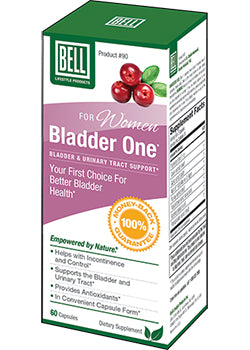
Formulated by Bell Lifestyle, Bladder One for Women offers bladder and urinary tract support. Bladder One uses Cranberry as their main ingredient to help with Urinary Tract Infections. Cranberry contains lectins, which prevent bacteria from sticking to the walls of the urinary tract and allow them to be flushed out. Bell Lifestyle's Bladder One also supports incontinence and control and also provides antioxidants which support overall health. Take 1 capsule per day for a minimum of 4 weeks for best results. [VCAPS]
Each capsule contains:
Cranberry extract 10:1 (Vaccinium macrocarpon) (fruit) 225mg
Parsley extract 10:1 (Petroselinum crispum) (aerial parts) 120mg
Stinging nettle extract 10:1 (Urtica dioica) (leaf) 100mg
Early goldenrod extract 10:1 (Solidago gigantea) (aerial parts) 50mg
Small-flower willow herb extract 10:1 (Epilobium parviflorum) (aerial parts) 50mg
Rose hips extract 10:1 (Rosa canina) (fruit) 25mg
Non-Medicinal Ingredients: Marshmallow root extract, cornsilk extract, vegetarian capsules (hydroxypropyl methylcellulose, water), magnesium stearate (vegetable grade), silicon dioxide.
Important Information:
Consult a health care practitioner prior to use if you have a history of kidney stones. Consult a health care practitioner prior to use if you are taking blood thinners. Consult a health care practitioner if symptoms persist. Do not use if pregnant or breast feeding. Do not take with highly-acidic food (eg. citrus fruits and juices) or with medications which may acidify urine. If you have heart disease, high or low blood pressure, kidney or liver disorder, diabetes or edema (swelling of hands, face and feet) or are taking products containing diuretics, do not use. Stop use and seek medical attention immediately if you experience dizziness, confusion, muscle weakness or pain, abnormal heartbeat and/or difficulty breathing. Keep out of reach of children.
Dosage
Take 1 capsule per day. Use for a minimum of 4 weeks to see beneficial effects.
Blended Herbal Complexes In Capsules, Teas, Liquids, & Creams
Bell Lifestyle is a trusted herbal supplement brand offering targeted natural health formulas designed to support digestion, cleansing, and overall wellness, including
Bell Ezee Digestion #29
to help ease indigestion and calm the stomach,
Bell Colon Care & Cleanse #74
to support regularity and healthy elimination with herbs, vitamins, and minerals, and
Bell Intestinal Cleansing #10
to help detox the digestive tract while supporting liver and colon health.
CRANBERRY
Containing a significant amount of
Vitamin C
is only one of the many benefits of cranberries...
Cranberries help fight urinary tract infections
Cranberries are the fruit of a bush (Vaccinium macrocarpon) that have a tart flavour and are commonly used in cooking, baking, juice, or eaten plain. Cranberry sauce is frequently paired with turkey during Thanksgiving celebrations in North America. Traditionally, cranberry has been used for hundreds of years to prevent and and treat urinary tract infections.
In the current medical model, a large amount of scientific research has been performed to confirm this traditional usage, and has also shown it to decrease the severity of established Urinary Tract Infections as well. It is now widely used by naturopathic and medical healthcare practitioners around the world.
How does it work?
Cranberry contains compounds called lectins that prevent bacteria from sticking to the walls of the urinary tract. When they cannot stay stuck to the bladder wall, they are easily flushed out with the urine and do not lead to infection. This is particularly true of the most common urinary tract pathogen, the bacteria commonly called E. coli. The increased activity against E. coli may also be due to the mannose content of cranberry. For more information on how mannose works, please see our Mannose article. Supplementation with cranberry also acidifies the urine, which makes it an uncomfortable environment for many bacteria to live and reproduce.
Aside from UTI research, cardiovascular health is one of the best researched areas of cranberries. The combination of antioxidants and anti-inflammatory phytonutrients found in cranberries are the reason for this. Dietary intake of cranberries has been shown to prevent triggering two
enzymes
that contributes to atherosclerosis. For more information on atherosclerosis, please click here. In animal studies, it was also shown that the antioxidants helped to decrease the risk of
high blood pressure. Consuming cranberry extracts helped prevent over constriction of blood vessels. For more information on high blood pressure, please click here. Lastly cranberries have been shown to help lower LDL-cholesterol and total cholesterol while increasing HDL-cholesterol levels. For more on cholesterol, please click here.
Cranberries have also been shown to help the digestive tract including the mouth, gums, stomach and colon. Due to it's anti-inflammatory properties dietary consumption of cranberries have been shown to reduce the risk of chronic, and unwanted inflammation in the stomach, large intestine and cardiovascular system.
Nutritional Content
In addition to the antibacterial sugar mannose, cranberries also contain significant amounts of
Vitamin C, which is important for the healing of the lining of the urinary tract. The chemical compounds called proanthocyanidins found in cranberry have been shown to have immune boosting effects in preliminary laboratory testing.
Why doesn’t sweetened cranberry juice work?
It is important to avoid drinking sweetened cranberry cocktails, because they often contain little actual cranberry juice and lots of sugar. Sugar actually feeds the bacteria that cause urinary tract infections, and can allow them to reproduce more quickly.
How can I take cranberry?
Cranberry can be purchased as a raw or dried berries, encapsulated dried berries, encapsulated extract, or concentrated juice. The concentrated unsweetened juice is the best way to consume cranberry for its medicinal qualities. The juice is very tart but be sure to only dilute the juice with water, not other fruit juices to avoid adding extra sugar. Encapsulated cranberry ranges in strength and quality. Purchase a product that gives an equivalent value of raw cranberries or concentrated cranberry juice. Combination products for urinary tract infections may contain cranberry. The dose of unsweetened juice recommended is generally 300ml daily (diluted as desired with water), and the dose for tablets is 400mg three times a day for at least a month. In children, the dose of concentrated juice is 15ml per kg of body weight (diluted as desired with water).
PARSLEY
Next time you're cooking with
PARSLEY
keep in mind you're also doing your body a favour...
Parsley is a natural freshener and detoxifier
Parsley has been added to food, and used as a garnish, for centuries for several reasons. Firstly it has a pleasant taste and aroma. Secondly the oils contained in parsley are antibacterial and antifungal, which was important in the days prior to the advent of refrigeration. Thirdly parsley sprigs, when chewed after a meal, decreased breath odour. These realizations are the basis for our use of parsley today as a medicinal agent.
Parsley is recommended for fungal infections (like thrush in adults), bacterial infections (especially in the digestive, urinary and respiratory tract) and bad breath. Additionally parsley contains many different nutrients including
chlorophyll
(an internal deodorizer), vitamin C and
vitamin K.
Parsley can be used as a raw leaves, dried herb, encapsulated oil or liquid oil. Fresh parsley can be added to dishes or chewed after a meal. The oil contains volatile compounds that can be toxic in high doses and should be used cautiously. A popular way to use parsley oil is as a gargle. Parsley may be found in formulas for urinary tract or respiratory tract health.
Parsley, when used as a food, has very few side effects. Most side effects and cautions are relevant only when parsley supplements are used. Parsley contains volatile oils (apiole and myristicin) that are toxic in high doses. Parsley supplements should be used with caution by those with impaired liver and kidney function, individuals taking MAO inhibitors or warfarin and individuals with blood disorders.
Carefully SelectedShips to the U.S.Wellness EssentialsTrusted Brands
Product Details
CRANBERRY
Containing a significant amount of
Vitamin C
is only one of the many benefits of cranberries...
Cranberries help fight urinary tract infections
Cranberries are the fruit of a bush (Vaccinium macrocarpon) that have a tart flavour and are commonly used in cooking, baking, juice, or eaten plain. Cranberry sauce is frequently paired with turkey during Thanksgiving celebrations in North America. Traditionally, cranberry has been used for hundreds of years to prevent and and treat urinary tract infections.
In the current medical model, a large amount of scientific research has been performed to confirm this traditional usage, and has also shown it to decrease the severity of established Urinary Tract Infections as well. It is now widely used by naturopathic and medical healthcare practitioners around the world.
How does it work?
Cranberry contains compounds called lectins that prevent bacteria from sticking to the walls of the urinary tract. When they cannot stay stuck to the bladder wall, they are easily flushed out with the urine and do not lead to infection. This is particularly true of the most common urinary tract pathogen, the bacteria commonly called E. coli. The increased activity against E. coli may also be due to the mannose content of cranberry. For more information on how mannose works, please see our Mannose article. Supplementation with cranberry also acidifies the urine, which makes it an uncomfortable environment for many bacteria to live and reproduce.
Aside from UTI research, cardiovascular health is one of the best researched areas of cranberries. The combination of antioxidants and anti-inflammatory phytonutrients found in cranberries are the reason for this. Dietary intake of cranberries has been shown to prevent triggering two
enzymes
that contributes to atherosclerosis. For more information on atherosclerosis, please click here. In animal studies, it was also shown that the antioxidants helped to decrease the risk of
high blood pressure. Consuming cranberry extracts helped prevent over constriction of blood vessels. For more information on high blood pressure, please click here. Lastly cranberries have been shown to help lower LDL-cholesterol and total cholesterol while increasing HDL-cholesterol levels. For more on cholesterol, please click here.
Cranberries have also been shown to help the digestive tract including the mouth, gums, stomach and colon. Due to it's anti-inflammatory properties dietary consumption of cranberries have been shown to reduce the risk of chronic, and unwanted inflammation in the stomach, large intestine and cardiovascular system.
Nutritional Content
In addition to the antibacterial sugar mannose, cranberries also contain significant amounts of
Vitamin C, which is important for the healing of the lining of the urinary tract. The chemical compounds called proanthocyanidins found in cranberry have been shown to have immune boosting effects in preliminary laboratory testing.
Why doesn’t sweetened cranberry juice work?
It is important to avoid drinking sweetened cranberry cocktails, because they often contain little actual cranberry juice and lots of sugar. Sugar actually feeds the bacteria that cause urinary tract infections, and can allow them to reproduce more quickly.
How can I take cranberry?
Cranberry can be purchased as a raw or dried berries, encapsulated dried berries, encapsulated extract, or concentrated juice. The concentrated unsweetened juice is the best way to consume cranberry for its medicinal qualities. The juice is very tart but be sure to only dilute the juice with water, not other fruit juices to avoid adding extra sugar. Encapsulated cranberry ranges in strength and quality. Purchase a product that gives an equivalent value of raw cranberries or concentrated cranberry juice. Combination products for urinary tract infections may contain cranberry. The dose of unsweetened juice recommended is generally 300ml daily (diluted as desired with water), and the dose for tablets is 400mg three times a day for at least a month. In children, the dose of concentrated juice is 15ml per kg of body weight (diluted as desired with water).
PARSLEY
Next time you're cooking with
PARSLEY
keep in mind you're also doing your body a favour...
Parsley is a natural freshener and detoxifier
Parsley has been added to food, and used as a garnish, for centuries for several reasons. Firstly it has a pleasant taste and aroma. Secondly the oils contained in parsley are antibacterial and antifungal, which was important in the days prior to the advent of refrigeration. Thirdly parsley sprigs, when chewed after a meal, decreased breath odour. These realizations are the basis for our use of parsley today as a medicinal agent.
Parsley is recommended for fungal infections (like thrush in adults), bacterial infections (especially in the digestive, urinary and respiratory tract) and bad breath. Additionally parsley contains many different nutrients including
chlorophyll
(an internal deodorizer), vitamin C and
vitamin K.
Parsley can be used as a raw leaves, dried herb, encapsulated oil or liquid oil. Fresh parsley can be added to dishes or chewed after a meal. The oil contains volatile compounds that can be toxic in high doses and should be used cautiously. A popular way to use parsley oil is as a gargle. Parsley may be found in formulas for urinary tract or respiratory tract health.
Parsley, when used as a food, has very few side effects. Most side effects and cautions are relevant only when parsley supplements are used. Parsley contains volatile oils (apiole and myristicin) that are toxic in high doses. Parsley supplements should be used with caution by those with impaired liver and kidney function, individuals taking MAO inhibitors or warfarin and individuals with blood disorders.
🌿
Daily Wellness
Easy to add to your everyday health routine.
✅
Carefully Selected
Chosen with quality and customer needs in mind.
💊
Simple to Use
Designed for convenient daily supplementation.
🚚
Ships to the U.S.
Fast, reliable shipping to U.S. customers.
Choosing a selection results in a full page refresh.