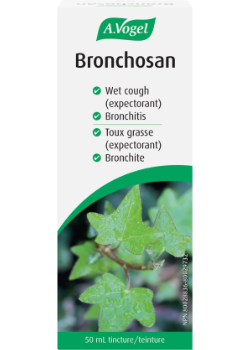
BRONCHOSAN (FORMERLY USNEA)Looking for an antitussive? Try A.Vogel Bronchosan the productive cough remedy. A.Vogel Bronchosan is a proven productive cough remedy! Bronchosan is helpful for loose cough, laryngitis or general hoarseness. Productive cough expectorant. A.Vogel Bronchosan is formulated with Fresh Common Ivy herb, Fresh Organic Thyme herb, Licorice root and essential oils of Star Anise and Eucalyptus. [LIQUID]
Each 10 drop dose contains:
Fresh Common Ivy herb, Fresh Organic Thyme* herb, Licorice root and essential oils of Star Anise, Eucalyptus 285mg
Non-medicinal ingredient:
1 mL of tincture contains 0.47 mL alcohol (ethanol)
* Certified by Bio Suisse
1 mL = 33 drops. Dropper included.
Important Information:
Sugar, Gluten & Lactose Free
Please see below for more important information.
Dosage
Adults and children over 12 years old: Take 10 drops in a small amount of water, 3 to 5 times daily. Salivate before swallowing.
Swiss remedies from fresh, organic plants since 1923
A.Vogel, top formulators of Swiss-made herbal health products and Canada’s best-selling Cold & Flu support. A Vogel products include Echinaforce and the best menopausal women's supplement, Menoforce. Now they bring to you A.Vogel Allergy Relief, Pollinosan complex as well as their classic Biostrath Elixir, arnica gel for topical pain relief and natural eye drops. Buy now at
History of...
Bronchosan contains many medicinal herb extracts acknowledged by tradition as well as present-day science for their effects on the respiratory tract. Ivy and
Thyme
have antispasmodic and expectorant properties. Thanks to its volatile essential oil content, Thyme is also useful against upper respiratory tract infections.
Licorice
is traditionally included in cough and cold preparations. Eucalyptus and Star Anise essential oils are useful to relieve cough and respiratory tract irritations.
The synergy of Bronchosan's components promotes not only the relief of cough and cold symptoms and the drainage of secretions, but also accelerates healing by supporting the immune system's natural functions, either by direct effects, or by antioxidant effects.
Ingredients
Ivy (Hedera helix)
Ivy is used as an expectorant, antispasmodic and for respiratory tract mucous inflammations. Scientific literature has now confirmed many of Ivy's traditional indications. One of Ivy's saponins, alpha hederine, has an antifungal effect against yeast like
Candida
albicans. Its antispasmodic effect was demonstrated in vitro on trachea cells. Phenols and saponins are mainly responsible for this effect.
Thyme (
Thymus
vulgaris)
Thyme is rich in terpenes and phenols (mainly thymol). Well known for its culinary worth, it is also an excellent antibacterial. According to an in vitro study, Thyme has a bactericide activity against at least 25 types of bacteria. Moreover, Thyme contains more than 26 different molecules with a demonstrated antioxidant effect. This effect might prove important in the treatment of respiratory inflammations. A team of researchers has revealed Thyme's significant anti-parasite effect. Thyme extract has also demonstrated in vitro antispasmodic properties on trachea cells. This tropism confirms its efficacy in respiratory ailments. Since Thyme's active molecules are volatile, they concentrate in the respiratory tract and are excreted in mucous.
Licorice (Glycyrrhiza glabra)
Licorice extracts have always been incorporated in cough and respiratory tract preparations. The sweetening power and the covering taste of Licorice are useful to cover the bitter taste of other herbs like Ivy. However, its respiratory properties are not to be sneezed at. Licorice is useful for coughs and to soothe mucous membranes. Its
isoflavones
have antioxidant properties. The flavonoids, including the isoflavones, also have anti-microbal effects. However, contrary to antibiotics, which may have a negative effect on the immune system, Licorice has demonstrated an immunostimulant effect by activating macrophages, the immune system cells that represent our first line of defense. Moreover, Licorice has demonstrated an antiviral effect.
Star Anise (Illicium anisatum, I. verum)
Thanks to its content in anethole, Star Anise has expectorant and soothing effects on mucous membranes. Anise is considered as GRAS (generally recognized as safe) as a food in the United States.
Eucalyptus
The use of
Eucalyptus oil
for colds, cough and flus is well established. Eucalyptus essential oil is used to relieve cough and upper respiratory tract inflammation and as an expectorant, freshener and counter-irritant. According to in vitro studies, Eucalyptus acts on histamine liberation, which might explain its effect on the symptoms of congestion and mucous membrane inflammation. The phenols, including eucalyptol, have demonstrated antioxidant and antimicrobial effects.
Important Information
Avoid taking in case of known allergy to any of the ingredients in the product.
Bronchosan is not recommended during pregnancy and nursing. The use of Bronchosan with anticoagulant medications is not recommended.
Licorice has a reputation for causing hypertension and water retention (water and salt retention) but these effects appear only at excessive dosages (many grams daily). Bronchosan does not contain enough Licorice to cause side effects or interactions.
Carefully SelectedShips to the U.S.Wellness EssentialsTrusted Brands
Product Details
History of...
Bronchosan contains many medicinal herb extracts acknowledged by tradition as well as present-day science for their effects on the respiratory tract. Ivy and
Thyme
have antispasmodic and expectorant properties. Thanks to its volatile essential oil content, Thyme is also useful against upper respiratory tract infections.
Licorice
is traditionally included in cough and cold preparations. Eucalyptus and Star Anise essential oils are useful to relieve cough and respiratory tract irritations.
The synergy of Bronchosan's components promotes not only the relief of cough and cold symptoms and the drainage of secretions, but also accelerates healing by supporting the immune system's natural functions, either by direct effects, or by antioxidant effects.
Ingredients
Ivy (Hedera helix)
Ivy is used as an expectorant, antispasmodic and for respiratory tract mucous inflammations. Scientific literature has now confirmed many of Ivy's traditional indications. One of Ivy's saponins, alpha hederine, has an antifungal effect against yeast like
Candida
albicans. Its antispasmodic effect was demonstrated in vitro on trachea cells. Phenols and saponins are mainly responsible for this effect.
Thyme (
Thymus
vulgaris)
Thyme is rich in terpenes and phenols (mainly thymol). Well known for its culinary worth, it is also an excellent antibacterial. According to an in vitro study, Thyme has a bactericide activity against at least 25 types of bacteria. Moreover, Thyme contains more than 26 different molecules with a demonstrated antioxidant effect. This effect might prove important in the treatment of respiratory inflammations. A team of researchers has revealed Thyme's significant anti-parasite effect. Thyme extract has also demonstrated in vitro antispasmodic properties on trachea cells. This tropism confirms its efficacy in respiratory ailments. Since Thyme's active molecules are volatile, they concentrate in the respiratory tract and are excreted in mucous.
Licorice (Glycyrrhiza glabra)
Licorice extracts have always been incorporated in cough and respiratory tract preparations. The sweetening power and the covering taste of Licorice are useful to cover the bitter taste of other herbs like Ivy. However, its respiratory properties are not to be sneezed at. Licorice is useful for coughs and to soothe mucous membranes. Its
isoflavones
have antioxidant properties. The flavonoids, including the isoflavones, also have anti-microbal effects. However, contrary to antibiotics, which may have a negative effect on the immune system, Licorice has demonstrated an immunostimulant effect by activating macrophages, the immune system cells that represent our first line of defense. Moreover, Licorice has demonstrated an antiviral effect.
Star Anise (Illicium anisatum, I. verum)
Thanks to its content in anethole, Star Anise has expectorant and soothing effects on mucous membranes. Anise is considered as GRAS (generally recognized as safe) as a food in the United States.
Eucalyptus
The use of
Eucalyptus oil
for colds, cough and flus is well established. Eucalyptus essential oil is used to relieve cough and upper respiratory tract inflammation and as an expectorant, freshener and counter-irritant. According to in vitro studies, Eucalyptus acts on histamine liberation, which might explain its effect on the symptoms of congestion and mucous membrane inflammation. The phenols, including eucalyptol, have demonstrated antioxidant and antimicrobial effects.
Important Information
Avoid taking in case of known allergy to any of the ingredients in the product.
Bronchosan is not recommended during pregnancy and nursing. The use of Bronchosan with anticoagulant medications is not recommended.
Licorice has a reputation for causing hypertension and water retention (water and salt retention) but these effects appear only at excessive dosages (many grams daily). Bronchosan does not contain enough Licorice to cause side effects or interactions.
🌿
Daily Wellness
Easy to add to your everyday health routine.
✅
Carefully Selected
Chosen with quality and customer needs in mind.
💊
Simple to Use
Designed for convenient daily supplementation.
🚚
Ships to the U.S.
Fast, reliable shipping to U.S. customers.
Choosing a selection results in a full page refresh.