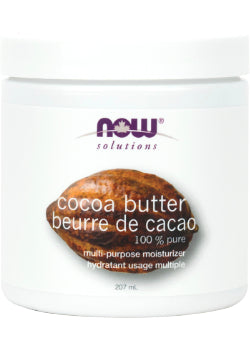
PURE COCOA BUTTER CREAM DERIVED FROM COCOA BEANS FOR ULTIMATE SKIN SOFTENING.Cocoa butter naturally has a slightly chocolately aroma, it has been used for years to provide natural relief to dry cracked skin. Now's Cocoa butter cream combines the benefits of jojoba oil for an even smoother texture. An excellent skin softener and moisturizer, cocoa butter is also praised for its ability to help replenish skin after sunburn and helps fade stretch marks from pregnancy. Frequently used for facials, body oils, and more, Cocoa butter is a natural way to help keep your skin looking and feeling beautiful.
Ingredients
100% pure Cocoa Butter
Important Information:
This product will melt at high temperatures and become solid again when cool. This is a natural and may affect the appearance, but will not harm the quality of the product. If liquid, shake and freeze to restore to original solid state.
It is normal for pure Cocoa Butter to be hard and to change color and texture slightly over time.
Dosage
Rub into skin until product soaks in. If hard, it can be melted or softened by placing in a pan of hot water for 30 minutes or microwaved for a few seconds.
Since 1968 NOW has been a leader in the natural products industry. NOW Foods is an award-winning and highly respected manufacturer of vitamins, minerals, dietary supplements and natural foods. Now Foods brings you over 1600 Natural Foods, Supplements, Sports Nutrition and Personal Care Products. NOW supplements are high quality products at affordable prices.
COCOA BUTTER
is an all-natural vegetable fat derived from cocoa beans. Also called Theobroma oil, Cocoa Butter is one of the most stable fats known and has a very mild chocolate flavor and aroma. Christopher Columbus is believed to have brought the first cocoa beans back to Europe as part of the treasures of the New World.
What is Cocoa ?
Cacao, better known as cocoa - Food of the Gods, divine food of the emperors, blessed by the Popes, on through the Europeans' imperial quest for monopolies on mild drugs for high society, into respectability and common usage, and finally as candy is the subject of both myth and science.
The history of cacao can be traced to Venezuela, where it is believed to have been first cultivated. The Olmec civilization of 3500 2500 years ago consumed it as a beverage and it was used by their warriors to fortify them during marches and in battle. From there the cacao tree and its fruit spread to the Mayans and Aztecs, who saw its value as a food. Additionally, it became so highly prized and valued that it was also used as currency.
The first European visitors to Central America were introduced to cacao as a drink prepared with toasted and ground cacao, a bit of maize, vanilla or chilies, and mixed with hot water. This concoction, although bitter, gave such a delightful buzz that in the 17
th
century the Swedish botanist Linnaeus first coined the phrase "food of the gods", and thus the Latin name
Theobroma. The 18
th
and 19
th
centuries saw the rise in popularity and use of cacao in Europe, along with the invention of processing techniques for cacao by those with names we are familiar with today Van Houten, Joseph Fry, Henri Nestle, Rudolphe Lindt, Milton Hershey, and John Cadbury. These processes are today responsible for the cocoa butter, low fat cocoa powder, bitter or dark cocoa, and
milk chocolate
products with which we are familiar.
There are some 22 varieties of
Theobroma
plant, but only
Theobroma cacao
is of commercial use in making cocoa. This variety can be divided into three groups:
Forastero
(an African cultivar and the good grade),
Crillo
(a Venezuelan variety and the better grade), and
Trinitero
(a hybrid of both
Forastero
and
Crillo, grown in the Antilles and considered the best grade).
A typical processing scheme is as follows: pod harvesting, seed removal, fermentation, drying of seeds, hot air roasting, crushing to produce nibs, then fine grinding to produce what is termed cacao liquor (or cocoa mass) with the solids having a particle size of approximately 100 microns. Correct fermentation and roasting are critical to flavor development. Cocoa butter is produced at this stage by mechanical pressing to separate the fat and solids. Adding ingredients to the cacao liquor such as additional cocoa butter, sugar, and or milk and performing additional grinding without heat (a process termed "melenging) or with heat (a process termed "conching"), produces the creamy sweet tastes associated with fine chocolate. This results in a (solids) particle size of less than 10 microns (a micron is about the size of a red blood cell.
Recent chemical and medical studies on cocoa are revealing the reasons for the many suspected health benefits of cacao and cacao-derived products. The
bioflavonoids
and other components present in cacao have shown to be of some benefit for alertness and mental well-being, with a robust body of studies indicating cocoa can benefit the heart and cardiovascular system. Additionally, cocoa butter has a unique fatty acid profile, as well as containing natural
antioxidants, making it a stable fat with certain health benefits, but remember that it does add calories!
Carefully SelectedShips to the U.S.Wellness EssentialsTrusted Brands
Product Details
COCOA BUTTER
is an all-natural vegetable fat derived from cocoa beans. Also called Theobroma oil, Cocoa Butter is one of the most stable fats known and has a very mild chocolate flavor and aroma. Christopher Columbus is believed to have brought the first cocoa beans back to Europe as part of the treasures of the New World.
What is Cocoa ?
Cacao, better known as cocoa - Food of the Gods, divine food of the emperors, blessed by the Popes, on through the Europeans' imperial quest for monopolies on mild drugs for high society, into respectability and common usage, and finally as candy is the subject of both myth and science.
The history of cacao can be traced to Venezuela, where it is believed to have been first cultivated. The Olmec civilization of 3500 2500 years ago consumed it as a beverage and it was used by their warriors to fortify them during marches and in battle. From there the cacao tree and its fruit spread to the Mayans and Aztecs, who saw its value as a food. Additionally, it became so highly prized and valued that it was also used as currency.
The first European visitors to Central America were introduced to cacao as a drink prepared with toasted and ground cacao, a bit of maize, vanilla or chilies, and mixed with hot water. This concoction, although bitter, gave such a delightful buzz that in the 17
th
century the Swedish botanist Linnaeus first coined the phrase "food of the gods", and thus the Latin name
Theobroma. The 18
th
and 19
th
centuries saw the rise in popularity and use of cacao in Europe, along with the invention of processing techniques for cacao by those with names we are familiar with today Van Houten, Joseph Fry, Henri Nestle, Rudolphe Lindt, Milton Hershey, and John Cadbury. These processes are today responsible for the cocoa butter, low fat cocoa powder, bitter or dark cocoa, and
milk chocolate
products with which we are familiar.
There are some 22 varieties of
Theobroma
plant, but only
Theobroma cacao
is of commercial use in making cocoa. This variety can be divided into three groups:
Forastero
(an African cultivar and the good grade),
Crillo
(a Venezuelan variety and the better grade), and
Trinitero
(a hybrid of both
Forastero
and
Crillo, grown in the Antilles and considered the best grade).
A typical processing scheme is as follows: pod harvesting, seed removal, fermentation, drying of seeds, hot air roasting, crushing to produce nibs, then fine grinding to produce what is termed cacao liquor (or cocoa mass) with the solids having a particle size of approximately 100 microns. Correct fermentation and roasting are critical to flavor development. Cocoa butter is produced at this stage by mechanical pressing to separate the fat and solids. Adding ingredients to the cacao liquor such as additional cocoa butter, sugar, and or milk and performing additional grinding without heat (a process termed "melenging) or with heat (a process termed "conching"), produces the creamy sweet tastes associated with fine chocolate. This results in a (solids) particle size of less than 10 microns (a micron is about the size of a red blood cell.
Recent chemical and medical studies on cocoa are revealing the reasons for the many suspected health benefits of cacao and cacao-derived products. The
bioflavonoids
and other components present in cacao have shown to be of some benefit for alertness and mental well-being, with a robust body of studies indicating cocoa can benefit the heart and cardiovascular system. Additionally, cocoa butter has a unique fatty acid profile, as well as containing natural
antioxidants, making it a stable fat with certain health benefits, but remember that it does add calories!
🌿
Daily Wellness
Easy to add to your everyday health routine.
✅
Carefully Selected
Chosen with quality and customer needs in mind.
💊
Simple to Use
Designed for convenient daily supplementation.
🚚
Ships to the U.S.
Fast, reliable shipping to U.S. customers.
Choosing a selection results in a full page refresh.