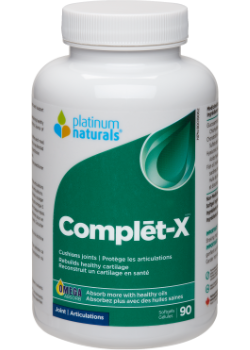
TAKE CARE OF YOUR JOINTS WITH NUTRI-JOINT COMPLET-X Complet-X is a complete joint care formula with Glucosamine, Chondroitin and Hyaluronic Acid that is designed to provide the necessary building blocks for your joint, including the synovial fluid so you can lead a productive and enjoyable life. [SOFTGEL]
Each softgel contains:
Glucosamine HCI (from shellfish exoskeleton) 500mg
Chondroitin Sulfate (from bovine cartilage) 400mg
Hyaluronic Acid (from sodium hyaluronate) 13.4mg
Fish Oil (molecularly distilled from herring sardines and anchovies) (18% EPA/12%DHA) 600mg
Non-Medicinal Ingredients:
Non-GMO soy lecithin and beeswax. Capsule ingredients: gelatin, glycerine, purified water and chlorophyll
Important Information:
Contains soy, beeswax and shellfish.
Dosage
Take 1 softgel 3 times daily after each meal
Quality Supplements with Superior Absorption
Platinum Naturals; makers of top-selling multi-vitamin natural health supplements: Activ EasyMulti, EasyMulti prenatal, EasyMulti men’s and women’s, EasyMulti 45+ and EasyMulti Vegan to support overall health plus popular Cold & Flu Oregano 8 for immune support. Platinum Naturals will keep you healthy all year long.
JOINT HEALTH
Keeping our joints young and healthy is a great way to maintain an active lifestyle for as long as we live...
In order for our bodies to be able to perform most of our daily routines, we require the ability to bend our limbs. It’s something that most of us take for granted, but this bending requires healthy joint function. Injury and inflammation can occur to any region of the joint and cause short or long-term restriction of movement and pain.
What is a Joint?
At each point that one bone meets another, there is a joint in our body. Each joint in our arms, legs, feet and hands consists of several pieces, including: a cartilage cushion layer on the end of each bone, surrounded by a fibrous capsule that completely encloses the joint space.
The joint capsule is filled with slippery synovial fluid that allows the bones to slide easily over one another. In some joints, like our knees (and between our vertebrae in our spine), there are additional cartilage cushions known as “discs” in the middle of the joint to provide further shock absorption. All of our joints are reinforced by fibrous bands, outside of the joint capsule, called ligaments. These ligaments restrict the range of motion to protect the internal workings of the joint. Tendons are fibrous bands that connect muscles to bone, and allow our muscles to move the bones involved in our joints. When a tendon changes direction and/or must cross over a bone, like those that connect our biceps muscle to our shoulder and arm, they slide over a fluid filled cushion called a bursa to prevent fraying or damage. To remember which fibrous band is which, you can know that ligaments connect bone to bone, while tendons connect muscle to bone.
Types of Injury
Muscles and joints can become injured whenever the body is in motion. It often occurs when doing strenuous or repetitive activities, like playing sports or working on an assembly line. Different types of injury have specific names to help explain what type of damage occurred. The term “sprain” refers to partial or complete tearing of a ligament. Sprains cause sharp pain and rapid swelling of the area, often accompanied by bruising. The term “strain” refers to the damage caused to a muscle by overloading or overuse. Muscle strains can appear as: cramps, localized pain during movement, swelling, and loss of mobility. A more common term for a strain is “pulling a muscle”. Generally speaking, tendons are more difficult to tear because the attached muscle will usually stretch to prevent any damage. That being said, tendon tears, and even full tendon ruptures (complete tears) can occur, and may require surgical repair. Another, more common, joint injury is bursitis, an irritation of the fluid-filled bursa cushion. It usually causes localized pain on motion, as the tendon slides across the irritated bursa.
Joint Damage
Cartilage acts as a living shock absorber in your joints that cushions and protects your bones from damage during the stresses of daily living, working, and playing. Age, overuse, and injury, all cause small tears and other damage to the cartilage in our joints. When the damage happens too frequently, the body is sometimes unable to regenerate damaged tissue fast enough to keep your cartilage, ligaments, and tendons supple and flexible. If this continues over time, the cartilage deteriorates enough for bone to rub directly against bone. This type of irritation results in a condition known as Osteoarthritis.
Exercise - Protecting your joints
Exercise moves our joints, and provides a way to spread the lubricating joint fluid. This helps to keep the cartilage soft and flexible and to reduce the risk of injury. Be sure to warm up before starting more strenuous activities and stretch to help prepare the joints and muscles for the tasks ahead. In cases of repetitive strain injuries, be sure to make your workplace and home life as ergonomic as possible. Maintain proper posture whenever possible and be sure to listen to your body.
Diet for Joint Health
To provide the body with the raw materials for tissue repair, it is important to eat sufficient amounts of
protein
or to use a protein supplement. Juice or eat plenty of raw fruits and vegetables including
beets, garlic and radishes, as each of these is packed with vitamins, minerals and
enzymes. Be sure to drink at least 2L of filtered water to flush waste products from the damaged area and to hydrate the cartilage and provide sufficient joint fluid. To help prevent muscle and joint injury, eat
chromium
rich foods such as nutritional yeast, lobster and cheese. This ensures a steady supply of blood sugar to working muscles.
You can eat wheat germ to provide octacosanol, which prevents strains by increasing muscle oxygenation, and
vitamin E, which heals tissue. Eating oats can provide the connective tissue supporting nutrient, Silica.
Immediate Treatment of Injury - RICE
Upon first injuring yourself, it is essential that you immediately stop the offending activity. The acronym “RICE” is used to allow you to remember how to treat an acute injury (within the first 48hrs): Rest, Ice, Compress (like a compression bandage), Elevate. This will help to reduce swelling and speed healing. When icing, be sure to elevate the injured area while you are doing so, and move the ice around the affected area, performing an “ice massage”. Ice for 15 minutes, and then allow the area to warm for at least 45 minutes before icing again. Repeat as much as possible to reduce the amount of time required for total healing later. If you must use the injured joint soon after the injury, be sure to support it as much as possible to reduce strain to the injured area. This is where compression bandages come in handy, as do air casts and even crutches when necessary. Poultices made of Goldenseal,
Fenugreek, Flaxseed powder, turmeric (
Curcumin
) or mustard can be used. They help to decrease swelling, decrease bruising and relax tense muscles. Be careful with mustard poultices as too much can cause the skin to blister. Topical and oral homeopathic and herbal preparations can also help to reduce inflammation and bring pain under control. See the chart below for recommendations.
Chronic Treatment of Injury
With chronic injuries, the treatment methods are a little different. If you have recently re-injured an old injury, then please treat it as an acute injury as listed above. Chronic injuries are those that have an ongoing low-grade problem due to improper or incomplete healing in the past. In general, chronic injuries often respond well to alternating hot and cold treatments. Simply apply a hot wet towel or submerge the area in hot water (be careful to mind your tolerance and do not burn yourself), and then switch over to an ice water towel, or submerge the area in ice water. In general, the ratio of time is 3:1 (hot: cold), with whatever amounts of time work for you. If you are submerging the area in ice water for the cold time, be sure to limit your time to avoid frost bite. In general the alternations are done 3 minutes hot followed by one minute cold. Repeat as many times as you like, but always finish with a cold session and allow the area to warm naturally afterwards. These alternating treatments help to increase local circulation and speed healing. If you cannot commit to such a complicated procedure, simply apply heat to the area to help relax supporting tissues and stimulate circulation. Natural anti-inflammatory herbs like
Curcumin
and Boswellia can help to reduce pain-causing inflammation. Devil’s Claw is particularly helpful in pain caused by inflamed joint tissues.
Conventional Treatments
Conventional treatment of muscle and joint injury involves the use of anti-inflammatory medications and pain relievers. These can be effective at taking away the acute symptoms and reducing pain, but they do not help to heal the injured tissue. If you use these medications, please be sure to spend a day off of them before you decide if you are ready to perform any physical tasks with the affected area.
WHAT YOU CAN DO TO HELP MAINTAIN JOINT HEALTH:
- TAKE GLUCOSAMINE & CHONDROITIN; THEY HAVE BEEN CLINICALLY PROVEN TO IMPROVE JOINT HEALTH. THEY CAN BE USED FOR PREVENTION AS WELL AS TREATMENT.
- EAT PLENTY OF VEGETABLES.
- EXERCISE.
- IF YOU INJURE A JOINT, GET THE APPROPRIATE PROFESSIONAL TREATMENT IMMEDIATELY.
- MAINTAIN AN ALKALINE
PH BALANCE
IN YOUR BODY; AN ACID PH PROMOTES INFLAMMATION.
- TAKE MINERAL SILICA; IT SUPPORTS
COLLAGEN
PRODUCTION.
- SEE A CHIROPRACTOR.
- TAKE NATURAL ANTI-INFLAMMATORIES LIKE MSM, BROM- ELAIN, AND CURCUMIN.
DID YOU KNOW?
(JOINT HEALTH FACTS)
- MOST PEOPLE PAST AGE 30 HAVE SOME DEGENERATION OF THE JOINTS WHETHER THEY HAVE SYMPTOMS OR NOT.
- BECAUSE POOR JOINT, JOINT INJURY AND ARTHRITIS CAN LIMIT LIFESTYLE, DEPRESSION CAN OFTEN RESULT.
- MANY PHARMACEUTICAL DRUGS FOR INFLAMMATION (SUCH AS VIOXX) HAVE SERIOUS SIDE EFFECTS. SOME WILL EVEN INCREASE THE DEGRADATION OF SOFT TISSUE.
Carefully SelectedShips to the U.S.Wellness EssentialsTrusted Brands
Product Details
JOINT HEALTH
Keeping our joints young and healthy is a great way to maintain an active lifestyle for as long as we live...
In order for our bodies to be able to perform most of our daily routines, we require the ability to bend our limbs. It’s something that most of us take for granted, but this bending requires healthy joint function. Injury and inflammation can occur to any region of the joint and cause short or long-term restriction of movement and pain.
What is a Joint?
At each point that one bone meets another, there is a joint in our body. Each joint in our arms, legs, feet and hands consists of several pieces, including: a cartilage cushion layer on the end of each bone, surrounded by a fibrous capsule that completely encloses the joint space.
The joint capsule is filled with slippery synovial fluid that allows the bones to slide easily over one another. In some joints, like our knees (and between our vertebrae in our spine), there are additional cartilage cushions known as “discs” in the middle of the joint to provide further shock absorption. All of our joints are reinforced by fibrous bands, outside of the joint capsule, called ligaments. These ligaments restrict the range of motion to protect the internal workings of the joint. Tendons are fibrous bands that connect muscles to bone, and allow our muscles to move the bones involved in our joints. When a tendon changes direction and/or must cross over a bone, like those that connect our biceps muscle to our shoulder and arm, they slide over a fluid filled cushion called a bursa to prevent fraying or damage. To remember which fibrous band is which, you can know that ligaments connect bone to bone, while tendons connect muscle to bone.
Types of Injury
Muscles and joints can become injured whenever the body is in motion. It often occurs when doing strenuous or repetitive activities, like playing sports or working on an assembly line. Different types of injury have specific names to help explain what type of damage occurred. The term “sprain” refers to partial or complete tearing of a ligament. Sprains cause sharp pain and rapid swelling of the area, often accompanied by bruising. The term “strain” refers to the damage caused to a muscle by overloading or overuse. Muscle strains can appear as: cramps, localized pain during movement, swelling, and loss of mobility. A more common term for a strain is “pulling a muscle”. Generally speaking, tendons are more difficult to tear because the attached muscle will usually stretch to prevent any damage. That being said, tendon tears, and even full tendon ruptures (complete tears) can occur, and may require surgical repair. Another, more common, joint injury is bursitis, an irritation of the fluid-filled bursa cushion. It usually causes localized pain on motion, as the tendon slides across the irritated bursa.
Joint Damage
Cartilage acts as a living shock absorber in your joints that cushions and protects your bones from damage during the stresses of daily living, working, and playing. Age, overuse, and injury, all cause small tears and other damage to the cartilage in our joints. When the damage happens too frequently, the body is sometimes unable to regenerate damaged tissue fast enough to keep your cartilage, ligaments, and tendons supple and flexible. If this continues over time, the cartilage deteriorates enough for bone to rub directly against bone. This type of irritation results in a condition known as Osteoarthritis.
Exercise - Protecting your joints
Exercise moves our joints, and provides a way to spread the lubricating joint fluid. This helps to keep the cartilage soft and flexible and to reduce the risk of injury. Be sure to warm up before starting more strenuous activities and stretch to help prepare the joints and muscles for the tasks ahead. In cases of repetitive strain injuries, be sure to make your workplace and home life as ergonomic as possible. Maintain proper posture whenever possible and be sure to listen to your body.
Diet for Joint Health
To provide the body with the raw materials for tissue repair, it is important to eat sufficient amounts of
protein
or to use a protein supplement. Juice or eat plenty of raw fruits and vegetables including
beets, garlic and radishes, as each of these is packed with vitamins, minerals and
enzymes. Be sure to drink at least 2L of filtered water to flush waste products from the damaged area and to hydrate the cartilage and provide sufficient joint fluid. To help prevent muscle and joint injury, eat
chromium
rich foods such as nutritional yeast, lobster and cheese. This ensures a steady supply of blood sugar to working muscles.
You can eat wheat germ to provide octacosanol, which prevents strains by increasing muscle oxygenation, and
vitamin E, which heals tissue. Eating oats can provide the connective tissue supporting nutrient, Silica.
Immediate Treatment of Injury - RICE
Upon first injuring yourself, it is essential that you immediately stop the offending activity. The acronym “RICE” is used to allow you to remember how to treat an acute injury (within the first 48hrs): Rest, Ice, Compress (like a compression bandage), Elevate. This will help to reduce swelling and speed healing. When icing, be sure to elevate the injured area while you are doing so, and move the ice around the affected area, performing an “ice massage”. Ice for 15 minutes, and then allow the area to warm for at least 45 minutes before icing again. Repeat as much as possible to reduce the amount of time required for total healing later. If you must use the injured joint soon after the injury, be sure to support it as much as possible to reduce strain to the injured area. This is where compression bandages come in handy, as do air casts and even crutches when necessary. Poultices made of Goldenseal,
Fenugreek, Flaxseed powder, turmeric (
Curcumin
) or mustard can be used. They help to decrease swelling, decrease bruising and relax tense muscles. Be careful with mustard poultices as too much can cause the skin to blister. Topical and oral homeopathic and herbal preparations can also help to reduce inflammation and bring pain under control. See the chart below for recommendations.
Chronic Treatment of Injury
With chronic injuries, the treatment methods are a little different. If you have recently re-injured an old injury, then please treat it as an acute injury as listed above. Chronic injuries are those that have an ongoing low-grade problem due to improper or incomplete healing in the past. In general, chronic injuries often respond well to alternating hot and cold treatments. Simply apply a hot wet towel or submerge the area in hot water (be careful to mind your tolerance and do not burn yourself), and then switch over to an ice water towel, or submerge the area in ice water. In general, the ratio of time is 3:1 (hot: cold), with whatever amounts of time work for you. If you are submerging the area in ice water for the cold time, be sure to limit your time to avoid frost bite. In general the alternations are done 3 minutes hot followed by one minute cold. Repeat as many times as you like, but always finish with a cold session and allow the area to warm naturally afterwards. These alternating treatments help to increase local circulation and speed healing. If you cannot commit to such a complicated procedure, simply apply heat to the area to help relax supporting tissues and stimulate circulation. Natural anti-inflammatory herbs like
Curcumin
and Boswellia can help to reduce pain-causing inflammation. Devil’s Claw is particularly helpful in pain caused by inflamed joint tissues.
Conventional Treatments
Conventional treatment of muscle and joint injury involves the use of anti-inflammatory medications and pain relievers. These can be effective at taking away the acute symptoms and reducing pain, but they do not help to heal the injured tissue. If you use these medications, please be sure to spend a day off of them before you decide if you are ready to perform any physical tasks with the affected area.
WHAT YOU CAN DO TO HELP MAINTAIN JOINT HEALTH:
- TAKE GLUCOSAMINE & CHONDROITIN; THEY HAVE BEEN CLINICALLY PROVEN TO IMPROVE JOINT HEALTH. THEY CAN BE USED FOR PREVENTION AS WELL AS TREATMENT.
- EAT PLENTY OF VEGETABLES.
- EXERCISE.
- IF YOU INJURE A JOINT, GET THE APPROPRIATE PROFESSIONAL TREATMENT IMMEDIATELY.
- MAINTAIN AN ALKALINE
PH BALANCE
IN YOUR BODY; AN ACID PH PROMOTES INFLAMMATION.
- TAKE MINERAL SILICA; IT SUPPORTS
COLLAGEN
PRODUCTION.
- SEE A CHIROPRACTOR.
- TAKE NATURAL ANTI-INFLAMMATORIES LIKE MSM, BROM- ELAIN, AND CURCUMIN.
DID YOU KNOW?
(JOINT HEALTH FACTS)
- MOST PEOPLE PAST AGE 30 HAVE SOME DEGENERATION OF THE JOINTS WHETHER THEY HAVE SYMPTOMS OR NOT.
- BECAUSE POOR JOINT, JOINT INJURY AND ARTHRITIS CAN LIMIT LIFESTYLE, DEPRESSION CAN OFTEN RESULT.
- MANY PHARMACEUTICAL DRUGS FOR INFLAMMATION (SUCH AS VIOXX) HAVE SERIOUS SIDE EFFECTS. SOME WILL EVEN INCREASE THE DEGRADATION OF SOFT TISSUE.
🌿
Daily Wellness
Easy to add to your everyday health routine.
✅
Carefully Selected
Chosen with quality and customer needs in mind.
💊
Simple to Use
Designed for convenient daily supplementation.
🚚
Ships to the U.S.
Fast, reliable shipping to U.S. customers.
Choosing a selection results in a full page refresh.