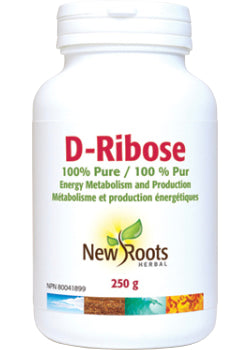
NEW ROOTS D-RIBOSE - 250GNew Roots Herbal D-Ribose is the simple five carbon sugar that forms the backbone of RNA and provides the currency for energy production at the cellular level. D-ribose is the rate limiting substance that enables our body to respond to increased energy demands along with speeding up recovery time following periods of stress and exertion. [POWDER]
Each teaspoon contains approximately:
ᴅ‑Ribose (100% pure) 5g
Important Information:
Consult a health-care practitioner for use beyond 8 weeks. Keep out of reach of children.
Dosage
Adults: Take 1 teaspoon once or twice daily or as directed by your health-care practitioner. We recommend weighing D-Ribose for precise dosage.
Proudly Manufactured In Canada & Available
New Roots Herbal offers high-quality natural health products like their best-selling probiotics, digestive enzymes, chill pills, strong bones, acidophilus ultra and black cumin seed oil among hundreds more herbal remedies. Founded in 1985 New Roots Canada delivers formulas that were designed to contribute to the prevention and cure of disease at their core. You can buy all New Roots supplements at ca
D-Ribose
New Roots Herbal D-Ribose is the simple five carbon sugar that forms the backbone of RNA and provides the currency for energy production at the cellular level. D-ribose is the rate limiting substance that enables our body to respond to increased energy demands along with speeding up recovery time following periods of stress and exertion. ATP production within the mitochondria benefits from d-ribose supplementation in two ways: ATP production from scratch can be increased up to 400%, and the more efficient recycling or salvaging method can increase up to 700%.
D-Ribose in supplemental form is absorbed at a rate of up to 95% to support increased metabolic demands, reduce exercise recovery time, and support critical myocardial function in times of need.
Stress
Stress is usually thought of as a negative factor in our daily lives but it is necessary part of life. Without stress life becomes boring. The key to stress, as with everything else in life, is balance. Enough to keep you interested but not enough to become overwhelmed. Individuals have different thresholds for stress. What is seen as stressful to one person may not be stressful to another.
The stress response is the body's way of preparing for action. As our species evolved it kept us safe, allowing us to fight for survival, or to flee from dangerous situations. The sympathetic nervous system response involves increased heart rate, blood pressure and adrenal output, as well as increased blood flow to the brain, muscles, lungs and heart. Those organs that are not needed to fight or flee receive less blood flow, for example, the digestive organs. This response is very efficient for a short period of time but it is meant to be used sparingly.
There are three types of stressors and the body deals with each one the same way. The three general categories are:
Emotional
Emotional stress can be caused by any emotion including love, hate, anger and envy.
Chemical
Chemical stressors are microbes, poisons, oxygen deprivation, drugs, nutrient deficiency, pollution, alcohol and junk foods.
Physical
Physical stressors are loud noises, x-rays, UV light, gravity and temperature. Nowadays our body's reaction to stress is seen as inappropriate, because the stressors we face are not usually life-threatening or dangerous, yet our body responds as it always has.
The result of constant stress can be tense muscles, headaches, stomach cramps, teeth grinding, decreased immunity, exhaustion and
insomnia. Emotionally stress can lead to memory problems, depression, emotional outbursts and panic attacks. It is believed that constant stress is a factor in the development of many chronic diseases.
Energy
Picture your body as a machine. In order to get your body to work your body needs fuel or food. It then transports that fuel to each cell. Inside each cell are little engines called mitochondria. They take in the fuel and process it to release energy.
The energy is used to power all cell processes and is the ultimate source of your body's energy. Another body system that impacts on energy is the glandular system. Picture it as the fuel injector of your body. It regulates what fuel gets into the body, which cells get the fuel and in what amounts. The blood cells are also a critical component of the body's energy system. They carry oxygen, a catalyst for many cell activities, around the body.
Lack of energy can be attributed to many causes. All of these causes must negatively impact on our body's ability to get fuel into the body, inhibit the mitochondria's ability to turn it into energy or alter the functioning of the hormonal and blood system.
Carefully SelectedShips to the U.S.Wellness EssentialsTrusted Brands
Product Details
D-Ribose
New Roots Herbal D-Ribose is the simple five carbon sugar that forms the backbone of RNA and provides the currency for energy production at the cellular level. D-ribose is the rate limiting substance that enables our body to respond to increased energy demands along with speeding up recovery time following periods of stress and exertion. ATP production within the mitochondria benefits from d-ribose supplementation in two ways: ATP production from scratch can be increased up to 400%, and the more efficient recycling or salvaging method can increase up to 700%.
D-Ribose in supplemental form is absorbed at a rate of up to 95% to support increased metabolic demands, reduce exercise recovery time, and support critical myocardial function in times of need.
Stress
Stress is usually thought of as a negative factor in our daily lives but it is necessary part of life. Without stress life becomes boring. The key to stress, as with everything else in life, is balance. Enough to keep you interested but not enough to become overwhelmed. Individuals have different thresholds for stress. What is seen as stressful to one person may not be stressful to another.
The stress response is the body's way of preparing for action. As our species evolved it kept us safe, allowing us to fight for survival, or to flee from dangerous situations. The sympathetic nervous system response involves increased heart rate, blood pressure and adrenal output, as well as increased blood flow to the brain, muscles, lungs and heart. Those organs that are not needed to fight or flee receive less blood flow, for example, the digestive organs. This response is very efficient for a short period of time but it is meant to be used sparingly.
There are three types of stressors and the body deals with each one the same way. The three general categories are:
Emotional
Emotional stress can be caused by any emotion including love, hate, anger and envy.
Chemical
Chemical stressors are microbes, poisons, oxygen deprivation, drugs, nutrient deficiency, pollution, alcohol and junk foods.
Physical
Physical stressors are loud noises, x-rays, UV light, gravity and temperature. Nowadays our body's reaction to stress is seen as inappropriate, because the stressors we face are not usually life-threatening or dangerous, yet our body responds as it always has.
The result of constant stress can be tense muscles, headaches, stomach cramps, teeth grinding, decreased immunity, exhaustion and
insomnia. Emotionally stress can lead to memory problems, depression, emotional outbursts and panic attacks. It is believed that constant stress is a factor in the development of many chronic diseases.
Energy
Picture your body as a machine. In order to get your body to work your body needs fuel or food. It then transports that fuel to each cell. Inside each cell are little engines called mitochondria. They take in the fuel and process it to release energy.
The energy is used to power all cell processes and is the ultimate source of your body's energy. Another body system that impacts on energy is the glandular system. Picture it as the fuel injector of your body. It regulates what fuel gets into the body, which cells get the fuel and in what amounts. The blood cells are also a critical component of the body's energy system. They carry oxygen, a catalyst for many cell activities, around the body.
Lack of energy can be attributed to many causes. All of these causes must negatively impact on our body's ability to get fuel into the body, inhibit the mitochondria's ability to turn it into energy or alter the functioning of the hormonal and blood system.