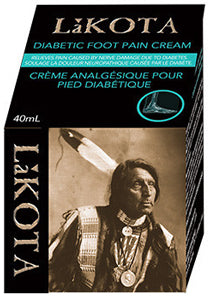
LAKOTA DIABETIC FOOT PAIN CREAMLakota Diabetic Foot Pain Cream is the only widely available natural source pain reliever for nerve pain related to diabetes. It features one of the few natural ingredients approved by Health Canada for the relief of pain associated with nerve damage due to diabetes. This innovative pain reliever is combined with a soothing cream. The cream is made with Shea butter, Green tea extract, Peppermint oil, Sunflower oil, and Vitamin A and D to provide a silky smooth sensation. Lakota Diabetic Foot Pain Cream is a soothing cream and pain reliever in one; pampering the skin, while relieving the pain. [CREAM]
Contains:
Capsicum annuum 0.075%
Non-Medicinal Ingredients:Purified Water, Shea Butter, Green Tea Extract, Peppermint Essential Oil #5654, Sunflower oil, Retinyl Palmitate (Vitamin A), d-alpha tocopherol, Caprylic/Capric Triglyceride, Glyceryl Stearate & PEG-100 Stearate, Ceteareth -12, Coco Caprylate / Caprate,Glycerol Monostearate SE,Cetearyl alcohol, Ethyl Alcohol 95%, Potassium Sorbate, Polyacrylamide & C13-14 Isoparaffin & Laureth-7, Diazolidinyl Urea & Iodopropynyl Butylcarbamate
Important Information:
Free of all common allergens, including: wheat, dairy, eggs, corn, and yeast. Wash hands with soap after applying. Consult a healthcare practitioner is symptoms persist or worsen.
Dosage
Adults, apply to feet or hand 4 times per day. Use for a minimum of 1 week to see beneficial effect. Wash hands with soap after applying.
Lakota Herbs provides natural pain relief for those dealing with arthritis, joint, back, and muscle pain. Lakota products include Joint Care Formula, Arthritis Roll-on, Back Pain Roll-on, Muscle Pain Roll-on, Rheumatoid Formula, Triple Action Back Pain, Maximum Strength Muscle Pain, Lakota PM, Extra Strength Arthritis.
Diabetic Foot Pain Cream
Lakota Diabetic Foot Pain Cream is the only widely available natural source pain reliever for nerve pain related to diabetes. It features one of the few natural ingredients approved by Health Canada for the relief of pain associated with nerve damage due to diabetes.
This innovative pain reliever is combined with a soothing cream. The cream is made with Shea butter, Green tea extract,
Peppermint oil, Sunflower oil, and
Vitamin A
and D to provide a silky smooth sensation. Lakota Diabetic Foot Pain Cream is a soothing cream and pain reliever in one; pampering the skin, while relieving the pain.
Diabetes
What is it?
Insulin is essential for the proper metabolism of glucose. Glucose is one of the most essential fuels within the body, required for basically all functions. Insulin is excreted by the
pancreas
in response to increased blood sugar levels, and helps to escort glucose into our liver, muscle and fat tissues where it is stored as glycogen to later be used used for energy. Diabetes mellitus is a chronic disease caused by either a lack of (Type I), or a resistance to (Type II), the hormone insulin.
Diabetes is often diagnosed based on symptomology, the classic triad including polyuria, polydipsia and polyphagia (increase urination, increased thirst and increased hunger). There is usually some unexplained or unintentional weight loss observed in Type I diabetes, whereas type II diabetics are often overweight. Lab work essential for diagnosis of diabetes includes a marked elevation in blood glucose, both post prandial and fasting. Levels lower than 6.1 (fasting) and 7.8 (2 hours following a meal) are considered normal, although these amounts are increased slightly when setting goals for diabetes treatment. Hemoglobin A1C is often tested before treatment, as well as periodically throughout treatment to monitor the efficacy of the intervention. It is a more long-term assessment of overall patterns of blood sugar regulation.
Who is at risk?
There is a genetic influence involved with the development of both Type I and II diabetes. In the case of Type I, many believe that a microbial infection may also play a part in the activation of the autoimmune reaction. Pertussis (whooping cough),
hepatitis, rubella, coxsackie, Epstein-Barr, cytomegalovirus, and herpes virus-6, may all be associated with an infection induced development of type I diabetes.
There is significant research to suggest that food sensitivities may play a role the the development of Type I diabetes, as well as the diabetic reaction of Type II diabetics. Research has shown that Type I diabetes, an autoimmune reaction to our own pancreatic cells, may actually be caused by cow's milk. Children given cow's milk in the first 3 months of life have been shown to be more susceptible to the development of Type I diabetes. Similarly, there is a reduced risk in infants that are exclusively breast fed during this time. Bovine
serum
albumin, a
protein
found in cow's milk, very closely resembles a molecule found on the surface of most pancreatic cells. It is thought that they body initially reacts to the milk and then thinking it is the same molecule, continues to react to these similar molecules on the pancreatic cells until they are subsequently destroyed.
In Type II diabetics, one theory suggests that specific food intolerances over time lead to inflammation that again destroys the insulin producing cells of the pancreas. Foods often at the root of these problems include corn, dairy, wheat and chocolate. Some studies have shown that eliminating the offending food(s) has resulted in decreased, if not total elimination, of diabetic reactions. Individuals at risk for diabetes or who have been diagnosed as pre-diabetic may find that an hypoallergenic diet, assessment and elimination of the offending foods may be all that is needed to regulate blood sugar levels and prevent any need for medication or further dietary restrictions.
Complications:
Often much more concerning than the initial symptoms of diabetes, are the complications that can occur over the long term if blood glucose levels are not effectively regulated. Most of these complication are due to a dysfunction of the circulatory system, causing damage to the blood vessels that supply various organs and areas within the body. Diabetic
neuropathy
occurs most commonly in the lower limbs and is characterized by pain and numbness in the feet and legs. This can also be associated with foot ulcers, including gangrene. The nerve and oxygen supply to the feet become so compromised that sometimes amputation is the only treatment option. Diabetics must be diligent about keeping their feet clean, dry and warm, as well as avoiding situations in which trauma to the foot can go unnoticed (due to nerve compromise), once again predisposing them to ulcers. Diabetic retinopathy is caused by the formation of fragile new blood vessels forming in the retina as a means to increase a deficient blood supply to that area. These new vessels are prone to breakage and often hemorrhage into the eye, causing damage if not treated. Diabetic nephropathy results from damage to the small vessels supplying the kidney, eventually causing damage and kidney failure. Even a small amount of kidney damage can then have detrimental effects on blood pressure. Diabetics are are more prone to stroke and
heart attack
due to damage of the vessels leading to the brain, and heart respectively.
Carefully SelectedShips to the U.S.Wellness EssentialsTrusted Brands
Product Details
Diabetic Foot Pain Cream
Lakota Diabetic Foot Pain Cream is the only widely available natural source pain reliever for nerve pain related to diabetes. It features one of the few natural ingredients approved by Health Canada for the relief of pain associated with nerve damage due to diabetes.
This innovative pain reliever is combined with a soothing cream. The cream is made with Shea butter, Green tea extract,
Peppermint oil, Sunflower oil, and
Vitamin A
and D to provide a silky smooth sensation. Lakota Diabetic Foot Pain Cream is a soothing cream and pain reliever in one; pampering the skin, while relieving the pain.
Diabetes
What is it?
Insulin is essential for the proper metabolism of glucose. Glucose is one of the most essential fuels within the body, required for basically all functions. Insulin is excreted by the
pancreas
in response to increased blood sugar levels, and helps to escort glucose into our liver, muscle and fat tissues where it is stored as glycogen to later be used used for energy. Diabetes mellitus is a chronic disease caused by either a lack of (Type I), or a resistance to (Type II), the hormone insulin.
Diabetes is often diagnosed based on symptomology, the classic triad including polyuria, polydipsia and polyphagia (increase urination, increased thirst and increased hunger). There is usually some unexplained or unintentional weight loss observed in Type I diabetes, whereas type II diabetics are often overweight. Lab work essential for diagnosis of diabetes includes a marked elevation in blood glucose, both post prandial and fasting. Levels lower than 6.1 (fasting) and 7.8 (2 hours following a meal) are considered normal, although these amounts are increased slightly when setting goals for diabetes treatment. Hemoglobin A1C is often tested before treatment, as well as periodically throughout treatment to monitor the efficacy of the intervention. It is a more long-term assessment of overall patterns of blood sugar regulation.
Who is at risk?
There is a genetic influence involved with the development of both Type I and II diabetes. In the case of Type I, many believe that a microbial infection may also play a part in the activation of the autoimmune reaction. Pertussis (whooping cough),
hepatitis, rubella, coxsackie, Epstein-Barr, cytomegalovirus, and herpes virus-6, may all be associated with an infection induced development of type I diabetes.
There is significant research to suggest that food sensitivities may play a role the the development of Type I diabetes, as well as the diabetic reaction of Type II diabetics. Research has shown that Type I diabetes, an autoimmune reaction to our own pancreatic cells, may actually be caused by cow's milk. Children given cow's milk in the first 3 months of life have been shown to be more susceptible to the development of Type I diabetes. Similarly, there is a reduced risk in infants that are exclusively breast fed during this time. Bovine
serum
albumin, a
protein
found in cow's milk, very closely resembles a molecule found on the surface of most pancreatic cells. It is thought that they body initially reacts to the milk and then thinking it is the same molecule, continues to react to these similar molecules on the pancreatic cells until they are subsequently destroyed.
In Type II diabetics, one theory suggests that specific food intolerances over time lead to inflammation that again destroys the insulin producing cells of the pancreas. Foods often at the root of these problems include corn, dairy, wheat and chocolate. Some studies have shown that eliminating the offending food(s) has resulted in decreased, if not total elimination, of diabetic reactions. Individuals at risk for diabetes or who have been diagnosed as pre-diabetic may find that an hypoallergenic diet, assessment and elimination of the offending foods may be all that is needed to regulate blood sugar levels and prevent any need for medication or further dietary restrictions.
Complications:
Often much more concerning than the initial symptoms of diabetes, are the complications that can occur over the long term if blood glucose levels are not effectively regulated. Most of these complication are due to a dysfunction of the circulatory system, causing damage to the blood vessels that supply various organs and areas within the body. Diabetic
neuropathy
occurs most commonly in the lower limbs and is characterized by pain and numbness in the feet and legs. This can also be associated with foot ulcers, including gangrene. The nerve and oxygen supply to the feet become so compromised that sometimes amputation is the only treatment option. Diabetics must be diligent about keeping their feet clean, dry and warm, as well as avoiding situations in which trauma to the foot can go unnoticed (due to nerve compromise), once again predisposing them to ulcers. Diabetic retinopathy is caused by the formation of fragile new blood vessels forming in the retina as a means to increase a deficient blood supply to that area. These new vessels are prone to breakage and often hemorrhage into the eye, causing damage if not treated. Diabetic nephropathy results from damage to the small vessels supplying the kidney, eventually causing damage and kidney failure. Even a small amount of kidney damage can then have detrimental effects on blood pressure. Diabetics are are more prone to stroke and
heart attack
due to damage of the vessels leading to the brain, and heart respectively.
🌿
Daily Wellness
Easy to add to your everyday health routine.
✅
Carefully Selected
Chosen with quality and customer needs in mind.
💊
Simple to Use
Designed for convenient daily supplementation.
🚚
Ships to the U.S.
Fast, reliable shipping to U.S. customers.
Choosing a selection results in a full page refresh.