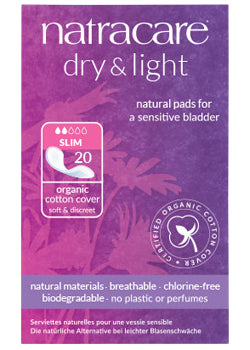
Incontinence can be both embarrassing and annoying, Dry & Light Incontinence Pads from Natracare are here to help. Soft and discreet, they are natural and absorbent pads for light urinary incontinence. Absorbent and comfortable, Dry & Light Incontinence Pads have a compressed pulp core to effectively absorb without the harsh chemicals. Don't suffer from itching and irritation caused from synthetic materials, Dry & Light Incontinence Pads are made with a certified organic cotton cover, and contain absolutely no plastic, superabsorbent polymers, perfumes, dyes or chlorine, providing a smart choice for sensitive skin types. [PADS]
Dosage
Peel back the paper strip and fit the pad to underwear
Say yes to plastic-free periods and incontinence protection! NatraCare brings you chlorine-free pads, all natural panty liners, organic tampons and plastic-free wet wipes. Natracare was created as a campaign to shake up the period protection industry and finally provide women with a viable eco-friendly alternative. Shop NatraCare organic cotton tampons and pads.
Incontinence
Urinary incontinence occurs when there is an inability to control the bladder and it spontaneously empties either some or all of its contents...
There are a number of organs involved in urination, including the kidneys, the bladder, the urethra, the ureters and the sphincter muscles. If one of these systems is not working properly, the process of urination will be impaired in someway. Urinary incontinence is a symptom of an underlying disorder, but it is not always easy to isolate which organ/area is at play. It can be a temporary or permanent process, depending on the cause.
Both in adults and children, urinary incontinence can also be caused by stress, urinary tract infection,
sleep apnea,
diabetes
(due to loss of nerve function), alcohol,
caffeine, over or dehydration, certain medications and even chronic
constipation.
Children
All children will experience a form of urinary incontinence or bedwetting, also known as nocturnal enuresis. For the most part, this is because nerves controlling the bladder take years to develop, for some children, longer than others. This means that the little ones are simply unable to recognize when their bladders are full. Additionally, their young bladders are still developing and are not able to hold the urine produced during sleep, as more fully developed bladders can.
Pregnancy
Urinary incontinence is also extremely common during and following pregnancy. Hormonal changes can cause sphincters to relax during pregnancy, as well as weight gain, and the mounting pressure of the uterus on the bladder. Childbirth itself can cause the sphincters to stretch or even damage or injure them, along with the pelvic nerves. stress incontinence is common in this group, meaning coughing, laughing or sneezing (any sudden bearing down) can cause some incontinence. For the most part, these symptoms are reversible with time and healing.
Over 60
As we age, our bladder muscles also simply become more weak, as most muscle does. Again, hormonal changes as we age, like a decrease in
estrogen
in women during
menopause, can affect the health of the lining of the bladder and urethra. Incontinence can be an incapacitating condition that effects approx. 3 million elderly in the United States alone. It is not uncommon for this group to withdraw from their community and social activities and may become depressed. Uninhibited bladder (also termed unstable bladder or detrusor hyperreflexia or uninhibited neurogenic bladder) is a common cause for incontinence in both men and women in this group. It involves the involuntary contraction of the bladder at low urine volumes. It can be caused by a number of underlying genitourinary or neurological issues and is commonly responsible for the complaints of both urinary urgency and frequency from this population.
Anti-cholinergic drugs, used very commonly to treat urinary incontinence, work by preventing these involuntary contractions. Women over the age of 50, postmenopausal or multi-parous (those multiple pregnancies) often suffer from a combination of this and stress incontinence, while men in this group can often have a correlated prostate enlargement or other issues, exacerbating their uninhibited bladder incontinence symptoms. Prostate issues, specifically, should be addressed thoroughly as part of any male incontinence or frequency concern.
Natural Remedies
There are some natural and plant-based products that are meant to support a healthy genitourinary system and help to prevent and even alleviate urinary incontinence based on cause. One of these plant-based medicines in
Horsetail, or equisetum arvensa.
Horsetail
has been shown to benefit various bladder and kidney issues, including incontinence. It does have mild diuretic effects, as well as being high in minerals, particularly
silica. Horsetail can be found in either tincture or capsule form, often added to joint and or bone formulations. It is also known to strengthen the hair, nails and skin. Scullcap or scutellaria laterflora is another herb recommended for the treatment of incontinence, especially in the case that irritation, or inflammation of some sort (urinary tract infection, etc.), is playing a part.
Do Your Kegels
Seeing as stress incontinence is caused, for the most part, by damage or weakening of the pelvic floor muscles, pelvic floor exercises can be extremely effective in terms of both treatment and prevention. Kegels, or pelvic floor exercises are often recommended to women both throughout pregnancy to strengthen the muscles and help to prevent damage, and after birth to restrengthen and repair stretching from birth. These exercises can be performed by both men and women. Essentially, a kegel consists of tightening the muscles of the pelvic floor. You can do this by imagining you are stopping the flow of urine during urination (although it is not recommended to actually perform your Kegels during urination, as stopping the flow from a full bladder can ultimately weaken the muscles.). Work your way up to holding the contraction for 10 seconds and relaxing for ten seconds between contractions. Do 5-10 reps, 3 times throughout the day to strengthen the pelvic floor muscles.
Carefully SelectedShips to the U.S.Wellness EssentialsTrusted Brands
Product Details
Incontinence
Urinary incontinence occurs when there is an inability to control the bladder and it spontaneously empties either some or all of its contents...
There are a number of organs involved in urination, including the kidneys, the bladder, the urethra, the ureters and the sphincter muscles. If one of these systems is not working properly, the process of urination will be impaired in someway. Urinary incontinence is a symptom of an underlying disorder, but it is not always easy to isolate which organ/area is at play. It can be a temporary or permanent process, depending on the cause.
Both in adults and children, urinary incontinence can also be caused by stress, urinary tract infection,
sleep apnea,
diabetes
(due to loss of nerve function), alcohol,
caffeine, over or dehydration, certain medications and even chronic
constipation.
Children
All children will experience a form of urinary incontinence or bedwetting, also known as nocturnal enuresis. For the most part, this is because nerves controlling the bladder take years to develop, for some children, longer than others. This means that the little ones are simply unable to recognize when their bladders are full. Additionally, their young bladders are still developing and are not able to hold the urine produced during sleep, as more fully developed bladders can.
Pregnancy
Urinary incontinence is also extremely common during and following pregnancy. Hormonal changes can cause sphincters to relax during pregnancy, as well as weight gain, and the mounting pressure of the uterus on the bladder. Childbirth itself can cause the sphincters to stretch or even damage or injure them, along with the pelvic nerves. stress incontinence is common in this group, meaning coughing, laughing or sneezing (any sudden bearing down) can cause some incontinence. For the most part, these symptoms are reversible with time and healing.
Over 60
As we age, our bladder muscles also simply become more weak, as most muscle does. Again, hormonal changes as we age, like a decrease in
estrogen
in women during
menopause, can affect the health of the lining of the bladder and urethra. Incontinence can be an incapacitating condition that effects approx. 3 million elderly in the United States alone. It is not uncommon for this group to withdraw from their community and social activities and may become depressed. Uninhibited bladder (also termed unstable bladder or detrusor hyperreflexia or uninhibited neurogenic bladder) is a common cause for incontinence in both men and women in this group. It involves the involuntary contraction of the bladder at low urine volumes. It can be caused by a number of underlying genitourinary or neurological issues and is commonly responsible for the complaints of both urinary urgency and frequency from this population.
Anti-cholinergic drugs, used very commonly to treat urinary incontinence, work by preventing these involuntary contractions. Women over the age of 50, postmenopausal or multi-parous (those multiple pregnancies) often suffer from a combination of this and stress incontinence, while men in this group can often have a correlated prostate enlargement or other issues, exacerbating their uninhibited bladder incontinence symptoms. Prostate issues, specifically, should be addressed thoroughly as part of any male incontinence or frequency concern.
Natural Remedies
There are some natural and plant-based products that are meant to support a healthy genitourinary system and help to prevent and even alleviate urinary incontinence based on cause. One of these plant-based medicines in
Horsetail, or equisetum arvensa.
Horsetail
has been shown to benefit various bladder and kidney issues, including incontinence. It does have mild diuretic effects, as well as being high in minerals, particularly
silica. Horsetail can be found in either tincture or capsule form, often added to joint and or bone formulations. It is also known to strengthen the hair, nails and skin. Scullcap or scutellaria laterflora is another herb recommended for the treatment of incontinence, especially in the case that irritation, or inflammation of some sort (urinary tract infection, etc.), is playing a part.
Do Your Kegels
Seeing as stress incontinence is caused, for the most part, by damage or weakening of the pelvic floor muscles, pelvic floor exercises can be extremely effective in terms of both treatment and prevention. Kegels, or pelvic floor exercises are often recommended to women both throughout pregnancy to strengthen the muscles and help to prevent damage, and after birth to restrengthen and repair stretching from birth. These exercises can be performed by both men and women. Essentially, a kegel consists of tightening the muscles of the pelvic floor. You can do this by imagining you are stopping the flow of urine during urination (although it is not recommended to actually perform your Kegels during urination, as stopping the flow from a full bladder can ultimately weaken the muscles.). Work your way up to holding the contraction for 10 seconds and relaxing for ten seconds between contractions. Do 5-10 reps, 3 times throughout the day to strengthen the pelvic floor muscles.
🌿
Daily Wellness
Easy to add to your everyday health routine.
✅
Carefully Selected
Chosen with quality and customer needs in mind.
💊
Simple to Use
Designed for convenient daily supplementation.
🚚
Ships to the U.S.
Fast, reliable shipping to U.S. customers.
Choosing a selection results in a full page refresh.