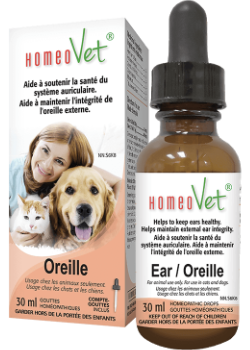
Earvet are homeopathic drops for both cats and dogs, designed to help keep ear healthy and maintain external ear integrity. HomeoVet offers a range of homeopathic medicines that can meet the most common health needs of our four-legged friends. Whether a condition is acute or chronic, Homeovet Ear Vet drops can provide assistance as a supportive treatment, but will not replace traditional veterinary medicine. Because Homeopathy is a safe and natural alternative, Homeocan experts have formulated specialized remedies for pets called HomeoVet. Follow the directions on the box for dosages based on your pets weight. Give drops directly in mouth or diluted in a bit of water or mixed with a small portion of food, 2 to 3 times per day or as recommended by a veterinarian. [LIQUID]
Contains:
Arsenicum album 5CH
Aethiops mineralis 5CH
Calendula officinalis 5CH
Calcarea picrata 5CH
Mezereum 5CH
Tellurium metallicum 5CH
Non-Medicinal Ingredients:
Purified water, Sorbitol, Glycerin, Sodium benzoate, Potassium sorbate, Citric acid
Important Information:
Do not use in pregnant or lactating females unless directed by a veterinarian. For use in cats and dogs. Do not use if seal is broken. Keep at room temperature. Keep out of reach of children
Dosage
Under 20 lbs/10 kg administer 5 drops
Over 21 lbs/11kg administer 10 drops
Give drops directly in mouth or diluted in a bit of water or mixed with a small portion of food, 2 to 3 times per day or as recommended by a veterinarian. Reduce intake with improvement. To be used only when needed.
Homeopathic Pet Supplements To Support Pet Health
Homeovet Advantage
Homeocan, a Canadian Montreal brand, has been at the forefront of natural health products for both humans and pets for over three decades. With a strong focus on homeopathy, Homeocan has become a trusted name in the industry, offering a wide range of natural remedies for various health conditions.
EAR INFECTION
By: Articles by a Naturopathic Doctor and a Holistic Nutritionist
Painful, annoying, and often recurring, infections of the ear are commonly linked to diet. Eliminating allergenic foods and taking the right supplements can boost the immune system...
Ear infections occur most often in children ages 3 months to 3 years. There are 3 areas of the ear that can be affected. Outer ear infections cause pain, swelling and redness that can be seen by looking in the ear. The individual may report itchiness, decreased hearing, painful chewing, pain on touching the ear and a slight fever.
Outer ear infections can be caused by bacterial infections, the spread of infection from the middle ear or food allergies.
Middle ear infections are painful and are accompanied by fever, nausea, vomiting and
diarrhea. Discharge only occurs if the eardrum bursts. Rupture of the membrane does not permanently alter hearing if the eardrum heals well. Inner ear infections can occur as a complication of a cold or flu, when the infection travels up the Eustachian tube that links the throat and ear. They can also be caused by food allergies, environmental allergies (especially to tobacco smoke) and exposure to cold or water.
Inner ear infections usually occur as a spread of infection from the middle ear. Dizziness occurs because the inner ear is responsible for balance. See the section on Meniere’s disease for more information. Swelling, redness, and pain may be reported behind the ear. Complications of an inner
ear infection
include abscesses and meningitis.
Conventional treatment of ear infection involves the use of antibiotics. This often clears up the current infection but the body becomes susceptible to subsequent infections if friendly bacteria are not replaced. The overuse of antibiotics has also lead to antibiotic resistant strains of various organisms. Recurrent use of antibiotics for ear infections often results in infections that are resistant to treatment. Individuals can help to minimize resistance by using antibiotics sparingly and always taking prescriptions until they are finished. Ear tubes can be placed in the eardrum to allow the constant drainage of fluid. They do not stop subsequent infections. Natural therapies are very successful at treating ear infections and making individuals less susceptible to subsequent infections.
There are many physical therapies for ear infections. Warm the ear to decrease pain by placing a wrapped hot water bottle over the area. Ear oil can be purchases with olive oil and a clove of garlic. Put a few drops in the ear several times a day. Note that if the individual has ear tubes or a perforated eardrum do not use any treatment that involves putting something into the ear canal.
Perform steam inhalations, or use a humidifier, with added
thyme,
sage
or
eucalyptus oil. Sleep with your head propped up to maximize ear drainage.
One tip for boosting the immune system is to alternate between hot and cold water at the end of your shower. This is called hydrotherapy and it will contribute to boosting your immune system. Ensure that you always finish hydrotherapy on cold.
Some causes of ear infections that reoccur include formula feeding in infants, food allergies and a lowered immune system. Common allergens include peanuts, dairy, soy, eggs, wheat and chicken. Dairy is implicated in ear infections because not only is it a common food allergen, but it also increases the amount of mucus the body produces – and this can negatively impact the body’s ability to heal.
Dietary approaches to ear infections are as follows. Increase fluid intake to decrease the viscosity of mucous secretions. A diet high in raw fruits and vegetables provides a good source of vitamins, minerals and
antioxidants. Onions and garlic are good sources of substances that make up anti-inflammatory compounds and help to kill microbes. Flaxseed and fish oils contain essential fatty acids that are anti-inflammatory. Avoid animal products because they contain inflammatory precursors. Avoid processed foods, white flour and sugar products all of which increase mucous production.
Carefully SelectedShips to the U.S.Wellness EssentialsTrusted Brands
Product Details
EAR INFECTION
By: Articles by a Naturopathic Doctor and a Holistic Nutritionist
Painful, annoying, and often recurring, infections of the ear are commonly linked to diet. Eliminating allergenic foods and taking the right supplements can boost the immune system...
Ear infections occur most often in children ages 3 months to 3 years. There are 3 areas of the ear that can be affected. Outer ear infections cause pain, swelling and redness that can be seen by looking in the ear. The individual may report itchiness, decreased hearing, painful chewing, pain on touching the ear and a slight fever.
Outer ear infections can be caused by bacterial infections, the spread of infection from the middle ear or food allergies.
Middle ear infections are painful and are accompanied by fever, nausea, vomiting and
diarrhea. Discharge only occurs if the eardrum bursts. Rupture of the membrane does not permanently alter hearing if the eardrum heals well. Inner ear infections can occur as a complication of a cold or flu, when the infection travels up the Eustachian tube that links the throat and ear. They can also be caused by food allergies, environmental allergies (especially to tobacco smoke) and exposure to cold or water.
Inner ear infections usually occur as a spread of infection from the middle ear. Dizziness occurs because the inner ear is responsible for balance. See the section on Meniere’s disease for more information. Swelling, redness, and pain may be reported behind the ear. Complications of an inner
ear infection
include abscesses and meningitis.
Conventional treatment of ear infection involves the use of antibiotics. This often clears up the current infection but the body becomes susceptible to subsequent infections if friendly bacteria are not replaced. The overuse of antibiotics has also lead to antibiotic resistant strains of various organisms. Recurrent use of antibiotics for ear infections often results in infections that are resistant to treatment. Individuals can help to minimize resistance by using antibiotics sparingly and always taking prescriptions until they are finished. Ear tubes can be placed in the eardrum to allow the constant drainage of fluid. They do not stop subsequent infections. Natural therapies are very successful at treating ear infections and making individuals less susceptible to subsequent infections.
There are many physical therapies for ear infections. Warm the ear to decrease pain by placing a wrapped hot water bottle over the area. Ear oil can be purchases with olive oil and a clove of garlic. Put a few drops in the ear several times a day. Note that if the individual has ear tubes or a perforated eardrum do not use any treatment that involves putting something into the ear canal.
Perform steam inhalations, or use a humidifier, with added
thyme,
sage
or
eucalyptus oil. Sleep with your head propped up to maximize ear drainage.
One tip for boosting the immune system is to alternate between hot and cold water at the end of your shower. This is called hydrotherapy and it will contribute to boosting your immune system. Ensure that you always finish hydrotherapy on cold.
Some causes of ear infections that reoccur include formula feeding in infants, food allergies and a lowered immune system. Common allergens include peanuts, dairy, soy, eggs, wheat and chicken. Dairy is implicated in ear infections because not only is it a common food allergen, but it also increases the amount of mucus the body produces – and this can negatively impact the body’s ability to heal.
Dietary approaches to ear infections are as follows. Increase fluid intake to decrease the viscosity of mucous secretions. A diet high in raw fruits and vegetables provides a good source of vitamins, minerals and
antioxidants. Onions and garlic are good sources of substances that make up anti-inflammatory compounds and help to kill microbes. Flaxseed and fish oils contain essential fatty acids that are anti-inflammatory. Avoid animal products because they contain inflammatory precursors. Avoid processed foods, white flour and sugar products all of which increase mucous production.
🌿
Daily Wellness
Easy to add to your everyday health routine.
✅
Carefully Selected
Chosen with quality and customer needs in mind.
💊
Simple to Use
Designed for convenient daily supplementation.
🚚
Ships to the U.S.
Fast, reliable shipping to U.S. customers.
Choosing a selection results in a full page refresh.