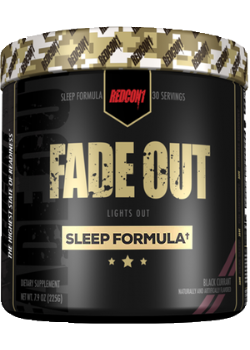
Fade Out by Redcon1 is a sleep formula but sleep formulas are beneficial for optimal hormone replenishment. During REM Sleep, your body replaces all of its hormones such as IGF-1, Growth Hormone, and testosterone, all key for growth and recovery. Redcon1 Black Currant flavoured Fade Out delivers over 100% of the recommended daily value of Vitamin C, Zinc and Magnesium to help support your immune system while you sleep. Vitamin C contributes to immune defense by supporting various cellular functions of both the innate and adaptive immune system. Zinc helps regulate immune function, maintain healthy testosterone levels and support the nervous system, plus also helps regulate sleep. An essential and abundant mineral in the body, Magnesium aids in numerous reactions and functions in the body including energy creation, muscle movement and nervous system regulation. Magnesium can also support sleep quality and help maintain healthy testosterone levels. [POWDER]
Each scoop contains:
[{"Calories\t":"5},{"Total Carbohydrate\t":"1g"},{"Vitamin C (as Ascorbic Acid)\t":"100mg"},{"Vitamin E (as DL-Alpha Tocopheryl Acetate)\t":"9mg"},{"Vitamin B6 (as Pyridoxine HCI)\t":"6mg"},{"Magnesium (as Magnesium Aspartate)\t":"425mg"},{"Zinc (as Zinc Aspartate)\t":"35mg"},{"Gamma Aminobutyric Acid (GABA)\t":"1g"},{"L-Arginine (as L-Arginine HCI)\t":"1g"},{"Mucuna pruriens Seed Extract (15% L-Dopa)\t":"1g"},{"L-Phenylalanine\t":"750mg"},{"Valerian (Valeriana officinalis) Root Extract\t":"600mg"},{"L-Ornithine (as Ornithine HCI)\t":"500mg"},{"L-Theanine\t":"500mg"},{"Chamomile (Matricaria chamomilla) Flower Extract (1.2% Apigenin)\t":"350mg"},{"Hops (Humulus lupulus) Flower Extract\t":"300mg"},{"Melatonin\t":"5mg"}]
Ingredients:
Citric Acid, Malic Acid, Natural and Artificial Flavor, Sucralose, Silicon Dioxide, Calcium Silicate, Tartaric Acid, Acesulfame Potassium.
Important Information:
This product is intended for healthy adults 18 years of age or older. As with any dietary supplement, consult a healthcare professional prior to use. Do not use if you are pregnant, nursing, have any medical condition or if you are taking any medications or supplements. This product is intended for occasional sleeplessness and is not a substitute for healthy sleep practices. Do not combine with alcohol or exceed recommended serving. Do not drive or operate machinery within eight hours of consumption. This product contains 750mg of Phenylalanine per serving. Do not use if you have Phenylketonuria. Discontinue 2 weeks prior to surgery. Immediately discontinue use and consult a healthcare professional if you experience any adverse reactions. Keep out of reach of children
Dosage
Mix 1 Scoop In 8 - 10 Oz Of Water Or Your Favorite Beverage. Take 30 Minutes Prior To Sleep. Allow For 6-8 Hours Of Sleep. Assess Your Tolerance By Taking (1 ⁄2) Scoop. Do Not Exceed (1) Scoop In A 24 -Hour Period.
Redcon1 is ready when you are. This military inspired sports nutrition brand supports veterans and first responders, as well as athletes and everyday gym goers. They use quality ingredients to formulate cutting edge natural health and sports nutrition supplements. Their range includes stimulating and non-stimulating pre-workouts such as Total War; muscle builders like HALO; fat burners; recovery blends including BCAA’s, EAA’s and sleep recovery formulas; vegan, non whey and whey protein blends; as well as CLA, collagen and apple cider vinegar gummies. Redcon1 helps optimize your fitness routine, naturally.
SLEEP DISORDERS
Read on to discover how you can help yourself get a good night's sleep...
Nothing replaces a good night's sleep. When you wake after one, you feel refreshed, energized, motivated and happy. Waking after tossing and turning for most of the night can make you feel the exact opposite. Unfortunately for a lot of people, they may wake feeling as if they hadn't slept at all, which leaves them unable to get a good start on the day.
Type Of Sleep and Time Spent:
- 1 Beginning Stage, Light Sleep. Aren't Aware You Are Asleep. 5 - 10 Min.
- 2 Falling Deeper - Body Temp Decreases And Heart Rate Slows. 20 Min.
- 3 Transitional Period Between Light And Very Deep Sleep. Varies
- 4 Deep Sleep. Time When Sleep Walking And Bed-Wetting Occur. 30 Min.
- 5 Rem (Rapid Eye Movement) Sleep. Dreaming Occurs. Increases
REM Sleep
The 5th stage of sleep is known as REM (rapid eye movement) sleep and is the time when we dream. This stage occurs approximately 90 minutes after we fall asleep and gets progressively longer each time we cycle through it, eventually lasting up to an hour.
Sleep and the Brain
We require sleep to rest and repair our bodies and our minds. It is thought that most of the sleep cycles are required for repairing the physical functions of our bodies, but that REM sleep is required for restoring our mental functions. Sleeping for an insufficient length of time does not allow the body to achieve sufficient REM sleep, and we cannot mentally rejuvenate. Since we also integrate our daily learning and store short-term knowledge in our long-term memory during our sleep, it is even more important for children to get sufficient sleep while they are growing and learning at exponential rates. Many bodily processes are regulated by sleep - for example production of certain neurotransmitters and hormones. If the specific glands and cells do not receive the correct messages produced by sleeping, then these important substances may not be properly produced. Depression may result in the case of neurotransmitter deficiency. Fatigue or anxiety may result in the case of insufficient adrenal or
thyroid hormones.
Sleep and Repair
During the time we are sleeping, our body is still quite active on the cellular level. As stated above, this is a time when many hormones and neurotransmitters are produced and stored for later use. Also, the body takes this time to heal and rebuild our bodies from any trauma or stress from the previous day's activities.
Our muscles repair themselves, and gain strength from the previous day's use, and any cuts, bruises or other wounds are allowed to heal. Without this time of rejuvenation, our body cannot keep up with the constant daily insult, and we begin to feel the physical effects that we associate with aging. Giving your body sufficient sleep can help to reduce these effects and leave you feeling revitalized. Maybe there's something to the phrase "getting your beauty sleep".
Sleep Requirements
There is no one correct amount of sleep for everyone. Each person has unique needs based on their own physiology, genetics, age, and physical and mental-emotional stress levels. In times of learning, stress, high activity, or growth our bodies require more sleep than they normally would. Please see the chart below for general daily sleep guidelines based on age:
- Infants Birth - 2 Months 12 - 18 Hours
- Babies 3 - 11 Months 14 - 15 Hours
- Toddlers 1 - 3 Years 12 Hours
- Children 3 - 5 Years 11 - 13 Hours
- Youth 5 - 10 Years 10 - 11 Hours
- Adolescents 10 - 17 Years 8.5 - 9.5 Hours
- Adults 18 Years + 7.5 - 9 Hours
Many people fail to achieve the required number of hours of sleep in a day. As we age, it becomes more difficult to get a full night's sleep, so napping during the day can help to fill any gaps. Any time we fail to achieve the required amount of sleep, our bodies are unable to fully repair and a "sleep debt" accumulates.
Sleep Debt
When we fail to get enough sleep for our body to heal, repair and mentally integrate the previous day, it is a condition known as "sleep debt". As the phrase implies, the effects of insufficient sleep accumulate over time, and leave a backlog of healing processes unfinished. Eventually, the body requires a sleep repayment, such as a night of sleeping extra hours or increased napping during the day so it can catch up with integration and repair. Most of us are familiar with sleeping for several extra hours on a weekend to make up for lack of sleep during a busy week. This is an example of repaying your sleep debt. Failing to repay your sleep debt over time can result in sleep deprivation, a condition that can result in a number of problems such as: hallucinations, emotional instability, depression, anxiety, fatigue, forgetfulness, and lowered immune status resulting in more frequent colds and infections.
Sunlight and Sleep
Ever wonder how your body knows when to sleep and when to wake up? Why do you get hungry and active during the day, but want to be still and relaxed at night? The body's daily rhythms, called circadian rhythms, dictate all of these functions. These rhythms are tied to the exposure of our eyes to sunlight during the day and darkness at night. In fact, as the light dims towards the end of the day, the body begins to produce increasing amounts of the hormone
melatonin, which is responsible for our "feeling sleepy". Thus, being exposed to light, even artificial light, can reduce the amount of
melatonin
produced in our brains and disrupt the natural sleep cycle. This effect is most pronounced when the light is in the blue spectrum and comes from above eye level, instead of below. The most common understanding of disturbance of the natural circadian rhythm is the condition we know as "jet lag", in which a person changes their circadian rhythm by exposing themselves to a different light-dark schedule by flying in or out of a different time zone. This can often result in sleep difficulties, fatigue, and mental confusion until the body can adapt, and re-establish its natural pattern.
Sleep Hygiene
Maintaining regular sleeping habits is an essential component of healthy sleep. Go to bed only when you are tired and do not stay in bed if you are not sleepy. Use the bedroom only for sleep and sex. Get up at the same time each day. Do not nap unless it is a daily routine and exercise during the day but not before bed. Take a hot bath or shower 1-2 hours before bed. Keep the bedroom dark, quiet and comfortable. This may require covering alarm clock lights and unplugging other electronic devices nearby. If necessary, use a white noise machine to generate background noise. Put worries out of your mind and think of positive things. For occasional sleeplessness try herbal combinations or melatonin.
What You Can Do To Sleep Better:
- Help your body control stress with exercises like tai chi and yoga.
- Take supplements to optimize neurotransmitter production like melatonin and 5htp.
- Take supplements to support adrenal health.
- Do not drink coffee, black tea, or cola; they all contain
caffeine
- Eat plenty of fresh vegetables
- Do not eat too late in the evening.
- Maintain a regular sleep cycle.
- Use relaxation techniques like self hypnosis
Carefully SelectedShips to the U.S.Wellness EssentialsTrusted Brands
Product Details
SLEEP DISORDERS
Read on to discover how you can help yourself get a good night's sleep...
Nothing replaces a good night's sleep. When you wake after one, you feel refreshed, energized, motivated and happy. Waking after tossing and turning for most of the night can make you feel the exact opposite. Unfortunately for a lot of people, they may wake feeling as if they hadn't slept at all, which leaves them unable to get a good start on the day.
Type Of Sleep and Time Spent:
- 1 Beginning Stage, Light Sleep. Aren't Aware You Are Asleep. 5 - 10 Min.
- 2 Falling Deeper - Body Temp Decreases And Heart Rate Slows. 20 Min.
- 3 Transitional Period Between Light And Very Deep Sleep. Varies
- 4 Deep Sleep. Time When Sleep Walking And Bed-Wetting Occur. 30 Min.
- 5 Rem (Rapid Eye Movement) Sleep. Dreaming Occurs. Increases
REM Sleep
The 5th stage of sleep is known as REM (rapid eye movement) sleep and is the time when we dream. This stage occurs approximately 90 minutes after we fall asleep and gets progressively longer each time we cycle through it, eventually lasting up to an hour.
Sleep and the Brain
We require sleep to rest and repair our bodies and our minds. It is thought that most of the sleep cycles are required for repairing the physical functions of our bodies, but that REM sleep is required for restoring our mental functions. Sleeping for an insufficient length of time does not allow the body to achieve sufficient REM sleep, and we cannot mentally rejuvenate. Since we also integrate our daily learning and store short-term knowledge in our long-term memory during our sleep, it is even more important for children to get sufficient sleep while they are growing and learning at exponential rates. Many bodily processes are regulated by sleep - for example production of certain neurotransmitters and hormones. If the specific glands and cells do not receive the correct messages produced by sleeping, then these important substances may not be properly produced. Depression may result in the case of neurotransmitter deficiency. Fatigue or anxiety may result in the case of insufficient adrenal or
thyroid hormones.
Sleep and Repair
During the time we are sleeping, our body is still quite active on the cellular level. As stated above, this is a time when many hormones and neurotransmitters are produced and stored for later use. Also, the body takes this time to heal and rebuild our bodies from any trauma or stress from the previous day's activities.
Our muscles repair themselves, and gain strength from the previous day's use, and any cuts, bruises or other wounds are allowed to heal. Without this time of rejuvenation, our body cannot keep up with the constant daily insult, and we begin to feel the physical effects that we associate with aging. Giving your body sufficient sleep can help to reduce these effects and leave you feeling revitalized. Maybe there's something to the phrase "getting your beauty sleep".
Sleep Requirements
There is no one correct amount of sleep for everyone. Each person has unique needs based on their own physiology, genetics, age, and physical and mental-emotional stress levels. In times of learning, stress, high activity, or growth our bodies require more sleep than they normally would. Please see the chart below for general daily sleep guidelines based on age:
- Infants Birth - 2 Months 12 - 18 Hours
- Babies 3 - 11 Months 14 - 15 Hours
- Toddlers 1 - 3 Years 12 Hours
- Children 3 - 5 Years 11 - 13 Hours
- Youth 5 - 10 Years 10 - 11 Hours
- Adolescents 10 - 17 Years 8.5 - 9.5 Hours
- Adults 18 Years + 7.5 - 9 Hours
Many people fail to achieve the required number of hours of sleep in a day. As we age, it becomes more difficult to get a full night's sleep, so napping during the day can help to fill any gaps. Any time we fail to achieve the required amount of sleep, our bodies are unable to fully repair and a "sleep debt" accumulates.
Sleep Debt
When we fail to get enough sleep for our body to heal, repair and mentally integrate the previous day, it is a condition known as "sleep debt". As the phrase implies, the effects of insufficient sleep accumulate over time, and leave a backlog of healing processes unfinished. Eventually, the body requires a sleep repayment, such as a night of sleeping extra hours or increased napping during the day so it can catch up with integration and repair. Most of us are familiar with sleeping for several extra hours on a weekend to make up for lack of sleep during a busy week. This is an example of repaying your sleep debt. Failing to repay your sleep debt over time can result in sleep deprivation, a condition that can result in a number of problems such as: hallucinations, emotional instability, depression, anxiety, fatigue, forgetfulness, and lowered immune status resulting in more frequent colds and infections.
Sunlight and Sleep
Ever wonder how your body knows when to sleep and when to wake up? Why do you get hungry and active during the day, but want to be still and relaxed at night? The body's daily rhythms, called circadian rhythms, dictate all of these functions. These rhythms are tied to the exposure of our eyes to sunlight during the day and darkness at night. In fact, as the light dims towards the end of the day, the body begins to produce increasing amounts of the hormone
melatonin, which is responsible for our "feeling sleepy". Thus, being exposed to light, even artificial light, can reduce the amount of
melatonin
produced in our brains and disrupt the natural sleep cycle. This effect is most pronounced when the light is in the blue spectrum and comes from above eye level, instead of below. The most common understanding of disturbance of the natural circadian rhythm is the condition we know as "jet lag", in which a person changes their circadian rhythm by exposing themselves to a different light-dark schedule by flying in or out of a different time zone. This can often result in sleep difficulties, fatigue, and mental confusion until the body can adapt, and re-establish its natural pattern.
Sleep Hygiene
Maintaining regular sleeping habits is an essential component of healthy sleep. Go to bed only when you are tired and do not stay in bed if you are not sleepy. Use the bedroom only for sleep and sex. Get up at the same time each day. Do not nap unless it is a daily routine and exercise during the day but not before bed. Take a hot bath or shower 1-2 hours before bed. Keep the bedroom dark, quiet and comfortable. This may require covering alarm clock lights and unplugging other electronic devices nearby. If necessary, use a white noise machine to generate background noise. Put worries out of your mind and think of positive things. For occasional sleeplessness try herbal combinations or melatonin.
What You Can Do To Sleep Better:
- Help your body control stress with exercises like tai chi and yoga.
- Take supplements to optimize neurotransmitter production like melatonin and 5htp.
- Take supplements to support adrenal health.
- Do not drink coffee, black tea, or cola; they all contain
caffeine
- Eat plenty of fresh vegetables
- Do not eat too late in the evening.
- Maintain a regular sleep cycle.
- Use relaxation techniques like self hypnosis
🌿
Daily Wellness
Easy to add to your everyday health routine.
✅
Carefully Selected
Chosen with quality and customer needs in mind.
💊
Simple to Use
Designed for convenient daily supplementation.
🚚
Ships to the U.S.
Fast, reliable shipping to U.S. customers.
Choosing a selection results in a full page refresh.