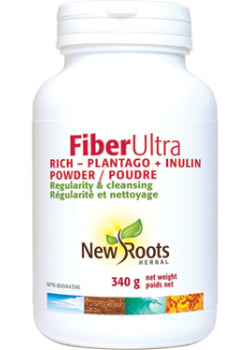
FIBER ULTRA RICH PLANTAGO + INULIN FROM NEW ROOTSNew Roots Herbal's Fibre Ultra Rich Plantago + Inulin is an excellent source of fibre. It purifies, decontaminates and is 100% natural. Plantago is a bulk forming laxative and is high in both fibre and mucilage. The laxative properties of plantago are due to the swelling of the husk when it comes in contact with water. This forms a gelatinous mass that keeps feces hydrated and soft, provided it is taken with sufficient water. The resulting bulk stimulates a reflex contraction of the walls of the bowel, followed by emptying. [POWDER]
Dosage
Take 1 teaspoon twice daily. For each gram of psyllium, take with 30 ml of liquid (water, milk, fruit juice, or similar aqueous beverage). Drink immediately and maintain adequate fluid intake. If you are taking other medications, take this product 2 hours before or after them.
Proudly Manufactured In Canada & Available
New Roots Herbal offers high-quality natural health products like their best-selling probiotics, digestive enzymes, chill pills, strong bones, acidophilus ultra and black cumin seed oil among hundreds more herbal remedies. Founded in 1985 New Roots Canada delivers formulas that were designed to contribute to the prevention and cure of disease at their core. You can buy all New Roots supplements at ca
New Roots Plantago Fibre Ultra Rich Plantago + Inulin
Fibre Ultra Rich Plantago + Inulin is an excellent source of fibre. It purifies, decontaminates and is 100% natural. Plantago is a bulk forming laxative and is high in both fibre and mucilage. The laxative properties of plantago are due to the swelling of the husk when it comes in contact with water. This forms a gelatinous mass that keeps feces hydrated and soft, provided it is taken with sufficient water. The resulting bulk stimulates a reflex contraction of the walls of the bowel, followed by emptying.
Fibre
Every time we turn around something reminds us about the importance of fibre. Advertising touts products new and improved when they are considered high fibre or have added whole grain. So what's all the fuss about? The standard North American diet is largely deficient in fibre because of the refining process. It strips the fibrous coat off of grains and removes the skins of fruits and vegetables.
Thus the food becomes easier to process but deficient in fibre and nutrients.
Diabetes
and
high cholesterol
are just a few of the conditions that afflict millions of people and can be helped by proper fibre intake. There are several different types of fibre each with their own health benefits.
Bran, gums and mucilage's are fibres that regulate blood sugar and lower cholesterol. They also bind to toxins and waste products in the intestines, ensuring that these harmful agents pass through the digestive tract without being reabsorbed by the body. By eating oatmeal, oat bran, sesame seeds and dried beans you take in substantial amounts of these fibres. Some medicinal types of this fibre are glucomannan and psyllium seed. Glucomannan binds to fat in the intestines, normalizes blood sugar and decreases appetite (by expanding in the stomach). It benefits those who are obese, diabetic or hypoglycemic. Psyllium seed is an intestinal cleanser and stool softener. It is the major component of the commercial preparation called Metamucil. But Metamucil contains colourings and flavourings that are not found in psyllium preparations.
Cellulose is an indigestible fibre that is found in fruit and vegetable skins. Because it is not absorbed in the gastrointestinal tract it bulks the stool and acts as an intestinal cleanser. It helps to prevent and treat
hemorrhoids,
varicose veins,
constipation
and
colitis. It also binds to toxins so that they are not absorbed into the body.
Hemicellulose is also an indigestible fibre that is found in fruit and vegetables. It regulates the water content of the stool. It is used as a treatment for weight loss, constipation, and detoxification.
Lignin is a fibre that has an affinity for fats and bile acids. It binds to these substances in the intestines and prevents their absorption or re-absorption into the body. Lignin is used to lower cholesterol, prevent gallstones and treat diabetes.
Pectin
slows the absorption of food after meals thereby decreasing the rate at which blood sugar enters the body. This is especially beneficial for people with diabetes whose bodies cannot properly take sugar into cells. Pectin, especially apple pectin, also binds to fats and bile acids. Thus it is used to prevent gallstones, and lower cholesterol. Citrus pectin has been studied for its ability to remove toxins from the body, reduce side effects from radiation therapy and limit tumor metastasis.
Fibre can be added to the diet by increasing your intake of whole grains, fresh fruit and vegetables (with skin!) and beans. If it is still needed, many commercial fibre preparations, each with a unique mix of fibres in tablets, capsules or powder form, are available. Read
fibre supplements
carefully because some may contain laxatives, making those preparations unsuitable for long-term use.
Soluble fibre dissolves in water. Its main medicinal function is to slow down the speed of digestion, By doing this, it stabilizes blood sugar, as well as increases the uptake of mineral and nutrients during digestion. Psyllium, apples, beans, dried apricots, and oat bran are all excellent sources of soluble fibre. Soluble fibres that are high in inulin or fructo-oligosaccharides, are said to have a high prebiotic potential or content. These fibres help to stimulate the selective growth of "good" intestinal bacteria (mainly the lactobacillus and bifidobacterium species), at the expense of "bad" bacteria. Bacteria like e-coli and clostridium species are also a normal and necessary as part of healthy gut flora, but if overgrown or unopposed, are more likely to cause infection. Leeks, onion, garlic, asparagus, jeruselum
artichoke
and chicory root are all high in inulin.
Insoluble fibre, in comparison, does not dissolve in water, nor does to affect the rate of digestion. It acts to increase stool volume, thereby also stimulating normal bowel contractions. Many grains contain both soluble and insoluble fibres. Examples of some sources of insoluble fibre include wheat, corn, rice, vegetables and beans.
The recommended intake of fibre is anywhere from 25-38 g/day, a goal that can be achieved quite easily if you know how to make the most of your diet. 2 pieces of whole wheat toast or 3/4 cups of cooked oats have about 6 g of dietary fibre. A cup of spinach has 7 g, while 1/2 of cooked blacked beans has just under 10 g of fibre.
Carefully SelectedShips to the U.S.Wellness EssentialsTrusted Brands
Product Details
New Roots Plantago Fibre Ultra Rich Plantago + Inulin
Fibre Ultra Rich Plantago + Inulin is an excellent source of fibre. It purifies, decontaminates and is 100% natural. Plantago is a bulk forming laxative and is high in both fibre and mucilage. The laxative properties of plantago are due to the swelling of the husk when it comes in contact with water. This forms a gelatinous mass that keeps feces hydrated and soft, provided it is taken with sufficient water. The resulting bulk stimulates a reflex contraction of the walls of the bowel, followed by emptying.
Fibre
Every time we turn around something reminds us about the importance of fibre. Advertising touts products new and improved when they are considered high fibre or have added whole grain. So what's all the fuss about? The standard North American diet is largely deficient in fibre because of the refining process. It strips the fibrous coat off of grains and removes the skins of fruits and vegetables.
Thus the food becomes easier to process but deficient in fibre and nutrients.
Diabetes
and
high cholesterol
are just a few of the conditions that afflict millions of people and can be helped by proper fibre intake. There are several different types of fibre each with their own health benefits.
Bran, gums and mucilage's are fibres that regulate blood sugar and lower cholesterol. They also bind to toxins and waste products in the intestines, ensuring that these harmful agents pass through the digestive tract without being reabsorbed by the body. By eating oatmeal, oat bran, sesame seeds and dried beans you take in substantial amounts of these fibres. Some medicinal types of this fibre are glucomannan and psyllium seed. Glucomannan binds to fat in the intestines, normalizes blood sugar and decreases appetite (by expanding in the stomach). It benefits those who are obese, diabetic or hypoglycemic. Psyllium seed is an intestinal cleanser and stool softener. It is the major component of the commercial preparation called Metamucil. But Metamucil contains colourings and flavourings that are not found in psyllium preparations.
Cellulose is an indigestible fibre that is found in fruit and vegetable skins. Because it is not absorbed in the gastrointestinal tract it bulks the stool and acts as an intestinal cleanser. It helps to prevent and treat
hemorrhoids,
varicose veins,
constipation
and
colitis. It also binds to toxins so that they are not absorbed into the body.
Hemicellulose is also an indigestible fibre that is found in fruit and vegetables. It regulates the water content of the stool. It is used as a treatment for weight loss, constipation, and detoxification.
Lignin is a fibre that has an affinity for fats and bile acids. It binds to these substances in the intestines and prevents their absorption or re-absorption into the body. Lignin is used to lower cholesterol, prevent gallstones and treat diabetes.
Pectin
slows the absorption of food after meals thereby decreasing the rate at which blood sugar enters the body. This is especially beneficial for people with diabetes whose bodies cannot properly take sugar into cells. Pectin, especially apple pectin, also binds to fats and bile acids. Thus it is used to prevent gallstones, and lower cholesterol. Citrus pectin has been studied for its ability to remove toxins from the body, reduce side effects from radiation therapy and limit tumor metastasis.
Fibre can be added to the diet by increasing your intake of whole grains, fresh fruit and vegetables (with skin!) and beans. If it is still needed, many commercial fibre preparations, each with a unique mix of fibres in tablets, capsules or powder form, are available. Read
fibre supplements
carefully because some may contain laxatives, making those preparations unsuitable for long-term use.
Soluble fibre dissolves in water. Its main medicinal function is to slow down the speed of digestion, By doing this, it stabilizes blood sugar, as well as increases the uptake of mineral and nutrients during digestion. Psyllium, apples, beans, dried apricots, and oat bran are all excellent sources of soluble fibre. Soluble fibres that are high in inulin or fructo-oligosaccharides, are said to have a high prebiotic potential or content. These fibres help to stimulate the selective growth of "good" intestinal bacteria (mainly the lactobacillus and bifidobacterium species), at the expense of "bad" bacteria. Bacteria like e-coli and clostridium species are also a normal and necessary as part of healthy gut flora, but if overgrown or unopposed, are more likely to cause infection. Leeks, onion, garlic, asparagus, jeruselum
artichoke
and chicory root are all high in inulin.
Insoluble fibre, in comparison, does not dissolve in water, nor does to affect the rate of digestion. It acts to increase stool volume, thereby also stimulating normal bowel contractions. Many grains contain both soluble and insoluble fibres. Examples of some sources of insoluble fibre include wheat, corn, rice, vegetables and beans.
The recommended intake of fibre is anywhere from 25-38 g/day, a goal that can be achieved quite easily if you know how to make the most of your diet. 2 pieces of whole wheat toast or 3/4 cups of cooked oats have about 6 g of dietary fibre. A cup of spinach has 7 g, while 1/2 of cooked blacked beans has just under 10 g of fibre.
🌿
Daily Wellness
Easy to add to your everyday health routine.
✅
Carefully Selected
Chosen with quality and customer needs in mind.
💊
Simple to Use
Designed for convenient daily supplementation.
🚚
Ships to the U.S.
Fast, reliable shipping to U.S. customers.
Choosing a selection results in a full page refresh.