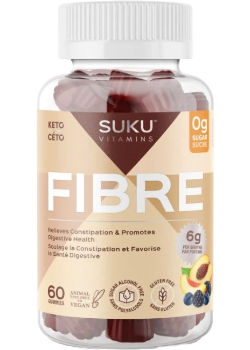
Gently relieve constipation and irregularity
Support the growth of healthy gut bacteria
Maintain a healthy digestive system
Delicious Peach Berry Flavour
Gluten, dairy, tree nut, shellfish, soy, egg, peanut free. Non-GMO
Pectin based
Sugar-free, sugar-alcohol free, vegan & keto-friendly
Gently relieve constipation and irregularity
Support the growth of healthy gut bacteria
Maintain a healthy digestive system
Delicious Peach Berry Flavour
Gluten, dairy, tree nut, shellfish, soy, egg, peanut free. NonGMO
Support your digestive wellness with Suku Vitamins Fibre Gummies, a convenient and tasty way to add more fibre to your daily routine. Each serving provides prebiotic fibre to help promote regularity and support the growth of beneficial gut bacteria. These easy-to-enjoy gummies are designed to help maintain a healthy digestive system while fitting seamlessly into your day. Made with a vegan, pectin-based formula and free from common allergens, they offer a simple and enjoyable option for supporting overall gut health. [GUMMIES]
Each gummy contains:
Inulin (Cichorium intybus – Root, Helianthus tuberosus – Tuber ) 3g
Non-Medicinal Ingredients:
Water, Agar, DL-malic acid, Pectin, Citric acid, Fruit flavour (Natural), Tapioca syrup, Sodium citrate dihydrate, Vegetable juice, Stevia leaf extract, Medium chain triglycerides, Carnauba wax
Important Information:
Consult a health care practitioner or physician if symptoms worsen, if laxative effect does not occur within 7 days, or prior to use if you have diabetes. Do not use if you have fever or any undiagnosed gastrointestinal trouble. Store in dry, cool space. Keep out of reach of children.
Dosage
Adults (19+): Take 2 gummies daily. Take with at least 250ml of liquid, a few hours before or after taking other medications or natural health products.
Daily Health Made Easy with SUKU Gummy Vitamins
Bridging the gap between beauty and wellness, Suku Vitamins formulates natural gummies for your skins health and overall well-being. They partner with naturopaths and nutritionists to ensure their ingredients are science-backed and in their most absorbable form. These Canadian made supplements are tested for purity and quality 3 times, and unlike most gummies, are free from sugar, sugar alcohols, and artificial colours and flavours. They offer a wide range of plant-based, non GMO, keto and allergen friendly supplements to support radiant, youthful skin; restful sleep; adult and kids immunity; men’s, women’s and kids multi’s; stress; prenatal concerns, and hair health.
FIBRE
Fibre - It doesn’t just keep you regular!
Psyllium fibre, a well-known and very commonly used fibre supplement, contains both insoluble and soluble forms of fibre, as do all plant foods. Many people are unfamiliar with what soluble and insoluble fibres really are, and the benefits they have for our health.
Soluble Fibre
Soluble fibre attracts water, dissolves in water and turns into a gel-like substance. The major benefit to soluble fibre is that it slows digestion, thus stabilizing blood sugar by delaying the absorption of glucose. Thus, soluble fibre plays a role in the prevention of
diabetes, as well as obesity. By slowing digestion, not only do soluble fibres increase the uptake of minerals and nutrients during digestion, they promote satiety and help to prevent overeating. Psyllium, apples, beans, dried apricots, and oat bran are all excellent sources of soluble fibre.
Insoluble Fibre
Insoluble fibre, in comparison, does not dissolve in water. It acts to increase stool volume, otherwise known as a bulking agent. Insoluble fibre helps to maintain regularity by increasing transit time, promoting regular and healthy bowel contractions. Examples of some sources of insoluble fibre include wheat, corn, rice, vegetables and beans. Insoluble fibre may help to prevent and treat haemorrhoids,
varicose veins, and
constipation. These fibres also help to promote the removal of toxins through the bowel, before they are given a chance to be reabsorbed into the bloodstream, wreaking havoc on the body. It is this action that gives it such an important role in the prevention of colon
cancer, among a myriad of other inflammatory diseases.
Fermentable Fibre
Recently there has been some dispute about the relevance of dividing fibre into soluble and insoluble categories. As an alternative, fibre can be divided in ‘viscous’ and ‘fermentable’. Soluble fibres that are high in inulin or fructo-oligosaccharides, are said to be fermentable. Friendly bacteria in the large intestine ferment these fibres. These fibres can also be called
probiotics. They help to stimulate the selective growth of "good" intestinal bacteria (mainly the lactobacillus and bifidobacterium species), at the expense of "bad" bacteria. Bacteria like e-coli and clostridium species are also normal and necessary as parts of healthy gut flora, but if overgrown or unopposed, are more likely to cause infection. Another advantage of fermentable bacteria is a fatty acids called butyric acid, produced through the fermentation process and the primary fuel of the large intestine. Other short-chained fatty acids produced by the fermentation process are thought to be responsible for some of the cholesterol lowering properties of fibre. Leeks, onion, garlic, asparagus, jeruselum
artichoke
and chicory root are all high in inulin.
Viscous Fibres
Also primarily associated with soluble fibre, viscous fibres are the cholesterol lowering specialists. These fibres complex with bile acids, which are made by the liver from cholesterol and necessary for proper digestion of fats. After complexing with bile acids, these compounds are the removed from circulation and in turn lower cholesterol levels.
Categories of Dietary Fibre
- Cellulose, found in bran, legumes, peas, root vegetables, cabbage family, outer covering of seeds, and apples
- Hemicellulose, found in bran and whole grains. Regulates the water content of the stool. It is used as a treatment for weight loss, constipation, and detoxification.
- Polyfructoses (Inulin and Oligofructans)
- Galactooligosaccharides
- Gums, found in oatmeal, barley, and legumes.
- Mucilages
- Pectins, found in apples, strawberries, and citrus fruits. Pectin slows the absorption of food after meals thereby decreasing the rate at which blood sugar enters the body. Apple pectin binds to fats and bile acids. Thus it is used to prevent gallstones, and lower cholesterol. Citrus pectin has been studied for its ability to remove toxins from the body, reduce side effects from radiation therapy and limit tumour metastasis.
- Lignin, found in root vegetables, wheat, fruits with edible seeds (such as strawberries). A fibre that has an affinity for fats and bile acids. It binds to these substances in the intestines and prevents their absorption or desorption into the body. Lignin is used to lower cholesterol, prevent gallstones and treat diabetes and colon cancer.
- Resistant Starches, found in ripe bananas, potatoes
Fibres can be added to the diet by increasing your intake of whole grains, fresh fruit and vegetables (with skin!) and beans/lentils. If it is still needed, many commercial fibre preparations, each with a unique mix of fibres in tablets, capsules or powder form, are available. Read
fibre supplements
carefully because some may contain laxatives, making those preparations unsuitable for long-term use. The recommended intake of fibre is anywhere from 25-40 g/day, a goal that can be achieved quite easily if you know how to make the most of your diet. 2 pieces of whole-wheat toast or 3/4 cups of cooked oats have about 6 g of dietary fibre. A cup of spinach has 7 g, while 1/2 of cooked black beans have just fewer than 10 g of fibre.
Fibre – Quick Facts
Food Sources
· Whole Grains, Brown Rice,
Agar
Agar, Bran, Fresh Fruit, Dried Prunes And Apricots, Nuts, Seeds, Flaxseeds, Psyllium, Chicory, Beans, Lentils, Raw Vegetables.
Applications
· Obesity, Diabetes, Hypoglycemia, Constipation, Haemorrhoids,
High Cholesterol, Detoxification
Optimum Dosage
· As Directed, Away From Other Supplements Or Medications, With Lots Of Water. (Clinical Doses May Be Higher As Recommended By Your Practitioner).
Works Well With
· Water, Digestive
Enzymes, Essential Fatty Acids
Important Information
· Start Fibre Supplementation With Small Doses, And Lots Of Water, Until Your Stool Is The Proper Consistency.
· Fibre Can Compromise The Absorption Of Other Nutrients And Medications If They Are Taken At The Same Time.
Carefully SelectedShips to the U.S.Wellness EssentialsTrusted Brands
Product Details
FIBRE
Fibre - It doesn’t just keep you regular!
Psyllium fibre, a well-known and very commonly used fibre supplement, contains both insoluble and soluble forms of fibre, as do all plant foods. Many people are unfamiliar with what soluble and insoluble fibres really are, and the benefits they have for our health.
Soluble Fibre
Soluble fibre attracts water, dissolves in water and turns into a gel-like substance. The major benefit to soluble fibre is that it slows digestion, thus stabilizing blood sugar by delaying the absorption of glucose. Thus, soluble fibre plays a role in the prevention of
diabetes, as well as obesity. By slowing digestion, not only do soluble fibres increase the uptake of minerals and nutrients during digestion, they promote satiety and help to prevent overeating. Psyllium, apples, beans, dried apricots, and oat bran are all excellent sources of soluble fibre.
Insoluble Fibre
Insoluble fibre, in comparison, does not dissolve in water. It acts to increase stool volume, otherwise known as a bulking agent. Insoluble fibre helps to maintain regularity by increasing transit time, promoting regular and healthy bowel contractions. Examples of some sources of insoluble fibre include wheat, corn, rice, vegetables and beans. Insoluble fibre may help to prevent and treat haemorrhoids,
varicose veins, and
constipation. These fibres also help to promote the removal of toxins through the bowel, before they are given a chance to be reabsorbed into the bloodstream, wreaking havoc on the body. It is this action that gives it such an important role in the prevention of colon
cancer, among a myriad of other inflammatory diseases.
Fermentable Fibre
Recently there has been some dispute about the relevance of dividing fibre into soluble and insoluble categories. As an alternative, fibre can be divided in ‘viscous’ and ‘fermentable’. Soluble fibres that are high in inulin or fructo-oligosaccharides, are said to be fermentable. Friendly bacteria in the large intestine ferment these fibres. These fibres can also be called
probiotics. They help to stimulate the selective growth of "good" intestinal bacteria (mainly the lactobacillus and bifidobacterium species), at the expense of "bad" bacteria. Bacteria like e-coli and clostridium species are also normal and necessary as parts of healthy gut flora, but if overgrown or unopposed, are more likely to cause infection. Another advantage of fermentable bacteria is a fatty acids called butyric acid, produced through the fermentation process and the primary fuel of the large intestine. Other short-chained fatty acids produced by the fermentation process are thought to be responsible for some of the cholesterol lowering properties of fibre. Leeks, onion, garlic, asparagus, jeruselum
artichoke
and chicory root are all high in inulin.
Viscous Fibres
Also primarily associated with soluble fibre, viscous fibres are the cholesterol lowering specialists. These fibres complex with bile acids, which are made by the liver from cholesterol and necessary for proper digestion of fats. After complexing with bile acids, these compounds are the removed from circulation and in turn lower cholesterol levels.
Categories of Dietary Fibre
- Cellulose, found in bran, legumes, peas, root vegetables, cabbage family, outer covering of seeds, and apples
- Hemicellulose, found in bran and whole grains. Regulates the water content of the stool. It is used as a treatment for weight loss, constipation, and detoxification.
- Polyfructoses (Inulin and Oligofructans)
- Galactooligosaccharides
- Gums, found in oatmeal, barley, and legumes.
- Mucilages
- Pectins, found in apples, strawberries, and citrus fruits. Pectin slows the absorption of food after meals thereby decreasing the rate at which blood sugar enters the body. Apple pectin binds to fats and bile acids. Thus it is used to prevent gallstones, and lower cholesterol. Citrus pectin has been studied for its ability to remove toxins from the body, reduce side effects from radiation therapy and limit tumour metastasis.
- Lignin, found in root vegetables, wheat, fruits with edible seeds (such as strawberries). A fibre that has an affinity for fats and bile acids. It binds to these substances in the intestines and prevents their absorption or desorption into the body. Lignin is used to lower cholesterol, prevent gallstones and treat diabetes and colon cancer.
- Resistant Starches, found in ripe bananas, potatoes
Fibres can be added to the diet by increasing your intake of whole grains, fresh fruit and vegetables (with skin!) and beans/lentils. If it is still needed, many commercial fibre preparations, each with a unique mix of fibres in tablets, capsules or powder form, are available. Read
fibre supplements
carefully because some may contain laxatives, making those preparations unsuitable for long-term use. The recommended intake of fibre is anywhere from 25-40 g/day, a goal that can be achieved quite easily if you know how to make the most of your diet. 2 pieces of whole-wheat toast or 3/4 cups of cooked oats have about 6 g of dietary fibre. A cup of spinach has 7 g, while 1/2 of cooked black beans have just fewer than 10 g of fibre.
Fibre – Quick Facts
Food Sources
· Whole Grains, Brown Rice,
Agar
Agar, Bran, Fresh Fruit, Dried Prunes And Apricots, Nuts, Seeds, Flaxseeds, Psyllium, Chicory, Beans, Lentils, Raw Vegetables.
Applications
· Obesity, Diabetes, Hypoglycemia, Constipation, Haemorrhoids,
High Cholesterol, Detoxification
Optimum Dosage
· As Directed, Away From Other Supplements Or Medications, With Lots Of Water. (Clinical Doses May Be Higher As Recommended By Your Practitioner).
Works Well With
· Water, Digestive
Enzymes, Essential Fatty Acids
Important Information
· Start Fibre Supplementation With Small Doses, And Lots Of Water, Until Your Stool Is The Proper Consistency.
· Fibre Can Compromise The Absorption Of Other Nutrients And Medications If They Are Taken At The Same Time.