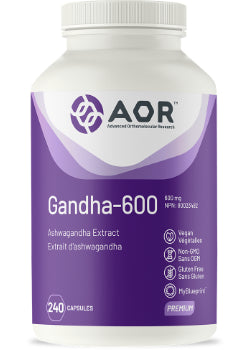
GANDHA 600 ASHWAGANDHA FROM AOR.Gandha is standardized Withania somnifera or better know as Ashwagandha. It is widely used in Ayurveda, the traditional medicine of ancient India. It is considered the "Indian Ginseng" and is valued for its adaptogenic properties, supporting the immune and liver function as well as the body's nonspecific adaptive response to environmental stress. [CAPS]
1 capsule contains:
Ashwagandha (Withania somnifera) 600mg
Other ingredients:
Sodium Stearyl Fumarate and Sodium Benzoate. Capsule: Hypromellose
Important Information:
Contains no wheat, gluten, corn, nuts, peanuts, sesame seeds, sulphites, mustard, soy, dairy, eggs, fish, shellfish or any animal byproduct. Consult a health care practitioner prior to use if you are pregnant or breastfeeding. Consumption with alcohol, other drugs or natural health products with sedative properties is not recommended.
Note:
Herbal extracts will naturally vary in colour from one batch to another.
Dosage
Take one capsule daily with/without food, or as directed by a qualified health care practitioner.
Innovative Formulas by AOR Canada found at
AOR Canada is the innovative formulators of Canada’s best-selling antioxidant support,
AOR Advanced B Complex
and
AOR Tri-B12. They are also known for their top bone health supplements, Ortho Adapt and Bone Basics. You can also
SHOP AOR's Nattokinase, and trusted Curcumin Ultra, Curcumin Active and Curcumin95 inflammation support at ca. AOR are leaders in natural health with innovative product development.
Ashwagandha (Withania somnifera)
is an Ayurvedic herb also known as Indian
Ginseng
(although it is not strictly a member of the
Ginseng
family) that has been traditionally used as an adrenal and nervous system tonic, an adaptogen, and an immune modulator. In Ayurveda, it is classified as a rasayana (rejuvenation) herb, meaning that it can promote physical and mental health, rejuvenate the body in debilitated conditions and increase longevity.
Current research has implicated Ashwagandha for the treatment of an incredible variety of conditions including: anxiety, sexual dysfunction, neurologically degenerative conditions (Alzheimer's and Parkinson's), autoimmune diseases, and arthritis.
Ashwagandha as an Adaptogen
Ashwagandha has active constituents called withanolides, chemicals that resemble human steroid (stress and sex) hormones. This gives them the potential to supplement these hormones in the body in cases of insufficient production or to compete with excess levels produced. This means that supplementation can help normalize hormone levels, whether high or low. In addition to the effects of the withanolides, supplementation of ashwagandha prevents the depletion of
vitamin C
in the body.
vitamin C
is required by the adrenal gland for the production of hormones, such as cortisol and sex hormones. Ashwagandha has also been studied for its ability to increase sexual functioning and physical endurance. This may also be due to Ashwagandha's support of the adrenal gland, as
testosterone
is produced in the adrenals and is responsible for libido and muscle growth. This herb has also been found to improve semen quality with supplementation.
Immune System Modulation and Neuroprotection
Ashwagandha also modulates the immune system, helping to promote underactive immune response and reduce overactive immune responses like those in autoimmune diseases. Because of its anti-inflammatory effects, Ashwagandha has also been studied for its ability to protect joint cartilage in cases of rheumatoid and
osteoarthritis. Due to its neuroprotective effects, Ashwagandha is also used in cases of Alzheimer's and Parkinson's diseases as well. In addition, this herb has been established as an effective treatment for anxiety in several studies in the last few years.
Ashwagandha and Optimal Cell Growth
Ashwagandha has been shown to kill unhealthy cells by at least five different pathways. Because of its ability to reduce the expression of a certain
estrogen
receptor in human tissues, it has been found to help treat certain breast issues as well as to act as a male aphrodesiac. It has also been found to increase reactive oxygen species (a type of free radical) in many different kinds of unhealthy cells, helping to force their natural destruction in the body..
How can I take Ashwagandha?
Ashwagandha can be purchased as raw herb, liquid extract or tincture and encapsulated herb. The root is the part of the plant that is used medicinally, although some of the healthy immune function research involves use of the leaf extract. This herb can be found alone or in combination formulas for the treatment of a variety of conditions. Dosing varies depending on the condition and particular study, but it has been safely supplemented between 1-2g daily of root extract. When Ashwagandha is found in a tea form, it can be safely taken by up to 3 cups a day (using 1-6g of whole herb). As a liquid or tincture, it can be dosed at between 2 and 4ml three times daily. Dosing for leaf extract has not yet been established as the research is still quite new in this area.
Edema
Edema may be a normal and very treatable symptom for many individuals. But, if it is a persistent problem that seems to be worsening and it is not relieved by elevating the feet, Or, if you are noticing significant edema around the eyes, in the legs, and hands, you many want to speak to your healthcare professional, so they can rule out more serious conditions that may be causing fluid retention.
Common Causes of Edema
Edema can be a very benign, transient and treatable problem in many cases. It is common to experience some edema when travelling on an air plane for long distances. In fact, prolonged sitting or standing of any sort can cause some mild swelling. Dietary habits can also play a role. A diet high in salt, for example, can lead to some excess water retention (more on this below). Extremely hot weather and sweating can also cause swelling in the hands and feet of some individuals. Edema is also a very common symptom in late pregnancy, as well as a cyclical symptom for some women, often resolving itself within the first day or two after menstruation begins. Certain medications may also be responsible for excess fluid retention.
Carefully SelectedShips to the U.S.Wellness EssentialsTrusted Brands
Product Details
Ashwagandha (Withania somnifera)
is an Ayurvedic herb also known as Indian
Ginseng
(although it is not strictly a member of the
Ginseng
family) that has been traditionally used as an adrenal and nervous system tonic, an adaptogen, and an immune modulator. In Ayurveda, it is classified as a rasayana (rejuvenation) herb, meaning that it can promote physical and mental health, rejuvenate the body in debilitated conditions and increase longevity.
Current research has implicated Ashwagandha for the treatment of an incredible variety of conditions including: anxiety, sexual dysfunction, neurologically degenerative conditions (Alzheimer's and Parkinson's), autoimmune diseases, and arthritis.
Ashwagandha as an Adaptogen
Ashwagandha has active constituents called withanolides, chemicals that resemble human steroid (stress and sex) hormones. This gives them the potential to supplement these hormones in the body in cases of insufficient production or to compete with excess levels produced. This means that supplementation can help normalize hormone levels, whether high or low. In addition to the effects of the withanolides, supplementation of ashwagandha prevents the depletion of
vitamin C
in the body.
vitamin C
is required by the adrenal gland for the production of hormones, such as cortisol and sex hormones. Ashwagandha has also been studied for its ability to increase sexual functioning and physical endurance. This may also be due to Ashwagandha's support of the adrenal gland, as
testosterone
is produced in the adrenals and is responsible for libido and muscle growth. This herb has also been found to improve semen quality with supplementation.
Immune System Modulation and Neuroprotection
Ashwagandha also modulates the immune system, helping to promote underactive immune response and reduce overactive immune responses like those in autoimmune diseases. Because of its anti-inflammatory effects, Ashwagandha has also been studied for its ability to protect joint cartilage in cases of rheumatoid and
osteoarthritis. Due to its neuroprotective effects, Ashwagandha is also used in cases of Alzheimer's and Parkinson's diseases as well. In addition, this herb has been established as an effective treatment for anxiety in several studies in the last few years.
Ashwagandha and Optimal Cell Growth
Ashwagandha has been shown to kill unhealthy cells by at least five different pathways. Because of its ability to reduce the expression of a certain
estrogen
receptor in human tissues, it has been found to help treat certain breast issues as well as to act as a male aphrodesiac. It has also been found to increase reactive oxygen species (a type of free radical) in many different kinds of unhealthy cells, helping to force their natural destruction in the body..
How can I take Ashwagandha?
Ashwagandha can be purchased as raw herb, liquid extract or tincture and encapsulated herb. The root is the part of the plant that is used medicinally, although some of the healthy immune function research involves use of the leaf extract. This herb can be found alone or in combination formulas for the treatment of a variety of conditions. Dosing varies depending on the condition and particular study, but it has been safely supplemented between 1-2g daily of root extract. When Ashwagandha is found in a tea form, it can be safely taken by up to 3 cups a day (using 1-6g of whole herb). As a liquid or tincture, it can be dosed at between 2 and 4ml three times daily. Dosing for leaf extract has not yet been established as the research is still quite new in this area.
Edema
Edema may be a normal and very treatable symptom for many individuals. But, if it is a persistent problem that seems to be worsening and it is not relieved by elevating the feet, Or, if you are noticing significant edema around the eyes, in the legs, and hands, you many want to speak to your healthcare professional, so they can rule out more serious conditions that may be causing fluid retention.
Common Causes of Edema
Edema can be a very benign, transient and treatable problem in many cases. It is common to experience some edema when travelling on an air plane for long distances. In fact, prolonged sitting or standing of any sort can cause some mild swelling. Dietary habits can also play a role. A diet high in salt, for example, can lead to some excess water retention (more on this below). Extremely hot weather and sweating can also cause swelling in the hands and feet of some individuals. Edema is also a very common symptom in late pregnancy, as well as a cyclical symptom for some women, often resolving itself within the first day or two after menstruation begins. Certain medications may also be responsible for excess fluid retention.