Decrease physical and intellectual fatigue and stress
Support recovery
Treat menstrual problems and menopause
Relieve functional dyspepsia, help digestion when it is troubled by stress or nervousness
Help maintain the immune system
Decrease physical and intellectual fatigue and stress
Support recovery
Treat menstrual problems and menopause
Relieve functional dyspepsia, help digestion when it is troubled by stress or nervousness
Help maintain the immune system
Quantity
Couldn't load pickup availability
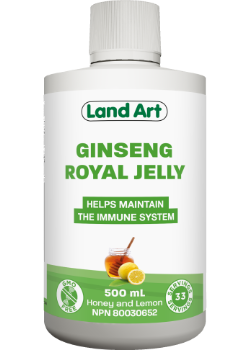
Ginseng Royal Jelly (Honey Lemon) - 500ml
$37.18
Land Art Ginseng Royal Jelly (Honey Lemon) - 500ml is a dietary supplement, intended for adults as part of a daily wellness routine.
Land Art’s Ginseng with Royal Jelly has been formulated to help maintain and boost the immune system. Also containing honey to improve the taste, Ginseng with Royal Honey's Ginseng extracts are made from the roots of plants that are at least 4 to 6-years-old and extracted using a traditional long infusion method to offer more quality and maximum medicinal properties. Royal jelly comes from bees and is known to help to reduce intellectual fatigue, relieve stress, and boost the immune system. It contains sugar, proteins, fats, minerals, vitamins (especially for the B-group). Ginseng and Royal Jelly formula was specially created with women in mind, particularly for those going through menopause. [LIQUID]
15ml contains:
American Ginseng, roots and rhizomes (Panax quinquefolium) 3600 mg of extract 1:4 900 mg
Royal jelly 300 mg
Non-medicinal Ingredients:
Water from reverse osmosis, honey, citric acid, sodium benzoate, potassium sorbate, ascorbic acid, natural lemon flavor.
Important Information:
Do not use for more than 15 to 20 days. Take at least a 2 month break between treatments. Consult a health care practitioner if needed for more than 1 month. Do not use if you have a fever, asthma, eczema, emphysema, cardiac disorders or problems with coagulation. Do not use for pregnant women who suffer from hormone dependent conditions or for individuals that take other supplements or stimulants. Consult a health care practitioner before using if you have diabetes, hay fever, fibro-cystic breasts, insomnia or schizophrenia, are taking anticoagulants or digoxin, or if you are pregnant or breast feeding. A hypersensitivity, like an allergy, may occur. If this is the case, stop using immediately. Do not use if the security seal is broken.
Keep out of the reach of children. Shake well before use. Keep refrigerated after opening. May cause rashes, eczema, conjunctivitis, rhinitis and dyspepsia.
Dosage
Children and adolescents (1 to 17 years old): Consult a health care practitioner
Adults (18 years and older): 1 tablespoon (15 ml) per day, take with food.
*May be diluted in a glass of juice or water.
Land Art formulates liquid supplements that offer superior absorption, bioavailability, and easier digestibility. Their professional, scientific team makes natural health products that are vegan and gluten-free. Their products undergo quality inspection and are packaged in BPA and BPS free bottles that are fully recyclable. They offer many liquid supplements to support various health concerns including, Chlorphyll and a detox blend, Milk Thistle, Melatonin, B-Complex and B-12, Collagen, or Silica, Vitamin D3, Vitamin C, Ginseng Royal Jelly, and many more, all processed in their Eco-cert NOP organic certified plant licensed by Health Canada.
Ginseng
By: Naturopathic Doctor (N.D.)
Increase your energy levels, boost your immune system, and help you better cope with stress...
What is / are ginseng(s)?
There are several plants that are commonly referred to as "ginseng". In the strict sense of the word "ginseng" refers to the Panax genus of plants, which includes Chinese Ginseng (Panax ginseng), Korean Ginseng (Panax schinsen) and American Ginseng (Panax quinquefolius). The active constituents of the Panax family are ginsenosides. The name Panax derives from the Greek word for "all healing," and it has been claimed to treat a very wide variety of conditions.
Siberian Ginseng
(Elutherococcus senticosus), Indian ginseng (Ashwagandha), Brazilian ginseng (Suma), and Peruvian ginseng (Maca) are not members of this genus, but share similar medicinal effects to the true ginsengs and thus, they share the same general name. Ginseng, as a category of plants, is renowned for its healing benefits, with some types having been used for more than 2,000 years. Ginseng was traditionally one of the most widely used plants across the globe, and is still used all over the world today.
What do they do?
The ginsengs are adaptogenic herbs, meaning that they help the body adapt and cope during stressful mental times and during recovery from illness and fatigue. Studies show that the active constituents of ginsengs have structures similar to those of human steroid hormones and that they can directly affect our brains. This action in the brain results in stimulation of the adrenal gland and activation of the body's energy reserves. This response keeps us safe, allowing us to fight for survival, or to flee from dangerous situations. It also increases heart rate; blood pressure and blood flow to the brain, muscles, lungs and heart. Thus ginseng leads to increased energy, mental performance and performance in physical tasks like athletics. Stimulation such as this can deplete the body over time (yang depleting yin – see below) so ginseng also contains substances that stimulate cell replication,
protein
synthesis, immune functioning and blood sugar regulation. All of these properties nourish the body and aid in recovery from times of high activity, illness and stress. The ginsengs are recommended by natural health practitioners for a variety of needs including: athletic performance, energy, recovery from illness or surgery, stress, impotence, low libido and frequent colds and infections.
Yin and Yang
Traditional Chinese Medicine
acknowledges that there is a delicate balance in the entire universe and everything in it between two forces known as yin and yang, woman and man. Yin represents females, rest and regeneration while yang represents males, action and energy. The same universal balance exists within each of our bodies that can be disturbed by excess or deficiency on either side (yin or yang), resulting in illness. The ginsengs are renowned in Chinese culture for their energizing (yang) properties, being complemented by their nutritive (yin) properties. This is the case in most ginsengs, except Korean Ginseng, which is far more yang, and thus cannot be taken for extended periods of time.
Cooling vs. Warming
Another means of viewing the properties of herbs is traditional to most societies on Earth with roots in Indian, Chinese, American (North and South), and European cultures. This categorizes the herbs on a scale between cooling and warming. Some obvious examples familiar to most are mint as a cooling herb and
cayenne
pepper as warming. The various ginsengs are also in different positions on this scale. This is important information for treatment, based on the inherent nature of the condition for which each particular ginseng is being used. For example, warming herbs are better used for cold, stagnant conditions such as a head cold with stuffiness and chills. On the other hand, cooling herbs are better used for hot conditions such as excessive fevers, and anxiety. The requirement for heating or cooling may also be determined by the seasons for those in climates where the weather changes with the seasons. Warming herbs are better used in the winter, and cooling herbs in the summer.
White vs. Red
There are many different preparations of the various ginsengs, two popular types are called white and red. The preparation called white ginseng consists of fresh ginseng that is grown for 4-6 years, peeled and dried. White ginseng is air dried in the sun and thus, becomes a yellowish-white colour and may contain less of the therapeutic constituents. The preparation called red ginseng is grown for 6 years before it is harvested and immediately boiled to steam-cure it, and then the root is dried. This process causes it to have a reddish-brown color, and is thought to change its biochemical composition and also to prevent the breakdown of the active constituents. Red ginseng is used more commonly for herbal preparations, and is generally the form studied when examining the pharmacological activities of ginsenosides.
Hormonal Effects
Ginseng members of the Panax family (North American, Chinese and Korean) have been shown to enhance libido and sexual performance. It is not known whether these effects are due to changes in hormone secretion or due to the direct effects of the ginsenoside constituents on nervous system and gonadal (sexual organ) tissues. It is known that in males, ginsenosides can stimulate penile erection. Certain ginsenosides have also been shown to have weakly phytoestrogenic effects, meaning that they can weakly act in the human body as
estrogen. This allows them to either directly stimulate estrogen receptors in people with insufficient estrogen, or to compete for binding sites with natural estrogen in those with excessive levels. In addition to their direct hormonal actions, the ginsengs are great examples of adaptogens. Because of their effect on the adrenal gland, they can both directly and indirectly affect many different hormones in the human body. The most obvious examples of these are: aldosterone, cortisol, adrenaline, and sex hormones.
Carefully SelectedShips to the U.S.Wellness EssentialsTrusted Brands
Product Details
Ginseng
By: Naturopathic Doctor (N.D.)
Increase your energy levels, boost your immune system, and help you better cope with stress...
What is / are ginseng(s)?
There are several plants that are commonly referred to as "ginseng". In the strict sense of the word "ginseng" refers to the Panax genus of plants, which includes Chinese Ginseng (Panax ginseng), Korean Ginseng (Panax schinsen) and American Ginseng (Panax quinquefolius). The active constituents of the Panax family are ginsenosides. The name Panax derives from the Greek word for "all healing," and it has been claimed to treat a very wide variety of conditions.
Siberian Ginseng
(Elutherococcus senticosus), Indian ginseng (Ashwagandha), Brazilian ginseng (Suma), and Peruvian ginseng (Maca) are not members of this genus, but share similar medicinal effects to the true ginsengs and thus, they share the same general name. Ginseng, as a category of plants, is renowned for its healing benefits, with some types having been used for more than 2,000 years. Ginseng was traditionally one of the most widely used plants across the globe, and is still used all over the world today.
What do they do?
The ginsengs are adaptogenic herbs, meaning that they help the body adapt and cope during stressful mental times and during recovery from illness and fatigue. Studies show that the active constituents of ginsengs have structures similar to those of human steroid hormones and that they can directly affect our brains. This action in the brain results in stimulation of the adrenal gland and activation of the body's energy reserves. This response keeps us safe, allowing us to fight for survival, or to flee from dangerous situations. It also increases heart rate; blood pressure and blood flow to the brain, muscles, lungs and heart. Thus ginseng leads to increased energy, mental performance and performance in physical tasks like athletics. Stimulation such as this can deplete the body over time (yang depleting yin – see below) so ginseng also contains substances that stimulate cell replication,
protein
synthesis, immune functioning and blood sugar regulation. All of these properties nourish the body and aid in recovery from times of high activity, illness and stress. The ginsengs are recommended by natural health practitioners for a variety of needs including: athletic performance, energy, recovery from illness or surgery, stress, impotence, low libido and frequent colds and infections.
Yin and Yang
Traditional Chinese Medicine
acknowledges that there is a delicate balance in the entire universe and everything in it between two forces known as yin and yang, woman and man. Yin represents females, rest and regeneration while yang represents males, action and energy. The same universal balance exists within each of our bodies that can be disturbed by excess or deficiency on either side (yin or yang), resulting in illness. The ginsengs are renowned in Chinese culture for their energizing (yang) properties, being complemented by their nutritive (yin) properties. This is the case in most ginsengs, except Korean Ginseng, which is far more yang, and thus cannot be taken for extended periods of time.
Cooling vs. Warming
Another means of viewing the properties of herbs is traditional to most societies on Earth with roots in Indian, Chinese, American (North and South), and European cultures. This categorizes the herbs on a scale between cooling and warming. Some obvious examples familiar to most are mint as a cooling herb and
cayenne
pepper as warming. The various ginsengs are also in different positions on this scale. This is important information for treatment, based on the inherent nature of the condition for which each particular ginseng is being used. For example, warming herbs are better used for cold, stagnant conditions such as a head cold with stuffiness and chills. On the other hand, cooling herbs are better used for hot conditions such as excessive fevers, and anxiety. The requirement for heating or cooling may also be determined by the seasons for those in climates where the weather changes with the seasons. Warming herbs are better used in the winter, and cooling herbs in the summer.
White vs. Red
There are many different preparations of the various ginsengs, two popular types are called white and red. The preparation called white ginseng consists of fresh ginseng that is grown for 4-6 years, peeled and dried. White ginseng is air dried in the sun and thus, becomes a yellowish-white colour and may contain less of the therapeutic constituents. The preparation called red ginseng is grown for 6 years before it is harvested and immediately boiled to steam-cure it, and then the root is dried. This process causes it to have a reddish-brown color, and is thought to change its biochemical composition and also to prevent the breakdown of the active constituents. Red ginseng is used more commonly for herbal preparations, and is generally the form studied when examining the pharmacological activities of ginsenosides.
Hormonal Effects
Ginseng members of the Panax family (North American, Chinese and Korean) have been shown to enhance libido and sexual performance. It is not known whether these effects are due to changes in hormone secretion or due to the direct effects of the ginsenoside constituents on nervous system and gonadal (sexual organ) tissues. It is known that in males, ginsenosides can stimulate penile erection. Certain ginsenosides have also been shown to have weakly phytoestrogenic effects, meaning that they can weakly act in the human body as
estrogen. This allows them to either directly stimulate estrogen receptors in people with insufficient estrogen, or to compete for binding sites with natural estrogen in those with excessive levels. In addition to their direct hormonal actions, the ginsengs are great examples of adaptogens. Because of their effect on the adrenal gland, they can both directly and indirectly affect many different hormones in the human body. The most obvious examples of these are: aldosterone, cortisol, adrenaline, and sex hormones.