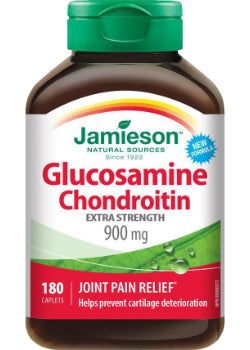
HIGH POTENCY FORMULA! Glucosamine Chondroitin from Jamieson offers 900mg of a high potency formula to help maintain healthy joints and cartilage, and relieve joint pain and stiffness that may be associated with osteoarthritis. This easy-to-swallow Glucosamine Chondroitin caplet supports vital joint and bone health and pain-free movement of hands, wrists, hips, ankles, knees, neck and back. Use for a minimum of 1 month to see effective and beneficial results. [CAPLET]
Each caplet contains:
Glucosamine sulfate(Glucosamine sulfate KCl derived from Shrimp and Crab exoskeleton) 500 mg
Chondroitin Sulfate (Bovine Cartilage) 400 mg
Non-Medicinal Ingredients:Cellulose, water-soluble cellulose, hydroxypropyl cellulose, modified cellulose gum, vegetable stearic acid, silica, titanium dioxide.
Important Information:
Consult a health care practitioner if symptoms worsen, or prior to use if you are pregnant or breast-feeding. NO salt (NaCl), sugar, starch, gluten, lactose, artificial flavours or preservatives.
Dosage
Adults: Take 1 caplet 3 times daily with a meal.
Jamieson Supplements for Whole-Family Health & Wellness
Jamieson has consistently been voted Canada’s most trusted brand of vitamins.
Jamieson vitamins and supplements
most popular natural health products include Jamieson probiotic, multivitamin, Jamieson vitamin C, Omega 3 and D3, plus many more! They provide consumers with the purest, safest and most effective natural health solutions available.
Shop Jamieson right here
at ca
GLUCOSAMINE
Glucosamine is a precursor molecule for the formation of cartilage...
Glucosamine is an amino sugar, which is a precursor in the synthesis of glycosaminoglycans (GAG). It is found in large concentrations in the shells of shellfish, and in the cell walls of some fungi. GAGs are also an essential component of joint cartilage, so supplementation with glucosamine may help provide the building blocks for cartilage formation.
As we age our ability to make glucosamine decreases and loss of glucosamine decreases the integrity of cartilage in joints, that results in less support, cushioning and more friction, like wear-and-tear injury. Glucosamine also has anti-inflammatory properties, which help the joint to repair itself after injury. Studies show that glucosamine supplementation improves joint function and decreases pain in individuals suffering from osteoarthritis. Natural health practitioners may also recommend glucosamine for: joint injury, osteoarthritis, inflammation, bursitis, tendonitis and skin problems.
Early Research
Decades ago, researchers found that glucosamine and chondroitin are both building blocks for the molecules that make up tendons, ligaments, bones, and synovial fluid. In the 1970’s, co-supplementation was found to reduce pain in osteoarthritis sufferers. Researchers also found that the formerly degenerating joint cartilage had actually begun to repair itself. From then on, glucosamine was frequently recommended to help protect
joint health, especially in combination with Chondroitin. These two molecules supply proteoglycans, which are an essential component of joint cartilage.
Glucosamine Declines with Age
Research continued and found that with age, the ability to regenerate and restore joint structure begins to fail, often due to a decrease in the body’s natural production of glucosamine sulfate and other structural molecules in the body. This deficiency causes slowing in the production of new joint and connective tissue and in the repair of old tissue. When the body’s repairs cannot keep up with injury occurring in the joint, it begins to degrade, which results in pain and stiffness. Research has repeatedly found that co-supplementing glucosamine and chondroitin can help to reduce pain in those suffering from arthritis. It can also decrease the destruction of cartilage that occurs when arthritis sufferers use non-steroidal anti-inflammatory drugs.
Questioning the Results
As the decades passed, further research was performed that brought the benefit of glucosamine and chondroitin supplementation into question. Finally, the GAIT study published in 2008 found that this combination was most effective for moderate to severe arthritis pain in the knee, and gave 79% of sufferers a 20% or greater reduction in pain. Unfortunately, glucosamine and chondroitin have been found to have much less effect in those with only slight pain. It is important to note that supplementation of chondroitin and glucosamine was also found to take several weeks of ongoing supplementation for benefits to occur. This helped to clarify the reason for the previous conflicted results in shorter research studies.
Deficiency
A deficiency of GAGs in the body can lead to joint deterioration because of insufficient cartilage synthesis. Break down of joint structure results in pain, and stiffness, especially after periods of rest, which is a condition known as Osteoarthritis. It can also cause creaking and cracking joints. It is likely that those with particularly low levels of GAGs will benefit from glucosamine supplementation. If this is not the underlying cause of the symptoms of the degeneration, then supplementation may not resolve the symptoms.
Co-Supplementation
When it is found in joint support formulas, glucosamine is often combined with other supplements that promote joint healing. Two common examples are chondroitin and
MSM.
Collagen
is also commonly supplemented in conjunction with any of these. This is primarily due to the fact that research has often combined these supplements together to examine their treatment of joint deterioration, rather than examining each one individually.
How can I take glucosamine?
There are a few different forms of glucosamine available such as: glucosamine sulfate, glucosamine hydrochloride, and N-acetyl-glucosamine. You can find any of these in powdered form alone in capsules, or in combination supplements for joint health. The recommended dose supported by research is 500mg taken three times daily. Generally, glucosamine should be taken with meals, as this will increase the amount of stomach acid and
enzymes
present to allow for proper absorption. Glucosamine may cause stomach upset in some very sensitive individuals, but this is quite rare. Some glucosamine is sourced from shellfish and individuals with shellfish allergies should use caution when choosing a glucosamine supplement, otherwise for the general population the shellfish source is an excellent type to use. Supplementation may need to continue for over a month (even 2-3 months in some cases) before full benefits are seen.
Glucosamine– QUICK FACTS
SOURCES
· Shellfish.
APPLICATIONS
· Osteoarthritis,
rheumatoid arthritis, inflammation, joint injury.
OPTIMUM DOSAGE
· 1500-2000 mg daily. (Clinical doses may be higher as recommended by your practitioner).
WORKS WELL WITH
·
Chondroitin sulfate, MSM,
Collagen
type II,
bromelain.
IMPORTANT INFORMATION
· Usually combined with chondroitin sulfate.
· Glucosamine has no toxicity associated with it although can theoretically alter blood sugar levels.
· Glucosamine may cause stomach upset.
· Some glucosamine is sourced from shellfish and individuals with shellfish allergies should use caution when choosing a glucosamine supplement.
Carefully SelectedShips to the U.S.Wellness EssentialsTrusted Brands
Product Details
GLUCOSAMINE
Glucosamine is a precursor molecule for the formation of cartilage...
Glucosamine is an amino sugar, which is a precursor in the synthesis of glycosaminoglycans (GAG). It is found in large concentrations in the shells of shellfish, and in the cell walls of some fungi. GAGs are also an essential component of joint cartilage, so supplementation with glucosamine may help provide the building blocks for cartilage formation.
As we age our ability to make glucosamine decreases and loss of glucosamine decreases the integrity of cartilage in joints, that results in less support, cushioning and more friction, like wear-and-tear injury. Glucosamine also has anti-inflammatory properties, which help the joint to repair itself after injury. Studies show that glucosamine supplementation improves joint function and decreases pain in individuals suffering from osteoarthritis. Natural health practitioners may also recommend glucosamine for: joint injury, osteoarthritis, inflammation, bursitis, tendonitis and skin problems.
Early Research
Decades ago, researchers found that glucosamine and chondroitin are both building blocks for the molecules that make up tendons, ligaments, bones, and synovial fluid. In the 1970’s, co-supplementation was found to reduce pain in osteoarthritis sufferers. Researchers also found that the formerly degenerating joint cartilage had actually begun to repair itself. From then on, glucosamine was frequently recommended to help protect
joint health, especially in combination with Chondroitin. These two molecules supply proteoglycans, which are an essential component of joint cartilage.
Glucosamine Declines with Age
Research continued and found that with age, the ability to regenerate and restore joint structure begins to fail, often due to a decrease in the body’s natural production of glucosamine sulfate and other structural molecules in the body. This deficiency causes slowing in the production of new joint and connective tissue and in the repair of old tissue. When the body’s repairs cannot keep up with injury occurring in the joint, it begins to degrade, which results in pain and stiffness. Research has repeatedly found that co-supplementing glucosamine and chondroitin can help to reduce pain in those suffering from arthritis. It can also decrease the destruction of cartilage that occurs when arthritis sufferers use non-steroidal anti-inflammatory drugs.
Questioning the Results
As the decades passed, further research was performed that brought the benefit of glucosamine and chondroitin supplementation into question. Finally, the GAIT study published in 2008 found that this combination was most effective for moderate to severe arthritis pain in the knee, and gave 79% of sufferers a 20% or greater reduction in pain. Unfortunately, glucosamine and chondroitin have been found to have much less effect in those with only slight pain. It is important to note that supplementation of chondroitin and glucosamine was also found to take several weeks of ongoing supplementation for benefits to occur. This helped to clarify the reason for the previous conflicted results in shorter research studies.
Deficiency
A deficiency of GAGs in the body can lead to joint deterioration because of insufficient cartilage synthesis. Break down of joint structure results in pain, and stiffness, especially after periods of rest, which is a condition known as Osteoarthritis. It can also cause creaking and cracking joints. It is likely that those with particularly low levels of GAGs will benefit from glucosamine supplementation. If this is not the underlying cause of the symptoms of the degeneration, then supplementation may not resolve the symptoms.
Co-Supplementation
When it is found in joint support formulas, glucosamine is often combined with other supplements that promote joint healing. Two common examples are chondroitin and
MSM.
Collagen
is also commonly supplemented in conjunction with any of these. This is primarily due to the fact that research has often combined these supplements together to examine their treatment of joint deterioration, rather than examining each one individually.
How can I take glucosamine?
There are a few different forms of glucosamine available such as: glucosamine sulfate, glucosamine hydrochloride, and N-acetyl-glucosamine. You can find any of these in powdered form alone in capsules, or in combination supplements for joint health. The recommended dose supported by research is 500mg taken three times daily. Generally, glucosamine should be taken with meals, as this will increase the amount of stomach acid and
enzymes
present to allow for proper absorption. Glucosamine may cause stomach upset in some very sensitive individuals, but this is quite rare. Some glucosamine is sourced from shellfish and individuals with shellfish allergies should use caution when choosing a glucosamine supplement, otherwise for the general population the shellfish source is an excellent type to use. Supplementation may need to continue for over a month (even 2-3 months in some cases) before full benefits are seen.
Glucosamine– QUICK FACTS
SOURCES
· Shellfish.
APPLICATIONS
· Osteoarthritis,
rheumatoid arthritis, inflammation, joint injury.
OPTIMUM DOSAGE
· 1500-2000 mg daily. (Clinical doses may be higher as recommended by your practitioner).
WORKS WELL WITH
·
Chondroitin sulfate, MSM,
Collagen
type II,
bromelain.
IMPORTANT INFORMATION
· Usually combined with chondroitin sulfate.
· Glucosamine has no toxicity associated with it although can theoretically alter blood sugar levels.
· Glucosamine may cause stomach upset.
· Some glucosamine is sourced from shellfish and individuals with shellfish allergies should use caution when choosing a glucosamine supplement.
🌿
Daily Wellness
Easy to add to your everyday health routine.
✅
Carefully Selected
Chosen with quality and customer needs in mind.
💊
Simple to Use
Designed for convenient daily supplementation.
🚚
Ships to the U.S.
Fast, reliable shipping to U.S. customers.
Choosing a selection results in a full page refresh.