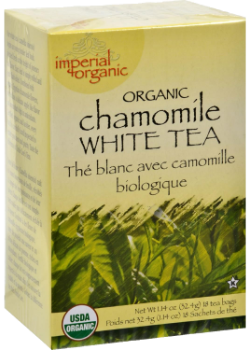
Uncle Lee's Tea White tea begins as young tender leaf buds, plucked fresh at the height of potency and flavor. Each leaf is simply rolled and gently flash-dried. Combined with organic Egyptian chamomile flowers, Imperial Organic Chamomile White Tea has a delicate apple like flavor and aroma that's high in antioxidants. Certified organic and kosher, every batch is carefully hand inspected to ensure goodness and purity. [TEA BAGS]
Each tea bag contains:
100% Organic Egyptian Chamomile Flower, 100% Organic White Tea Leaves
Important Information:
Packaged in air-tight tea bags for guaranteed highest quality of freshness that you come to expect from Uncle Lee's. Tea bags are oxygen-bleached without the use of any type of chemicals
Dosage
Just before water comes to a full boil, pour over the tea bag and brew for 3 to 5 minutes, or to desired strength. Add desired sweetener to taste.
Uncle Lee’s Tea, makers of popular: Legends of China Green Tea, Legends of China Jasmine Green Tea, Organic Green Tea and Organic White tea are top selling food supplements. Uncle Lee’s teas are sourced from the Fu-Jian province of China and are available in organic and non organic varieties.
WHAT IS WHITE TEA?
Before we delve into what white tea is, it’s important to understand that all tea – whether black, green, yellow, oolong, or white – comes from the same plant, Camellia sinensis, an evergreen shrub in the flowering plant family, Theaceae, which is indigenous to both China and India. And while a dizzying array of cultivars and hybrids have evolved from the Camellia sinensis plant over the years, it is how the tea plant’s leaves are processed that will determine the type of tea. Indeed, how tea is processed determines the level of oxidation, an important chemical reaction that is in large part responsible for the final flavour of the tea, including its appearance and colour. As a frame of reference, black tea is the most oxidized and
green tea, the least.
White tea, on the other hand, is one of the most delicate tea varieties because it is so minimally processed, and gets its name from the white fuzz on the young leaves that helps protect the tea plant's new growth from insects. White tea is harvested before the Camellia sinensis leaves fully open, the buds and unfurled leaves of the plant are handpicked and quickly dried using natural sunlight, heat vents, or drying chambers to prevent oxidization, which imparts white tea with its mellow and delicate flavour. This process also helps retain a high antioxidant content. Despite its name; however, once brewed, white tea is closer to pale yellow or gold, rather than white.
White Tea - Taste, Texture, Aroma
White tea is low in
caffeine
and has a floral fragrance and when brewed properly, it has a decidedly floral flavour that may best be described as delicate, fresh, and fruity, with a hint of cucumber or melon. Certain varieties of white tea offer a more full-bodied flavour profile and may give off nutty, woody, or earthy tones, with sweet honey undertones.
Preparing A Perfect Cup Of White Tea
To make the perfect cup of white tea, add a teaspoon of compact buds (or a tablespoon of lightweight leaves) per eight-ounce cup of clean, pure filtered water that’s been heated to between 175 to 190 F (never boiling). Steep white tea for one to five minutes, depending on your flavour preference. This is largely dependent on the variety of white tea you’re using, so may take a little trial and error. Some varieties will become astringent and bitter if left to steep for too long, or brewed with water that's too hot. White tea is usually served freshly brewed and hot, and because of its subtle flavour, sweeteners and milk are not typically added.
Active Compounds In White Tea
Caffeine – Most traditional white teas are low in caffeine (containing roughly 3.35-5.74 %) and also lower in acidity. Because of this low caffeine content, white tea is also much less bitter than other types.
Catechins / EGCG
– Catechins are the primary compounds responsible for the white and green tea’s antioxidant and anti-inflammatory properties. Epigallocatechin gallate (EGCG) is the major antioxidant tea catechin, is found in higher concentrations in white tea than in green tea, and can help protect the body’s cells from free radicals.
L-
Theanine
– White tea has the highest concentration of L-
Theanine, an amino acid that boosts levels of key neurotransmitters in the brain,
GABA,
serotonin, and dopamine. These work to support healthy mood, concentration, alertness, sleep, and energy. Theanine also contributes to the full-bodied floral taste of white tea.
Tannins
– While there are far fewer tannins in white tea than in other tea varieties, their presence does nonetheless contribute to white tea’s antioxidant and anti-inflammatory effects and promote
heart health
and healthy blood sugar.
Theaflavins
– These are polyphenols that directly contribute to slight the bitterness and astringency of white tea. Though they are in significantly high concentrations in white tea than in black tea, they are largely responsible for white tea’s sweetness.
Carefully SelectedShips to the U.S.Wellness EssentialsTrusted Brands
Product Details
WHAT IS WHITE TEA?
Before we delve into what white tea is, it’s important to understand that all tea – whether black, green, yellow, oolong, or white – comes from the same plant, Camellia sinensis, an evergreen shrub in the flowering plant family, Theaceae, which is indigenous to both China and India. And while a dizzying array of cultivars and hybrids have evolved from the Camellia sinensis plant over the years, it is how the tea plant’s leaves are processed that will determine the type of tea. Indeed, how tea is processed determines the level of oxidation, an important chemical reaction that is in large part responsible for the final flavour of the tea, including its appearance and colour. As a frame of reference, black tea is the most oxidized and
green tea, the least.
White tea, on the other hand, is one of the most delicate tea varieties because it is so minimally processed, and gets its name from the white fuzz on the young leaves that helps protect the tea plant's new growth from insects. White tea is harvested before the Camellia sinensis leaves fully open, the buds and unfurled leaves of the plant are handpicked and quickly dried using natural sunlight, heat vents, or drying chambers to prevent oxidization, which imparts white tea with its mellow and delicate flavour. This process also helps retain a high antioxidant content. Despite its name; however, once brewed, white tea is closer to pale yellow or gold, rather than white.
White Tea - Taste, Texture, Aroma
White tea is low in
caffeine
and has a floral fragrance and when brewed properly, it has a decidedly floral flavour that may best be described as delicate, fresh, and fruity, with a hint of cucumber or melon. Certain varieties of white tea offer a more full-bodied flavour profile and may give off nutty, woody, or earthy tones, with sweet honey undertones.
Preparing A Perfect Cup Of White Tea
To make the perfect cup of white tea, add a teaspoon of compact buds (or a tablespoon of lightweight leaves) per eight-ounce cup of clean, pure filtered water that’s been heated to between 175 to 190 F (never boiling). Steep white tea for one to five minutes, depending on your flavour preference. This is largely dependent on the variety of white tea you’re using, so may take a little trial and error. Some varieties will become astringent and bitter if left to steep for too long, or brewed with water that's too hot. White tea is usually served freshly brewed and hot, and because of its subtle flavour, sweeteners and milk are not typically added.
Active Compounds In White Tea
Caffeine – Most traditional white teas are low in caffeine (containing roughly 3.35-5.74 %) and also lower in acidity. Because of this low caffeine content, white tea is also much less bitter than other types.
Catechins / EGCG
– Catechins are the primary compounds responsible for the white and green tea’s antioxidant and anti-inflammatory properties. Epigallocatechin gallate (EGCG) is the major antioxidant tea catechin, is found in higher concentrations in white tea than in green tea, and can help protect the body’s cells from free radicals.
L-
Theanine
– White tea has the highest concentration of L-
Theanine, an amino acid that boosts levels of key neurotransmitters in the brain,
GABA,
serotonin, and dopamine. These work to support healthy mood, concentration, alertness, sleep, and energy. Theanine also contributes to the full-bodied floral taste of white tea.
Tannins
– While there are far fewer tannins in white tea than in other tea varieties, their presence does nonetheless contribute to white tea’s antioxidant and anti-inflammatory effects and promote
heart health
and healthy blood sugar.
Theaflavins
– These are polyphenols that directly contribute to slight the bitterness and astringency of white tea. Though they are in significantly high concentrations in white tea than in black tea, they are largely responsible for white tea’s sweetness.
🌿
Daily Wellness
Easy to add to your everyday health routine.
✅
Carefully Selected
Chosen with quality and customer needs in mind.
💊
Simple to Use
Designed for convenient daily supplementation.
🚚
Ships to the U.S.
Fast, reliable shipping to U.S. customers.
Choosing a selection results in a full page refresh.