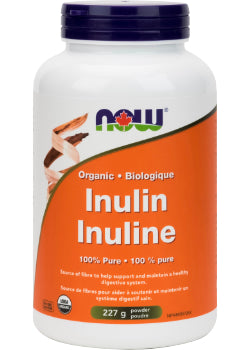
NOW INULIN CERTIFIED ORGANIC, 100% PURE POWDER FROM NOW FOODSNOW Organic Inulin is a fructooligosaccharide that acts as a prebiotic, stimulating the growth of friendly and healthy intestinal bacteria, which supports good colon health. Since it also has a very low glycemic index, it is suitable for many people who are on restricted diets. Add Now Inulin to your favorite beverage or food. Its taste is comparable to sugar and can be used as a sugar replacement. [POWDER]
Each tsp contains:
Organic Inulin (from Blue Agave plant (Agave tequila)) 2.8g
Important Information:
Contains no:
salt, starch, yeast, wheat, corn, soy, milk, egg, shellfish or preservatives. Hypersensitivity has been known to occur. May cause mild gastro-intestinal discomfort such as gas, bloating, cramps.
Vegetarian/Vegan Product.
Dosage
As a dietary supplement, take 1 level teaspoon 1 to 2 times daily. Mix into your favorite beverage or food.
Since 1968 NOW has been a leader in the natural products industry. NOW Foods is an award-winning and highly respected manufacturer of vitamins, minerals, dietary supplements and natural foods. Now Foods brings you over 1600 Natural Foods, Supplements, Sports Nutrition and Personal Care Products. NOW supplements are high quality products at affordable prices.
Prebiotics
Prebiotics are defined based on 3 criteria; 1) The (food)source must be non-digestable and resistant to gastric acidity, hydrolysis by intestinal digestive
enzymes, and gastrointestinal absorption. 2) It must be fermentable 3) should, in a selective way, stimulate growth and/or metabolic activity of intestinal bacteria, which it does at the expense of pathogenic bacteria.
Two specific fructooligosaccharides (FOS), inulin and oligofructose, are considered by Marcel Roberfroid, the man who both discovered and named prebiotics in 1995, to be the only sources to fully meet his definition of prebiotics.
Although a food cannot be considered a prebiotic, certain foods can be a rich source of prebiotic or have higher prebiotic potential. Foods with a high inulin content, for example include Jerusalem
artichoke, onion, garlic, and chicory root. These foods are said to selectively increase the production of both the lactic acid producing bacteria (Lactobacillus species) and the bifidobacterium species of 'beneficial' bacteria. FOS is a form of fibre, meaning it also has the added benefit of being able to regulate blood sugar, applicable not only to individuals with
diabetes
or prediabetic, but helpful for those looking to control cravings and weight gain. Fibre has also been shown to help to lower cholesterol.
A synbiotic diet is one that is high in both prebiotic and probiotic foods/supplements. Pre and
probiotics
when taken together enhance each others' effects. This is why many companies are now including prebiotic fibre/FOS/inulin in with the live cells of a probiotic. Prebiotics can be taken this way, in capsule form, or in powder. Some companies are now combining these rich prebiotic substances with
protein, multi mineral combinations and
greens
to increased overall health.
Intestinal Health
The intestine is the main absorptive area of the digestive tract. It is essentially a tube with a thin mucosal lining and lots of blood vessels on the inside and muscles around the outside. It has its own immune tissue called GALT, or gut associated lymphoid tissue. The inner lining is filled with little fingers, or projection of the mucosa, which greatly increases its absorptive surface.
Lying on the membrane are many friendly organisms, which help our body with the digestive process. The small intestine attaches to the stomach. Near it's beginning, ducts from the liver and
pancreas
release digestive juices. These juices mix with the partially digested food from the stomach and continue the digestive process. Nutrients are absorbed through the thin intestinal wall and transported via the bloodstream, to where they are needed. The liver also excretes processed toxins and fats through the bile. These substances must be carried through the intestine without being absorbed.
The remainder of the food is pushed through into the large intestine. The main function of the large intestine is the preparation of stool for excretion. In order to do this the digested food must be dehydrated and compacted. The last bit of nutrients may also be absorbed here.
Some of the most important players in intestinal health are not part of our own body. Friendly intestinal bacteria, often called
probiotics, are an essential part of digestion. They break down food particles, manufacture vitamins and prevent the infection of the tract with other microbes. Each bowel movement actually contains millions of these friendly bacteria; they are in a constant state of renewal. Many concerns like
indigestion, gas, bloating and
constipation
can be due to an imbalance of the intestinal bacteria. It is easy to upset this balance by improper diet or taking medications like antibiotics.
Carefully SelectedShips to the U.S.Wellness EssentialsTrusted Brands
Product Details
Prebiotics
Prebiotics are defined based on 3 criteria; 1) The (food)source must be non-digestable and resistant to gastric acidity, hydrolysis by intestinal digestive
enzymes, and gastrointestinal absorption. 2) It must be fermentable 3) should, in a selective way, stimulate growth and/or metabolic activity of intestinal bacteria, which it does at the expense of pathogenic bacteria.
Two specific fructooligosaccharides (FOS), inulin and oligofructose, are considered by Marcel Roberfroid, the man who both discovered and named prebiotics in 1995, to be the only sources to fully meet his definition of prebiotics.
Although a food cannot be considered a prebiotic, certain foods can be a rich source of prebiotic or have higher prebiotic potential. Foods with a high inulin content, for example include Jerusalem
artichoke, onion, garlic, and chicory root. These foods are said to selectively increase the production of both the lactic acid producing bacteria (Lactobacillus species) and the bifidobacterium species of 'beneficial' bacteria. FOS is a form of fibre, meaning it also has the added benefit of being able to regulate blood sugar, applicable not only to individuals with
diabetes
or prediabetic, but helpful for those looking to control cravings and weight gain. Fibre has also been shown to help to lower cholesterol.
A synbiotic diet is one that is high in both prebiotic and probiotic foods/supplements. Pre and
probiotics
when taken together enhance each others' effects. This is why many companies are now including prebiotic fibre/FOS/inulin in with the live cells of a probiotic. Prebiotics can be taken this way, in capsule form, or in powder. Some companies are now combining these rich prebiotic substances with
protein, multi mineral combinations and
greens
to increased overall health.
Intestinal Health
The intestine is the main absorptive area of the digestive tract. It is essentially a tube with a thin mucosal lining and lots of blood vessels on the inside and muscles around the outside. It has its own immune tissue called GALT, or gut associated lymphoid tissue. The inner lining is filled with little fingers, or projection of the mucosa, which greatly increases its absorptive surface.
Lying on the membrane are many friendly organisms, which help our body with the digestive process. The small intestine attaches to the stomach. Near it's beginning, ducts from the liver and
pancreas
release digestive juices. These juices mix with the partially digested food from the stomach and continue the digestive process. Nutrients are absorbed through the thin intestinal wall and transported via the bloodstream, to where they are needed. The liver also excretes processed toxins and fats through the bile. These substances must be carried through the intestine without being absorbed.
The remainder of the food is pushed through into the large intestine. The main function of the large intestine is the preparation of stool for excretion. In order to do this the digested food must be dehydrated and compacted. The last bit of nutrients may also be absorbed here.
Some of the most important players in intestinal health are not part of our own body. Friendly intestinal bacteria, often called
probiotics, are an essential part of digestion. They break down food particles, manufacture vitamins and prevent the infection of the tract with other microbes. Each bowel movement actually contains millions of these friendly bacteria; they are in a constant state of renewal. Many concerns like
indigestion, gas, bloating and
constipation
can be due to an imbalance of the intestinal bacteria. It is easy to upset this balance by improper diet or taking medications like antibiotics.
🌿
Daily Wellness
Easy to add to your everyday health routine.
✅
Carefully Selected
Chosen with quality and customer needs in mind.
💊
Simple to Use
Designed for convenient daily supplementation.
🚚
Ships to the U.S.
Fast, reliable shipping to U.S. customers.
Choosing a selection results in a full page refresh.