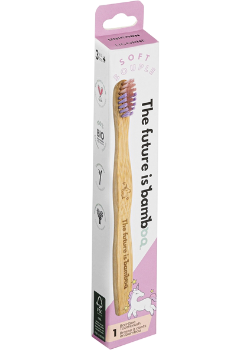
Switch to an Eco-Friendly Bamboo Toothbrush and make a positive impact on the environment while keeping your teeth clean and healthy. This Kids Unicorn Soft Toothbrush from The Future is Bamboo is made with ultra-soft, BPA-free bristles ensure a gentle yet effective clean, suitable for all types of teeth and gums. Embrace a waste-minimizing lifestyle with The Future is Bamboo’s biodegradable toothbrush, designed to decompose naturally without polluting our planet. Experience the perfect fusion of sustainability and oral hygiene with our Eco-Friendly Bamboo Toothbrush today. [TOOTHBRUSH]
Contains:
Ultra-soft, BPA-free bristles, Biodegradable and renewable bamboo handle
Important Information:
Air dry your toothbrush. Use an open toothbrush holder, which does not retain water. Dry your toothbrush before putting it in a travel case or other.
Dosage
Brush teeth thoroughly for at least 2 minutes twice a day, preferably after each meal, or as directed by a dentist.
Rooted In Nature. Built For The Future. At
Going eco has never been easier. Discover home essentials eliminating single-use plastic with the brand The Future is Bamboo. Why choose Bamboo? Simple! These products are biodegradable, highly renewable & durable. From biodegradable bamboo toothbrushes to now a full range of eco-friendly home essentials, like cotton swabs, floss picks, charcoal facial round wipes and candles. The Future is Bamboo are grateful to provide products that make your everyday life a lot kinder to our Planet.
FIND THE BEST TOOTHBRUSH FOR YOUR ORAL HEALTH NEEDS
Brushing your teeth is integral to a healthy lifestyle, hygiene and daily routine. Not only is it essential to maintaining good oral and
dental health, but it’s also critical to health maintenance in general. Indeed, while we rarely think about it, daily brushing keeps our teeth sparkly clean, helps us maintain fresh breath, and also minimizes the risk of
tooth decay
and gum disease, the last of which is associated with an increased risk of heart disease,
high blood pressure, and other conditions down the line. But which toothbrush is best? Read on to learn more.
Toothbrushes are essential for maintaining good oral hygiene and preventing dental problems like caries and gum disease. But it isn't enough to brush your teeth. You must also do it safely and effectively, which requires the right tools. A good-quality toothbrush, in fact, can not only help clean teeth of food particles and debris but also helps to remove plaque, a sticky film of bacteria that forms on teeth and gums. If plaque is not removed regularly, it can quickly harden into tartar, which can only be removed by a dentist or dental hygienist. Additionally, brushing can help to stimulate the gums and promote good blood circulation in the mouth.
So, how do you select a good toothbrush, and just as importantly, what constitutes a good toothbrush?
Choosing the Right Toothbrush: Options for Every Need
Individual preference prevails when it comes to the shape and size of your brush. Beyond this detail, however, toothbrush varieties abound, the most common of which are:
Manual toothbrushes
– the traditional brush that requires you to move the brush back and forth to clean your teeth.
Electric toothbrushes
– can produce thousands of strokes per minute to remove plaque from your teeth, far outpacing what you can do with a manual toothbrush. Dental studies, in fact, have shown that electric brushes clean gums and teeth much better than manual brushes, producing whiter teeth and healthier gums and helping to prevent tooth decay and gum disease.
Sonic toothbrushes
– use high-frequency vibrations to create a cleaning action that is said to be more effective at removing plaque and bacteria from your teeth and gums.
Interdental toothbrushes
– a small, narrow brush head designed to clean between teeth and hard-to-reach areas.
Orthodontic toothbrushes
– have a specially designed brush head to clean around braces and other orthodontic appliances.
Natural toothbrushes
– made from natural materials like bamboo and often come with biodegradable packaging. This is important because most conventional toothbrushes are made with plastic handles and nylon bristles, which have the potential to release estrogenic chemicals directly into our mouths. In fact, studies have shown that even brushes labelled as "BPA-free" can release estrogenic chemicals because they contain phthalates – chemical plasticizers that are known endocrine disruptors and potential carcinogens.
Natural & Eco-Friendly Toothbrushes are widely available online and in your favourite health food store in all sorts of shapes and sizes, with some even featuring charcoal to help whiten teeth naturally, according to your personal preference and dental health needs.
Oral Care Essentials: Maximizing Your Toothbrushing Routine
The Canadian Dental Association (CDA) recommends brushing your teeth for 2-3 minutes twice daily to help remove food and plaque and keep the mouth free of bacteria that lead to cavities and gum disease.
Additional tips from the CDA include:
- Using a manual or electric toothbrush to brush all areas of the teeth, including the inside, outside and chewing surfaces
- Not rinsing with water immediately after brushing. Spitting out any excess toothpaste instead.
- Waiting 30 minutes after eating before brushing to avoid damaging enamel.
- Replacing your toothbrush every 3 months.
- Flossing at least once daily.
- Tongue cleaning when needed.
- Flushing mouth with an oral rinse/mouthwash without alcohol.
Carefully SelectedShips to the U.S.Wellness EssentialsTrusted Brands
Product Details
FIND THE BEST TOOTHBRUSH FOR YOUR ORAL HEALTH NEEDS
Brushing your teeth is integral to a healthy lifestyle, hygiene and daily routine. Not only is it essential to maintaining good oral and
dental health, but it’s also critical to health maintenance in general. Indeed, while we rarely think about it, daily brushing keeps our teeth sparkly clean, helps us maintain fresh breath, and also minimizes the risk of
tooth decay
and gum disease, the last of which is associated with an increased risk of heart disease,
high blood pressure, and other conditions down the line. But which toothbrush is best? Read on to learn more.
Toothbrushes are essential for maintaining good oral hygiene and preventing dental problems like caries and gum disease. But it isn't enough to brush your teeth. You must also do it safely and effectively, which requires the right tools. A good-quality toothbrush, in fact, can not only help clean teeth of food particles and debris but also helps to remove plaque, a sticky film of bacteria that forms on teeth and gums. If plaque is not removed regularly, it can quickly harden into tartar, which can only be removed by a dentist or dental hygienist. Additionally, brushing can help to stimulate the gums and promote good blood circulation in the mouth.
So, how do you select a good toothbrush, and just as importantly, what constitutes a good toothbrush?
Choosing the Right Toothbrush: Options for Every Need
Individual preference prevails when it comes to the shape and size of your brush. Beyond this detail, however, toothbrush varieties abound, the most common of which are:
Manual toothbrushes
– the traditional brush that requires you to move the brush back and forth to clean your teeth.
Electric toothbrushes
– can produce thousands of strokes per minute to remove plaque from your teeth, far outpacing what you can do with a manual toothbrush. Dental studies, in fact, have shown that electric brushes clean gums and teeth much better than manual brushes, producing whiter teeth and healthier gums and helping to prevent tooth decay and gum disease.
Sonic toothbrushes
– use high-frequency vibrations to create a cleaning action that is said to be more effective at removing plaque and bacteria from your teeth and gums.
Interdental toothbrushes
– a small, narrow brush head designed to clean between teeth and hard-to-reach areas.
Orthodontic toothbrushes
– have a specially designed brush head to clean around braces and other orthodontic appliances.
Natural toothbrushes
– made from natural materials like bamboo and often come with biodegradable packaging. This is important because most conventional toothbrushes are made with plastic handles and nylon bristles, which have the potential to release estrogenic chemicals directly into our mouths. In fact, studies have shown that even brushes labelled as "BPA-free" can release estrogenic chemicals because they contain phthalates – chemical plasticizers that are known endocrine disruptors and potential carcinogens.
Natural & Eco-Friendly Toothbrushes are widely available online and in your favourite health food store in all sorts of shapes and sizes, with some even featuring charcoal to help whiten teeth naturally, according to your personal preference and dental health needs.
Oral Care Essentials: Maximizing Your Toothbrushing Routine
The Canadian Dental Association (CDA) recommends brushing your teeth for 2-3 minutes twice daily to help remove food and plaque and keep the mouth free of bacteria that lead to cavities and gum disease.
Additional tips from the CDA include:
- Using a manual or electric toothbrush to brush all areas of the teeth, including the inside, outside and chewing surfaces
- Not rinsing with water immediately after brushing. Spitting out any excess toothpaste instead.
- Waiting 30 minutes after eating before brushing to avoid damaging enamel.
- Replacing your toothbrush every 3 months.
- Flossing at least once daily.
- Tongue cleaning when needed.
- Flushing mouth with an oral rinse/mouthwash without alcohol.
🌿
Daily Wellness
Easy to add to your everyday health routine.
✅
Carefully Selected
Chosen with quality and customer needs in mind.
💊
Simple to Use
Designed for convenient daily supplementation.
🚚
Ships to the U.S.
Fast, reliable shipping to U.S. customers.
Choosing a selection results in a full page refresh.