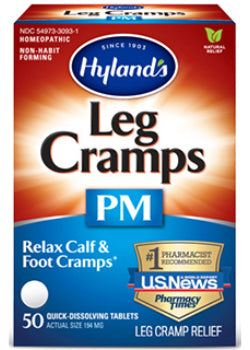
Leg Cramp PM from Hydland's is a unique homeopathic formula created to help ease leg cramps throughout the night as well as a sleep formula to help you to fall back to sleep. Leg cramps can be particularly annoying, and conventional muscle relaxants can be habit forming. Hyland's natural Leg Cramp PM homeopathic formula an ideal remedy when leg muscles get knotted and cramped. Safe and effective wioth no aspirin, acetaminophen, ibuprofen, naproxen or diphenhydramine. [TABLET]
Contains:
Calcarea Carbonica 12X HPUS
Causticum 12X HPUS
Chamomilla 6X HPUS
Cinchona Officinalis 3X HPUS
Cuprum Metallicum 12X HPUS
Lycopodium 12X HPUS
Magnesia Phosphorica 6X HPUS
Rhus Toxicodendron 6X HPUS
Silicea 12X HPUS
Sulphur 6X HPUS
“HPUS” indicates the active ingredients are in the official Homeopathic Pharmacopoeia of the United States.
Inactive Ingredient:
Acacia Gum, Lactose NF
Important Information:
As with any drug, ask a doctor before use if pregnant or nursing. Consult a physician if: ▪ Symptoms persist for more than 7 days or worsen ▪ Sensitive to quinine. Keep this and all medications out of the reach of children. In case of accidental overdose, contact a medical professional or a poison control center immediately. Do not use if imprinted tamper band is broken or missing.
Dosage
Adults and Children 12 years and older: Dissolve 2-3 tablets under tongue before bed to fall asleep, stay asleep and relieve leg cramps. If the initial dosage is not providing relief, dissolve 2-3 tablets under tongue every 15 minutes, for up to 6 doses.
Hylands Homeopathy has been trusted for generations to provide gentle and safe homeopathic medicines for all members of the family. Hyland’s stands as a leader in innovations that answer to the changing health needs of our modern world.
Muscles & Joints
Muscles and joints can become injured whenever the body is in motion. It often occurs when doing strenuous or repetitive activities, like sports or working on an assembly line. Sprains refer to damage to a tendon or ligament. Tendons hold bone and muscle together. Ligaments hold bones together. Sprains cause sharp pain and rapid swelling of the area. Strains refer to overworking a muscle. It causes muscle cramps, localized pain during movement, swelling and loss of mobility. Another joint injury is bursitis, a swelling of the fluid-filled sac inside the joint. It usually causes localized pain on movement of the joint and swelling.
Conventional treatment of muscle and joint injury involves the use of anti-inflammatories and pain relievers. They take away the acute symptoms but do not help to heal the injured tissue. The use of such medications may make an individual return to activity too quickly, predisposing the area to re-injury.
First aid for muscle and joint injuries is easily remembered by the acronym RICE, Rest, Ice, Compression and Elevation. Immediately after the injury raise the area above the heart and apply ice for up to 20 minutes. Apply ice every 4 hours for 2 days. Only use heat after the initial swelling has subsided. Use a splint or sling to immobilize the area. Go to the hospital if there is significant swelling or if joint activity is compromised.
Restless Leg Syndrome
When your legs just won't let you get to sleep...
Restless Leg Syndrome (RLS) is described by those who suffer from it as an odd sensation (or pain) that usually travels through the leg. This sensation produces a need to move the affected limb in order to temporarily stop the sensation. It is often described as a creeping, itching, crawling, tingling or electrical sensation. This condition is more often experienced at night and although typically it is felt in the legs, some individuals can experience it in their arms or torso. RLS can cause a decreased quality of sleep and even
insomnia.
The National Institute of Health has defined RLS by the following criteria:
1) an urge to move the limbs with or without sensations
2) improvement with activity
3) worsening at rest
4) worsening in the evening or at night
Types of RLS
There are two types of RLS. Primary RLS is considered idiopathic, meaning there is no known cause. It typically develops slowly and gets progressively worse as a person ages. Secondary RLS usually begins suddenly and the intensity does not seem to change over time.
What causes restless leg syndrome?
RLS can begin in childhood, and may be associated with what many call "growing pains" throughout childhood and adolescence. It most commonly begins around the age of 40-45 years old, and is generally worsened by stress. Unfortunately, the cause of this condition is not yet known. It has been found to be associated with chronic kidney disease,
diabetes, iron deficiency,
varicose veins, pregnancy,
Parkinson's disease, peripheral
neuropathy
and withdrawal from sedatives.
Because of these associations, some theories suggest iron, dopamine, or other nutritional deficiencies may play a role in the development of RLS. Interestingly, RLS is often passed down in families, and over 50% of sufferers report a family member with the same symptoms. The genetic link is especially present when symptoms begin at a younger age.
Carefully SelectedShips to the U.S.Wellness EssentialsTrusted Brands
Product Details
Muscles & Joints
Muscles and joints can become injured whenever the body is in motion. It often occurs when doing strenuous or repetitive activities, like sports or working on an assembly line. Sprains refer to damage to a tendon or ligament. Tendons hold bone and muscle together. Ligaments hold bones together. Sprains cause sharp pain and rapid swelling of the area. Strains refer to overworking a muscle. It causes muscle cramps, localized pain during movement, swelling and loss of mobility. Another joint injury is bursitis, a swelling of the fluid-filled sac inside the joint. It usually causes localized pain on movement of the joint and swelling.
Conventional treatment of muscle and joint injury involves the use of anti-inflammatories and pain relievers. They take away the acute symptoms but do not help to heal the injured tissue. The use of such medications may make an individual return to activity too quickly, predisposing the area to re-injury.
First aid for muscle and joint injuries is easily remembered by the acronym RICE, Rest, Ice, Compression and Elevation. Immediately after the injury raise the area above the heart and apply ice for up to 20 minutes. Apply ice every 4 hours for 2 days. Only use heat after the initial swelling has subsided. Use a splint or sling to immobilize the area. Go to the hospital if there is significant swelling or if joint activity is compromised.
Restless Leg Syndrome
When your legs just won't let you get to sleep...
Restless Leg Syndrome (RLS) is described by those who suffer from it as an odd sensation (or pain) that usually travels through the leg. This sensation produces a need to move the affected limb in order to temporarily stop the sensation. It is often described as a creeping, itching, crawling, tingling or electrical sensation. This condition is more often experienced at night and although typically it is felt in the legs, some individuals can experience it in their arms or torso. RLS can cause a decreased quality of sleep and even
insomnia.
The National Institute of Health has defined RLS by the following criteria:
1) an urge to move the limbs with or without sensations
2) improvement with activity
3) worsening at rest
4) worsening in the evening or at night
Types of RLS
There are two types of RLS. Primary RLS is considered idiopathic, meaning there is no known cause. It typically develops slowly and gets progressively worse as a person ages. Secondary RLS usually begins suddenly and the intensity does not seem to change over time.
What causes restless leg syndrome?
RLS can begin in childhood, and may be associated with what many call "growing pains" throughout childhood and adolescence. It most commonly begins around the age of 40-45 years old, and is generally worsened by stress. Unfortunately, the cause of this condition is not yet known. It has been found to be associated with chronic kidney disease,
diabetes, iron deficiency,
varicose veins, pregnancy,
Parkinson's disease, peripheral
neuropathy
and withdrawal from sedatives.
Because of these associations, some theories suggest iron, dopamine, or other nutritional deficiencies may play a role in the development of RLS. Interestingly, RLS is often passed down in families, and over 50% of sufferers report a family member with the same symptoms. The genetic link is especially present when symptoms begin at a younger age.
🌿
Daily Wellness
Easy to add to your everyday health routine.
✅
Carefully Selected
Chosen with quality and customer needs in mind.
💊
Simple to Use
Designed for convenient daily supplementation.
🚚
Ships to the U.S.
Fast, reliable shipping to U.S. customers.
Choosing a selection results in a full page refresh.