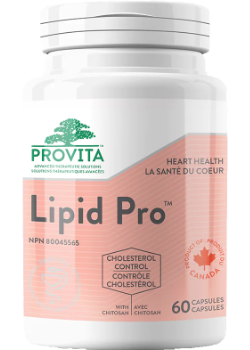
Maintain healthy blood sugar levels with Provita’s Lipid Pro, used in Herbal Medicine to help reduce elevated blood lipid levels/hyperlipidemia and as supportive therapy for the promotion of healthy glucose levels, plus helps lower blood total (and LDL) cholesterol. Triglycerides are fats (lipids) that circulate in the blood. Not to be confused with cholesterol. Any value above 150 milligrams per deciliter of triglycerides (mg/dl) is considered high and increases the risk of cardiovascular disease. Very high (over 500 mg / dl) can cause pancreatitis (inflammation of the pancreas). Often high cholesterol values are accompanied by high triglycerides (dyslipidemia). Provita’s Lipid Pro™ contains Chitosan, known for its triglyceride lowering effect. Triglyceride lipids store unused calories and provide your body with energy, and cholesterol lipids are used to build cells and certain hormones. Elevated values of either one of these lipids increase the cardiovascular risk. [CAPS]
Each capsule contains:
Chitosan 400 mg
Beta-glucan 250 mg
Fenugreek 10:1 Extract (Trigonella foenum-graecum) 250 mg
Non-medicinal Ingredients:
Vegetable stearate, gelatin.
Important Information:
Consult a health care practitioner if symptoms persist or worsen. Consult a health care practitioner prior to use if you are pregnant. Consult a health care practitioner prior to use if you are taking medication for diabetes. If you are taking blood thinners, consult a health care practitioner prior to use. if you are breastfeeding, consult a healthcare practitioner prior to use. May cause abdominal pain, bloating, constipation, indigestion and / or diarrhea. Sealed for your protection. Keep out of reach of children. Keep sealed, store in a cool, dry place.
Dosage
Adults take 2 capsules 2 times per day.
High-Potency Herbal Supplements by Provita
Provita offers targeted natural solutions for sleep, stress, and cognitive health with formulas like
Dream-On
for deep, restful sleep without melatonin,
GABA Pro
to support calm and relaxation,
Lion’s Mane 5000
for memory, focus, and brain function, and
PS-100+ With ALC
for cognitive support and mental clarity.
These advanced, non-habit-forming supplements are designed to support neurotransmitter balance, reduce mental fatigue, and promote overall brain health and wellness.
HIGH CHOLESTEROL
By: Articles by a Naturopathic Doctor and a Holistic Nutritionist
Controlling
high cholesterol
can be a challenge, but with the right nutritional supplements many people have success...
Despite the hype, cholesterol is actually not all bad; it is the amount and the ratio of the certain forms of cholesterol that are a health concern. Low-density lipoprotein (LDL cholesterol) is commonly called “bad” cholesterol, while high-density lipoprotein (HDL cholesterol) is commonly referred to as “good” cholesterol. Interestingly, it is not the type of cholesterol that is important, so much as the balance of “good” vs. “bad”.
Cholesterol is an essential molecule in our bodies. Our body cells use cholesterol to support their cell membranes and some of the membrane-associated receptor molecules. Cholesterol is also used to make steroid hormones in the body. Some examples of steroid hormones are reproductive hormones such as
estrogen,
progesterone,
testosterone, and the stress hormone cortisol. Because of this, it is essential to keep cholesterol in balance in the body.
Blood Cycle
Cholesterol cycles from the liver to the body cells, and back again, via the blood. LDL cholesterol consists of fats that are being transported from the liver for use by your cells. HDL cholesterol consists of fat that is taking unused (excess) cholesterol from your cells back to the liver, where it is excreted. Because of this, high levels of LDL are not a big concern, so long as there are sufficient levels of HDL to retrieve any excess cholesterol left behind in the body. Thus, cholesterol levels are unhealthy if you have excess circulating LDL, insufficient HDL, or a combination of the two. Cholesterol that is left in the rest of the body and not retrieved by sufficient HDL can build up inside the arteries and when combined with systemic inflammation, can cause cardiovascular disease. Thus, maintaining cholesterol balance, or a good cholesterol ratio on your blood work is actually more important than targeting LDL cholesterol directly. Supplementing
fish oil
is an excellent way to boost your HDL cholesterol. For more information, please see our Fish Oil article.
Cardiovascular Disease
High cholesterol contributes to cardiovascular disease, also known as heart disease, which is the number one cause of death in North Americans. High cholesterol causes a buildup of molecules inside of arteries that narrows the arteries and erases the elasticity and flexibility of the artery walls. The body responds to this narrowed space by increasing blood pressure to ensure adequate blood flow to all tissues. This is referred to as
high blood pressure. When pieces of the cholesterol plaque break off, they can cause a change in the blood flow which leads to clots; clots and cholesterol plaque can and do end up causing heart attacks and strokes. For more information, please see our Cardiovascular Health article.
Cholesterol Cycle
Interestingly, the liver not only synthesizes cholesterol, it is also responsible for excreting any excess. It does this by mixing it in with the bile, and releasing it into the digestive tract. This cholesterol in the gut gets mixed with any food and is bound by any soluble fibre present. For more information on its cholesterol-binding capability, please see our Fiber article. Once it is bound, the cholesterol is shed with the stool. Unfortunately, any unbound cholesterol in the gut is free to be reabsorbed by the body and to again cycle in the bloodstream.
BALANCING BLOOD CHOLESTEROL
Lifestyle Changes
Lifestyle factors such as smoking, obesity, improper diet, stress and lack of exercise contribute to your risk of developing high cholesterol and heart disease by causing inflammation and increasing the burden on your liver.
It is encouraging to note that adopting a healthier lifestyle and using natural therapies can maintain a healthy vascular system.
Conventional treatment
Standard treatment of high cholesterol with lipid-lowering drugs decreases
serum
cholesterol but makes only small improvements to your chances of developing heart disease. This may be due to the role of systemic inflammation in arteriosclerosis.
Also, these drugs have many side effects. The most troublesome is the increased risk of depression and suicide amongst medicated individuals. The drugs also deplete vital nutrients for heart health such as
coenzyme Q10. For more information, please see our
coenzyme Q10
article. These medications can interact with natural products. Consult a health professional before starting any new therapy.
Dietary Changes
There are a number of dietary changes that can be used for high cholesterol. These include maintaining adequate fiber intake and lowering the fat and cholesterol content of your foods. Be sure to drink lots of clear fluids and eat raw fruits, vegetables, and whole grains. Include green leafy vegetables, nuts, and seeds. Try to focus on vegetable proteins like legumes and soybeans. Also try to preferentially use unrefined oils like olive, flax, and sunflower in your daily diet. Foods to avoid are any kinds of margarine, hydrogenated oils, junk foods, fried foods, processed foods, fast foods, white flour products, white sugar products, red meat, ice cream, salt, coffee, colas and other caffeine sources. Eliminate alcohol, tobacco and highly spiced foods to help reduce your systemic inflammation. Use diet, exercise, and supplements to maintain a healthy weight.
Limits of Dietary Changes
Dietary cholesterol is different than the serum (blood) cholesterol mentioned above. Eating foods that are high in cholesterol can raise serum cholesterol levels, but the liver is responsible for synthesizing cholesterol as the body requires. This is the way in which genetics plays a role in high cholesterol. Thus, a cholesterol reduction plan should include a low cholesterol diet with other treatments to help to reduce serum cholesterol by treating the liver. For more information, please see our
Liver Support
article.
Stress Reduction
Stress reduction techniques such as deep breathing, yoga or biofeedback will help to maintain a healthy stress level. Reducing stress can help to reduce systemic inflammation, and thus help to reduce the risk of cardiovascular disease. For more information, please see our Stress article.
Carefully SelectedShips to the U.S.Wellness EssentialsTrusted Brands
Product Details
HIGH CHOLESTEROL
By: Articles by a Naturopathic Doctor and a Holistic Nutritionist
Controlling
high cholesterol
can be a challenge, but with the right nutritional supplements many people have success...
Despite the hype, cholesterol is actually not all bad; it is the amount and the ratio of the certain forms of cholesterol that are a health concern. Low-density lipoprotein (LDL cholesterol) is commonly called “bad” cholesterol, while high-density lipoprotein (HDL cholesterol) is commonly referred to as “good” cholesterol. Interestingly, it is not the type of cholesterol that is important, so much as the balance of “good” vs. “bad”.
Cholesterol is an essential molecule in our bodies. Our body cells use cholesterol to support their cell membranes and some of the membrane-associated receptor molecules. Cholesterol is also used to make steroid hormones in the body. Some examples of steroid hormones are reproductive hormones such as
estrogen,
progesterone,
testosterone, and the stress hormone cortisol. Because of this, it is essential to keep cholesterol in balance in the body.
Blood Cycle
Cholesterol cycles from the liver to the body cells, and back again, via the blood. LDL cholesterol consists of fats that are being transported from the liver for use by your cells. HDL cholesterol consists of fat that is taking unused (excess) cholesterol from your cells back to the liver, where it is excreted. Because of this, high levels of LDL are not a big concern, so long as there are sufficient levels of HDL to retrieve any excess cholesterol left behind in the body. Thus, cholesterol levels are unhealthy if you have excess circulating LDL, insufficient HDL, or a combination of the two. Cholesterol that is left in the rest of the body and not retrieved by sufficient HDL can build up inside the arteries and when combined with systemic inflammation, can cause cardiovascular disease. Thus, maintaining cholesterol balance, or a good cholesterol ratio on your blood work is actually more important than targeting LDL cholesterol directly. Supplementing
fish oil
is an excellent way to boost your HDL cholesterol. For more information, please see our Fish Oil article.
Cardiovascular Disease
High cholesterol contributes to cardiovascular disease, also known as heart disease, which is the number one cause of death in North Americans. High cholesterol causes a buildup of molecules inside of arteries that narrows the arteries and erases the elasticity and flexibility of the artery walls. The body responds to this narrowed space by increasing blood pressure to ensure adequate blood flow to all tissues. This is referred to as
high blood pressure. When pieces of the cholesterol plaque break off, they can cause a change in the blood flow which leads to clots; clots and cholesterol plaque can and do end up causing heart attacks and strokes. For more information, please see our Cardiovascular Health article.
Cholesterol Cycle
Interestingly, the liver not only synthesizes cholesterol, it is also responsible for excreting any excess. It does this by mixing it in with the bile, and releasing it into the digestive tract. This cholesterol in the gut gets mixed with any food and is bound by any soluble fibre present. For more information on its cholesterol-binding capability, please see our Fiber article. Once it is bound, the cholesterol is shed with the stool. Unfortunately, any unbound cholesterol in the gut is free to be reabsorbed by the body and to again cycle in the bloodstream.
BALANCING BLOOD CHOLESTEROL
Lifestyle Changes
Lifestyle factors such as smoking, obesity, improper diet, stress and lack of exercise contribute to your risk of developing high cholesterol and heart disease by causing inflammation and increasing the burden on your liver.
It is encouraging to note that adopting a healthier lifestyle and using natural therapies can maintain a healthy vascular system.
Conventional treatment
Standard treatment of high cholesterol with lipid-lowering drugs decreases
serum
cholesterol but makes only small improvements to your chances of developing heart disease. This may be due to the role of systemic inflammation in arteriosclerosis.
Also, these drugs have many side effects. The most troublesome is the increased risk of depression and suicide amongst medicated individuals. The drugs also deplete vital nutrients for heart health such as
coenzyme Q10. For more information, please see our
coenzyme Q10
article. These medications can interact with natural products. Consult a health professional before starting any new therapy.
Dietary Changes
There are a number of dietary changes that can be used for high cholesterol. These include maintaining adequate fiber intake and lowering the fat and cholesterol content of your foods. Be sure to drink lots of clear fluids and eat raw fruits, vegetables, and whole grains. Include green leafy vegetables, nuts, and seeds. Try to focus on vegetable proteins like legumes and soybeans. Also try to preferentially use unrefined oils like olive, flax, and sunflower in your daily diet. Foods to avoid are any kinds of margarine, hydrogenated oils, junk foods, fried foods, processed foods, fast foods, white flour products, white sugar products, red meat, ice cream, salt, coffee, colas and other caffeine sources. Eliminate alcohol, tobacco and highly spiced foods to help reduce your systemic inflammation. Use diet, exercise, and supplements to maintain a healthy weight.
Limits of Dietary Changes
Dietary cholesterol is different than the serum (blood) cholesterol mentioned above. Eating foods that are high in cholesterol can raise serum cholesterol levels, but the liver is responsible for synthesizing cholesterol as the body requires. This is the way in which genetics plays a role in high cholesterol. Thus, a cholesterol reduction plan should include a low cholesterol diet with other treatments to help to reduce serum cholesterol by treating the liver. For more information, please see our
Liver Support
article.
Stress Reduction
Stress reduction techniques such as deep breathing, yoga or biofeedback will help to maintain a healthy stress level. Reducing stress can help to reduce systemic inflammation, and thus help to reduce the risk of cardiovascular disease. For more information, please see our Stress article.
🌿
Daily Wellness
Easy to add to your everyday health routine.
✅
Carefully Selected
Chosen with quality and customer needs in mind.
💊
Simple to Use
Designed for convenient daily supplementation.
🚚
Ships to the U.S.
Fast, reliable shipping to U.S. customers.
Choosing a selection results in a full page refresh.