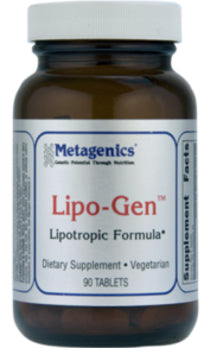
LIPO-GEN FROM METAGENICSLipo-Gen is a highly specialized formula that features a broad-spectrum and unique blend of lipotropic nutrients combined with select amino acids, vitamins, and herbs to support healthy liver and gallbladder function. [TABS]
2 tablets contain:
Vitamin C (as ascorbic acid) 100 mg
Vitamin B6 (as pyridoxine HCI) 10 mg
Folate (as folic acid) 100 mcg
Vitamin B12 (as cyanocobalamin) 10 mcg
Magnesium (as magnesium oxide) 50 mg
Choline (as choline bitartrate) 300 mg
Inositol150 mgtaurine 100 mg
L-Methionine 100 mg
Betaine HCl 100 mg
A proprietary blend of herbal extracts: Artichoke (Cynara scolymus) Leaf Extract (containing cynarin and chlorogenic acid), Chen Pi (Citrus reticulata) 5:1 Extract (containing chlorogenic acid,hyperoside, caffeic acid, and rutin) 95 mg
Other Ingredients:
cellulose, stearic acid (vegetable), croscarmellose sodium, silica, coating (water, hypromellose, medium chain triglycerides, and hydroxypropylcellulose)
Important Information:
If pregnant or nursing, or taking medication, please consult your healthcare practitioner before use. Keep out of the reach of children.
Dosage
Take two tablets three times daily at mealtime or as directed by your healthcare practitioner.
Premium Metagenics Formulas for Whole‑Body Health
For over 30 years, Metagenics has been dedicated to scientific discovery and bringing you the highest quality supplements. Some of Metagenics most popular supplements inlcude Metagenics Ultra Flora, Probiotics, Phytomulti, Clear Change, Ultra Glucose Control, Candibactin-BR and Candibactin-AR. From gluten-free to non-GMO, Metagenics aims to deliver clear and accurately labeled nutritional solutions with over 120 vegetarian supplements.
What you can expect from Lipo-Gen by Metagenics:
Provides nutrients involved in fat metabolism, including
inositol,
choline, and
taurine.
Delivers methyl donors, folic acid, vitamins B6 and B12, and select herbs that are traditionally used to support bile flow and healthy liver function.
FOLIC ACID
Folic acid is a water-soluble member of the
B complex. It is also known as folate and folacin. This vitamin is needed for energy production, cell replication and the formation of red and white blood cells. It plays an important role in the conversion of homocysteine into harmless substances. Homocysteine damages the inner lining of arteries and high levels of homocysteine are correlated to an increased risk of atherosclerosis. Folic acid is especially needed in areas where there is high cell turnover. Therefore it is an essential component of normal fetal development, especially in the first trimester when most of the neural network is laid down.
It is commonly recommended by natural health care practitioners for a variety of different therapeutic applications including: cervical dysplasia, depression, anxiety, anemia and atherosclerosis.All of the B vitamins work together and are best used by the body in a B complex, which is why many B complex supplements include a small dose of folic acid in them. If additional supplementation of folic acid is needed it should be taken in addition to a good B complex. Most B vitamins are water-soluble and any extra from large doses is flushed out of the body easily, therefore it's best to take lower dosages of the B complex several times a day than one larger dose. Spray or sublingual forms of B vitamins are easily absorbed, as are capsules - if your digestion is healthy, then the tablet form is usually suitable for most people.
CHOLINE
Choline is a member of the B complex. Best known as a fat emulsifier (lipotropic), it works well with inositol and is one of the few substances that can cross the blood-brain barrier to produce brain chemicals (neurotransmitters) that aid in memory in particular acetylcholine. Choline is also needed for the insulation of nerve cells.
In this respect choline helps to make the sheath (myelin) that surrounds the nerves that conduct messages from the brain to the muscles and organs of your body, performing a similar function to the insulation sheathing of electrical wires. If this protective sheath degenerates (as in MS), a "shorting out" of the message that the nerve is carrying occurs. Choline also helps to regulate fat metabolism (both the good and bad) & cholesterol metabolism in the liver and gallbladder, breaking them down into smaller particles which makes it easier for your body reduce their accumulation.
Beatine HCI
Betaine hydrochloride contains approximately 23% hydrochloric acid, commonly known as stomach acid. It is naturally sourced from
beets. Stomach acid initiates the digestive process by beginning the breakdown of food, especially
protein. It is also an important protective mechanism against infection by killing any microbes that are contained in our food or water. Low stomach acid impairs one's ability to digest food by limiting the release and functioning of other digestive
enzymes.
Although it may seem contradictory, low stomach acid can also lead to gastric reflux (heartburn). Closure of the valve at the top of the stomach is stimulated by the hydrochloric acid that is released in response to food intake. In an individual with low stomach acid the valve does not close and allowing the remaining acid to push up into the esophagus and cause a burning sensation. Betaine hydrochloride is recommended for indigestion, low stomach acid and gastric reflux.
Betaine HCl
can be purchased in capsules. It is found on its own or as a component of a digestive or multi-enzyme formula. It should be taken with meals and more may be necessary with large meals or those containing protein. To assess you need for HCl some practitioners recommend an HCl challenge test. The number of HCl capsules taken each day is increased by one until a slight burning sensation is felt in the stomach. The appropriate daily dosage is slightly lower than the amount that causes burning. This test should be done cautiously and under medical supervision if you have a gastrointestinal condition.
MAGNESIUM
Some of the most important reactions involving magnesium are in the Kreb's cycle, the cycle inside every cell that leads to energy production.
Recently there has been some debate in regards to the efficacy of magnesium status testing. There are arguments that blood testing may not show deficiencies until they are dangerously low.
It is possible that 50 % or more of the population is "subclinically deficient" or have low magnesium stores despite normal
serum
levels. These deficiencies may have to do with low dietary intake of magnesium,due to poor dietary habits, or loss through refining and processing of foods. Foods rich in magnesium include dark leafy vegetables, bananas, avocado, peas, legumes, soy and whole grains.
Carefully SelectedShips to the U.S.Wellness EssentialsTrusted Brands
Product Details
What you can expect from Lipo-Gen by Metagenics:
Provides nutrients involved in fat metabolism, including
inositol,
choline, and
taurine.
Delivers methyl donors, folic acid, vitamins B6 and B12, and select herbs that are traditionally used to support bile flow and healthy liver function.
FOLIC ACID
Folic acid is a water-soluble member of the
B complex. It is also known as folate and folacin. This vitamin is needed for energy production, cell replication and the formation of red and white blood cells. It plays an important role in the conversion of homocysteine into harmless substances. Homocysteine damages the inner lining of arteries and high levels of homocysteine are correlated to an increased risk of atherosclerosis. Folic acid is especially needed in areas where there is high cell turnover. Therefore it is an essential component of normal fetal development, especially in the first trimester when most of the neural network is laid down.
It is commonly recommended by natural health care practitioners for a variety of different therapeutic applications including: cervical dysplasia, depression, anxiety, anemia and atherosclerosis.All of the B vitamins work together and are best used by the body in a B complex, which is why many B complex supplements include a small dose of folic acid in them. If additional supplementation of folic acid is needed it should be taken in addition to a good B complex. Most B vitamins are water-soluble and any extra from large doses is flushed out of the body easily, therefore it's best to take lower dosages of the B complex several times a day than one larger dose. Spray or sublingual forms of B vitamins are easily absorbed, as are capsules - if your digestion is healthy, then the tablet form is usually suitable for most people.
CHOLINE
Choline is a member of the B complex. Best known as a fat emulsifier (lipotropic), it works well with inositol and is one of the few substances that can cross the blood-brain barrier to produce brain chemicals (neurotransmitters) that aid in memory in particular acetylcholine. Choline is also needed for the insulation of nerve cells.
In this respect choline helps to make the sheath (myelin) that surrounds the nerves that conduct messages from the brain to the muscles and organs of your body, performing a similar function to the insulation sheathing of electrical wires. If this protective sheath degenerates (as in MS), a "shorting out" of the message that the nerve is carrying occurs. Choline also helps to regulate fat metabolism (both the good and bad) & cholesterol metabolism in the liver and gallbladder, breaking them down into smaller particles which makes it easier for your body reduce their accumulation.
Beatine HCI
Betaine hydrochloride contains approximately 23% hydrochloric acid, commonly known as stomach acid. It is naturally sourced from
beets. Stomach acid initiates the digestive process by beginning the breakdown of food, especially
protein. It is also an important protective mechanism against infection by killing any microbes that are contained in our food or water. Low stomach acid impairs one's ability to digest food by limiting the release and functioning of other digestive
enzymes.
Although it may seem contradictory, low stomach acid can also lead to gastric reflux (heartburn). Closure of the valve at the top of the stomach is stimulated by the hydrochloric acid that is released in response to food intake. In an individual with low stomach acid the valve does not close and allowing the remaining acid to push up into the esophagus and cause a burning sensation. Betaine hydrochloride is recommended for indigestion, low stomach acid and gastric reflux.
Betaine HCl
can be purchased in capsules. It is found on its own or as a component of a digestive or multi-enzyme formula. It should be taken with meals and more may be necessary with large meals or those containing protein. To assess you need for HCl some practitioners recommend an HCl challenge test. The number of HCl capsules taken each day is increased by one until a slight burning sensation is felt in the stomach. The appropriate daily dosage is slightly lower than the amount that causes burning. This test should be done cautiously and under medical supervision if you have a gastrointestinal condition.
MAGNESIUM
Some of the most important reactions involving magnesium are in the Kreb's cycle, the cycle inside every cell that leads to energy production.
Recently there has been some debate in regards to the efficacy of magnesium status testing. There are arguments that blood testing may not show deficiencies until they are dangerously low.
It is possible that 50 % or more of the population is "subclinically deficient" or have low magnesium stores despite normal
serum
levels. These deficiencies may have to do with low dietary intake of magnesium,due to poor dietary habits, or loss through refining and processing of foods. Foods rich in magnesium include dark leafy vegetables, bananas, avocado, peas, legumes, soy and whole grains.
🌿
Daily Wellness
Easy to add to your everyday health routine.
✅
Carefully Selected
Chosen with quality and customer needs in mind.
💊
Simple to Use
Designed for convenient daily supplementation.
🚚
Ships to the U.S.
Fast, reliable shipping to U.S. customers.
Choosing a selection results in a full page refresh.