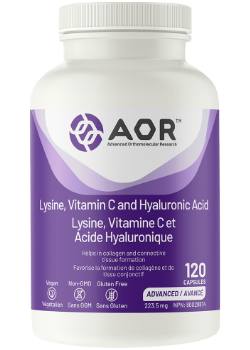
HYALURONIC ACID.Hyaluronic Acid is a plant-derived, pharmaceutical grade, low molecular weight and highly bioavailable hyaluronic acid which provides viscoelastic properties for joint function as well as an anti-inflammatory effect. It is essential to synovial fluid, a viscous liquid present in the articular cavity of the joint. Its function is to lubricate and nourish articular cartilage, thus reducing friction and facilitating movement of the joints. Studies show that the hyaluronic acid content in osteoarthritic cartilage is greatly reduced. [CAPS]
Each capsule contains:
Hyaluronic Acid 98.5mg
Lysine 75mg
Vitamin C 50mg
Non-Medicinal Ingredients:
Microcrystalline cellulose, sodium stearyl fumarate, hyprolose. Capsule: hypromellose.
Important Information:
Consult a health care practitioner prior to use if you are pregnant, breastfeeding, following a low protein diet, or for use beyond three months.
Dosage
Adults: Take one capsule twice daily with or without food, or as directed by a qualified health care practitioner.
Innovative Formulas by AOR Canada found at
AOR Canada is the innovative formulators of Canada’s best-selling antioxidant support,
AOR Advanced B Complex
and
AOR Tri-B12. They are also known for their top bone health supplements, Ortho Adapt and Bone Basics. You can also
SHOP AOR's Nattokinase, and trusted Curcumin Ultra, Curcumin Active and Curcumin95 inflammation support at ca. AOR are leaders in natural health with innovative product development.
What is Hyaluronic acid?
Hyaluronic acid is a cementing and protective substance found in the synovial fluid and connective tissue of movable joints. Hyaluronic acid is a naturally occurring substance that has a high water affinity. It is essential for joint mobility. Like
chondroitin
sulphate and
glucosamine
it is a mucopolysaccharide, a polysaccharide with a
protein
attachment. It's utility in joint dysfunction comes from its viscoelastic and pseudoplastic properties. Simply put, hyaluronic acid forms a thick gel that lubricates and protects joints. Hyaluronic acid is found throughout the body but high concentrations are found in the skin, vitreous humour and synovial fluid.
Hyaluronic acid to protect articulations
Normal synovial fluid contains 3-4 mg/ml of hyaluronic acid. Hyaluronic acid helps protect joints by augmenting the viscosity of the synovial fluid, by increasing the elasticity of the cartilage found in joints and because of its anti-inflammatory effect. Recent studies have shown that
serum
hyaluronic acid levels are a useful marker for the activity and severity of rheumatoid disease. In animal models, hyaluronic acid significantly reduced the production of
nitric oxide, a free radical involved in cartilage degeneration and joint inflammation. Supplementation with hyaluronic acid reduces pain and improves function in patients with
osteoarthritis
of the knee. These effects are thought to be attributable to the return of a more normal synovial fluid, improved viscoelasticity, improved cartilage biosynthesis, anti-inflammatory and analgesic effects. It is no surprise that
sodium
hyaluronate has been used in several countries since 1987 to treat osteoarthritis. Hyaluronic acid also promotes wound healing; it is thought that its cementing ability allows room for white blood cells, which increases the speed of recovery. It is used topically as an analgesic, in skin care products to moisturize the skin and in eye drops to reduce ocular discomfort.
Research Studies
Studies show that the hyaluronic acid content in osteoarthritic cartilage is greatly reduced and that hyaluronic acid supplementation lessens pain and improves function in patients with osteoarthritis of the knee.
Hyaluronic acid was shown to exert anti-inflammatory activity through its effect on nitric oxide, a molecule that is pivotal in synovium inflammation, cartilage and meniscus degeneration.
Animal studies have shown that a formula containing niacinamide and hyaluronate was effective at reducing paw swelling.
Hyaluronic supplementation also allowed for faster healing times of open wounds in rats. The group receiving hyaluronic acid healed 10 days faster than the control group. Hyaluronic supplementation also inhibited scar formation.
Serum hyaluronic acid levels were shown to be a useful marker for the activity and severity of disease activity in
rheumatoid arthritis
patients.
In vitro studies have clearly demonstrated that the presence of hyaluronic acid has a stimulatory effect on chondrocyte metabolism. In other words, hyaluronic acid increases the activity of the cells responsible for cartilage production and maintenance.
Why Hyaluronic Acid?
There have been concerns about the absorption of hyaluronic acid. Given its structure, it is possible that what is absorbed is not sodium hyaluronate but some of its derivatives. It is thought that those metabolites reach the tissues. This is especially true for oral supplements containing larger molecules of hyaluronic acid. Hyaluronic Acid is a high-potency vegetarian formulation specific for oral use and of lower molecular weight. A lower molecular weight means that the molecules are smaller which makes the product much more absorbable. It is produced specifically for the nutrition of synovial joints and is supported by several clinical studies showing its effectiveness. Hyaluronic acid is widely distributed in the body and it is one of the most potent "water holders" found in the human body. Its capacity at binding water is impressive and up to 6 liters of water may be bound per gram of hyaluronic acid.
Carefully SelectedShips to the U.S.Wellness EssentialsTrusted Brands
Product Details
What is Hyaluronic acid?
Hyaluronic acid is a cementing and protective substance found in the synovial fluid and connective tissue of movable joints. Hyaluronic acid is a naturally occurring substance that has a high water affinity. It is essential for joint mobility. Like
chondroitin
sulphate and
glucosamine
it is a mucopolysaccharide, a polysaccharide with a
protein
attachment. It's utility in joint dysfunction comes from its viscoelastic and pseudoplastic properties. Simply put, hyaluronic acid forms a thick gel that lubricates and protects joints. Hyaluronic acid is found throughout the body but high concentrations are found in the skin, vitreous humour and synovial fluid.
Hyaluronic acid to protect articulations
Normal synovial fluid contains 3-4 mg/ml of hyaluronic acid. Hyaluronic acid helps protect joints by augmenting the viscosity of the synovial fluid, by increasing the elasticity of the cartilage found in joints and because of its anti-inflammatory effect. Recent studies have shown that
serum
hyaluronic acid levels are a useful marker for the activity and severity of rheumatoid disease. In animal models, hyaluronic acid significantly reduced the production of
nitric oxide, a free radical involved in cartilage degeneration and joint inflammation. Supplementation with hyaluronic acid reduces pain and improves function in patients with
osteoarthritis
of the knee. These effects are thought to be attributable to the return of a more normal synovial fluid, improved viscoelasticity, improved cartilage biosynthesis, anti-inflammatory and analgesic effects. It is no surprise that
sodium
hyaluronate has been used in several countries since 1987 to treat osteoarthritis. Hyaluronic acid also promotes wound healing; it is thought that its cementing ability allows room for white blood cells, which increases the speed of recovery. It is used topically as an analgesic, in skin care products to moisturize the skin and in eye drops to reduce ocular discomfort.
Research Studies
Studies show that the hyaluronic acid content in osteoarthritic cartilage is greatly reduced and that hyaluronic acid supplementation lessens pain and improves function in patients with osteoarthritis of the knee.
Hyaluronic acid was shown to exert anti-inflammatory activity through its effect on nitric oxide, a molecule that is pivotal in synovium inflammation, cartilage and meniscus degeneration.
Animal studies have shown that a formula containing niacinamide and hyaluronate was effective at reducing paw swelling.
Hyaluronic supplementation also allowed for faster healing times of open wounds in rats. The group receiving hyaluronic acid healed 10 days faster than the control group. Hyaluronic supplementation also inhibited scar formation.
Serum hyaluronic acid levels were shown to be a useful marker for the activity and severity of disease activity in
rheumatoid arthritis
patients.
In vitro studies have clearly demonstrated that the presence of hyaluronic acid has a stimulatory effect on chondrocyte metabolism. In other words, hyaluronic acid increases the activity of the cells responsible for cartilage production and maintenance.
Why Hyaluronic Acid?
There have been concerns about the absorption of hyaluronic acid. Given its structure, it is possible that what is absorbed is not sodium hyaluronate but some of its derivatives. It is thought that those metabolites reach the tissues. This is especially true for oral supplements containing larger molecules of hyaluronic acid. Hyaluronic Acid is a high-potency vegetarian formulation specific for oral use and of lower molecular weight. A lower molecular weight means that the molecules are smaller which makes the product much more absorbable. It is produced specifically for the nutrition of synovial joints and is supported by several clinical studies showing its effectiveness. Hyaluronic acid is widely distributed in the body and it is one of the most potent "water holders" found in the human body. Its capacity at binding water is impressive and up to 6 liters of water may be bound per gram of hyaluronic acid.
🌿
Daily Wellness
Easy to add to your everyday health routine.
✅
Carefully Selected
Chosen with quality and customer needs in mind.
💊
Simple to Use
Designed for convenient daily supplementation.
🚚
Ships to the U.S.
Fast, reliable shipping to U.S. customers.
Choosing a selection results in a full page refresh.