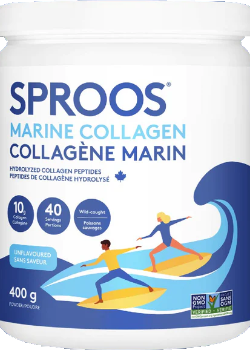
Marine collagen is a source of type I collagen and is the most plentiful collagen in our bodies. It can be found in our skin, tendons, bones, teeth, ligaments and connective tissues. Collagen is often associated with skin health and rightly so! Type I collagen is the main component of our skin and is a key building block for maintaining its elasticity and firmness. The science is clear: collagen is a key component for the maintenance of healthy skin, hair, joints and gut. Sproos sources the highest quality collagen from sustainable and non-GMO sources. This Marine Collagen is sourced from North Atlantic, wild-caught fish and processed in Canada. Sproos Marine Collagen is highly soluble, meaning that it dissolves easily into both hot and cold beverages. [POWDER]
Each scoop (10g) contains:
Hydrolyzed Collagen (from wild-caught Atlantic fish skin) 10 g
Alanine 756 mg
Arginine 954 mg
Aspartic Acid 423 mg
Glutamic Acid 873 mg
Glycine 1,962 mg
Histidine* 207 mg
Hydroxylysine 126 mg
Hydroxyproline 612 mg
Isoleucine* 108 mg
Leucine* 198 mg
Lysine* 405 mg
Methionine 153 mg
Phenylalanine* 189 mg
Proline 945 mg
Serine 540 mg
Threonine 333 mg
Tyrosine 45 mg
Valine* 153 mg
*Essential Amino Acids
Important Information:
If you are pregnant or breastfeeding, consult a health care practitioner prior to use. If you have liver or kidney disease or have been instructed to follow a low protein diet, consult a health care practitioner prior to use. If you have gallstones, bile duct obstruction or excess stomach acid consult a health core practitioner prior to use. Collagen may cause mild gastrointestinal disturbances.
Dosage
Simply add one scoop into a glass of water. Also great in smoothies and juices, tea and coffee.
Canadian company from Whistler, BC, Sproos, offers a line of collagen and natural health supplements. They choose every ingredient with intent and consult naturopaths on their product formulations to ensure their ingredients are effective, high quality and work synergistically. They produce popular collagen products including both marine and grass-fed collagen powders; collagen greens; beauty, joint, and gut health blends; collagen bars; MCT creamers with collagen or ghee; and turmeric lattes for inflammation and antioxidant protection. Their formulations don’t contain fillers, GMO’s, or artificial colours or flavours. Their packaging is BPA free and recyclable, and they choose organic ingredients when possible.
COLLAGEN
By: Articles by a Naturopathic Doctor and a Holistic Nutritionist
Collagen is beneficial for arthritis, skin ulcers due to vascular insufficiency, burns, wounds, and sprains and strains...
Collagen is one of the major proteins found in the soft tissue and connective tissue of humans and other mammals. As a supplement, Collagen acts as a source of
amino acids
for use in making and repairing connective tissue all over the body. Thus collagen is used to repair skin that is damaged by wounds and burns, and it can also help to support healthy cartilage, ligaments and tendons in the body. Natural health practitioners commonly recommend collagen supplementation for joint injury, arthritis, joint inflammation, skin ulcers, burns, wounds, as well as joint strains and sprains.
Cartilage and Joint Support
Cartilage is the connective tissue pad that acts as a cushion and eliminates friction in your joints. It is the cushion in your knees, and other large joints, and it forms the pads that space each vertebra to help protect the spinal cord. Wear-and-tear injuries occur in the joints and cause less support, less cushioning and more friction. Breakdown of cartilage is responsible for erosive conditions, such as osteoarthritis. For more information, please see our Osteoarthritis article. Interestingly, the presence of the stress hormone cortisol in the blood promotes the breakdown of collagen into its amino acid building blocks. To help avoid this, please see our article on Stress.
Skin
Collagen is one of the main building blocks of our skin. The structure of collagen actually draws water into the tissues, resulting in firm, plump, youthful skin. Thus, a lack of sufficient cartilage can result in wrinkles and sagging of skin associated with aging. Collagen is often added to skin care products for topical application against wrinkles and age spots. In addition to keeping our youthful glow, the presence of collagen heals skin ulcers by repairing the skin and increasing the integrity of the arteries and veins. Because collagen provides the building blocks for skin repair, it can speed the healing of most wounds.
TYPES OF COLLAGEN
There are a large number of collagen types in the body, referred to in the health industry by roman numeral. Four of these are the main ones used to form our tissues and organs.
Type I & III Collagen
Type I collagen is the type found in over 90% of the body. It is found in skin, tendon, vascular ligature, organs, bone, and scar tissue. In fact, collagen type I is the main organic component of the bone. Type III collagen is commonly found alongside type I in the human body. These types of collagen can also be used to provide the building blocks to help repair damaged ligaments and tendons. For more information on these uses, please see our Types I & III Collagen article.
Type II Collagen
Over 50% of cartilage
protein
is made of type II collagen. This type is also commonly called hyaline cartilage. Cartilage is the tissue that eliminates friction in your joints. Because of this, type II collagen is often used as a supplement to provide the building blocks for the protection and repair of cartilage in the body. This allows it to be used to help treat wear-and-tear injuries, and erosive joint conditions like osteoarthritis. For more information, please see our Type II Collagen article.
Type IV Collagen
This particular type of collagen is found in the body's tissues and actually forms the vast majority of the basement membrane. This means that it forms the main connections between the bases of the cells of our tissues. This allows type IV collagen to support proper healing of wounds.
How Can I Take Collagen?
Various types of collagen can be found as encapsulated powder or liquid. They are usually combined with other joint repairing nutrients and vitamins. Sometimes cartilage is directly supplemented to be a source of collagen, particularly type II collagen. When found individually, type II collagen is found as a component of pain relieving and anti-inflammatory formulas. It is often added to anti-aging skin care products. Type I & III collagen are also available and should be used after good results are found with type II to further rebuild damaged joints or tissue. Depending on the severity of joint destruction collagen may need to be taken for a few months before results are seen.
Collagen– Quick Facts
Sources
· Bovine.
Applications
· Arthritis, Skin Ulcers Due To Vascular Insufficiency, Burns, Wounds
Optimum Dosage
· 600-1200 Mg Daily. (Clinical Doses May Be Higher As Recommended By Your Practitioner).
Works Well With
·
Vitamin C,
Chondroitin Sulfate,
Msm,
Glucosamine, Calendula,
Vitamin E
Important Information
· There Is No Toxicity, Side Effects Or Contraindications For The Use Of Collagen.
· Collagen Should Be Taken With A Juice That Is High In
Vitamin C
Or A Vitamin C Tablet.
Carefully SelectedShips to the U.S.Wellness EssentialsTrusted Brands
Product Details
COLLAGEN
By: Articles by a Naturopathic Doctor and a Holistic Nutritionist
Collagen is beneficial for arthritis, skin ulcers due to vascular insufficiency, burns, wounds, and sprains and strains...
Collagen is one of the major proteins found in the soft tissue and connective tissue of humans and other mammals. As a supplement, Collagen acts as a source of
amino acids
for use in making and repairing connective tissue all over the body. Thus collagen is used to repair skin that is damaged by wounds and burns, and it can also help to support healthy cartilage, ligaments and tendons in the body. Natural health practitioners commonly recommend collagen supplementation for joint injury, arthritis, joint inflammation, skin ulcers, burns, wounds, as well as joint strains and sprains.
Cartilage and Joint Support
Cartilage is the connective tissue pad that acts as a cushion and eliminates friction in your joints. It is the cushion in your knees, and other large joints, and it forms the pads that space each vertebra to help protect the spinal cord. Wear-and-tear injuries occur in the joints and cause less support, less cushioning and more friction. Breakdown of cartilage is responsible for erosive conditions, such as osteoarthritis. For more information, please see our Osteoarthritis article. Interestingly, the presence of the stress hormone cortisol in the blood promotes the breakdown of collagen into its amino acid building blocks. To help avoid this, please see our article on Stress.
Skin
Collagen is one of the main building blocks of our skin. The structure of collagen actually draws water into the tissues, resulting in firm, plump, youthful skin. Thus, a lack of sufficient cartilage can result in wrinkles and sagging of skin associated with aging. Collagen is often added to skin care products for topical application against wrinkles and age spots. In addition to keeping our youthful glow, the presence of collagen heals skin ulcers by repairing the skin and increasing the integrity of the arteries and veins. Because collagen provides the building blocks for skin repair, it can speed the healing of most wounds.
TYPES OF COLLAGEN
There are a large number of collagen types in the body, referred to in the health industry by roman numeral. Four of these are the main ones used to form our tissues and organs.
Type I & III Collagen
Type I collagen is the type found in over 90% of the body. It is found in skin, tendon, vascular ligature, organs, bone, and scar tissue. In fact, collagen type I is the main organic component of the bone. Type III collagen is commonly found alongside type I in the human body. These types of collagen can also be used to provide the building blocks to help repair damaged ligaments and tendons. For more information on these uses, please see our Types I & III Collagen article.
Type II Collagen
Over 50% of cartilage
protein
is made of type II collagen. This type is also commonly called hyaline cartilage. Cartilage is the tissue that eliminates friction in your joints. Because of this, type II collagen is often used as a supplement to provide the building blocks for the protection and repair of cartilage in the body. This allows it to be used to help treat wear-and-tear injuries, and erosive joint conditions like osteoarthritis. For more information, please see our Type II Collagen article.
Type IV Collagen
This particular type of collagen is found in the body's tissues and actually forms the vast majority of the basement membrane. This means that it forms the main connections between the bases of the cells of our tissues. This allows type IV collagen to support proper healing of wounds.
How Can I Take Collagen?
Various types of collagen can be found as encapsulated powder or liquid. They are usually combined with other joint repairing nutrients and vitamins. Sometimes cartilage is directly supplemented to be a source of collagen, particularly type II collagen. When found individually, type II collagen is found as a component of pain relieving and anti-inflammatory formulas. It is often added to anti-aging skin care products. Type I & III collagen are also available and should be used after good results are found with type II to further rebuild damaged joints or tissue. Depending on the severity of joint destruction collagen may need to be taken for a few months before results are seen.
Collagen– Quick Facts
Sources
· Bovine.
Applications
· Arthritis, Skin Ulcers Due To Vascular Insufficiency, Burns, Wounds
Optimum Dosage
· 600-1200 Mg Daily. (Clinical Doses May Be Higher As Recommended By Your Practitioner).
Works Well With
·
Vitamin C,
Chondroitin Sulfate,
Msm,
Glucosamine, Calendula,
Vitamin E
Important Information
· There Is No Toxicity, Side Effects Or Contraindications For The Use Of Collagen.
· Collagen Should Be Taken With A Juice That Is High In
Vitamin C
Or A Vitamin C Tablet.
🌿
Daily Wellness
Easy to add to your everyday health routine.
✅
Carefully Selected
Chosen with quality and customer needs in mind.
💊
Simple to Use
Designed for convenient daily supplementation.
🚚
Ships to the U.S.
Fast, reliable shipping to U.S. customers.
Choosing a selection results in a full page refresh.