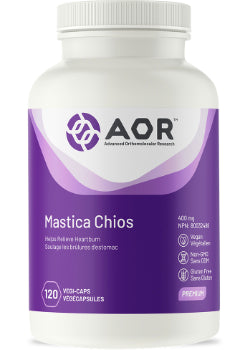
MASTICA CHIOSMastica Chios is Chios gum mastic, the resinous extract of the mastic tree (Pistacia lentiscus). Research supports gum mastic's contribution to gastrointestinal health through its effects on unfriendly bacteria in the stomach. Mastica chios is often recommended by natural health care practitioners for people with leaky gut, ulcers, colitis and other chronic digestive conditions which require support for the digestive lining. [VCAPS]
1 v-cap contains:
Chios Gum Mastic 400mg
Non-medicinal Ingredients:
Microcrystalline cellulose, sodium stearyl fumarate. Capsule: hypromellose.
Important Information:
Contains no wheat, gluten, corn, nuts, peanuts, sesame seeds, sulphites, mustard, soy, dairy, eggs, fish, shellfish or any animal by product.
See Below For Cautions
Dosage
Take one capsule three times daily on an empty stomach, or as directed by a qualified health care practitioner.
Innovative Formulas by AOR Canada found at
AOR Canada is the innovative formulators of Canada’s best-selling antioxidant support,
AOR Advanced B Complex
and
AOR Tri-B12. They are also known for their top bone health supplements, Ortho Adapt and Bone Basics. You can also
SHOP AOR's Nattokinase, and trusted Curcumin Ultra, Curcumin Active and Curcumin95 inflammation support at ca. AOR are leaders in natural health with innovative product development.
History
For decades, it was believed that ulcers were caused by having too much acid in the stomach. Spicy foods and stress were targeted as acidic culprits; antacids, or more powerful antisecretory drugs like omeprazole (Losec or Prilosec), were recommended in order to suppress the body's ability to make the "offending" stomach acid. Well, it's true that the gnawing, burning pain of an ulcer flares up when acid burning into the injured stomach wall. But the acid doesn't cause the ulcer itself. Instead, recent research has proven that ninety percent of peptic ulcers, and sixty to eighty percent of gastric ulcers are caused by germs - by an infection with the bacterium
Helicobacter pylori.
Mastica ChiosFacts
H. pylori
is everywhere: about two thirds of the human family has caught the bug, which hides from the hostile environment of the stomach by bunkering down in folds in the lining of the stomach wall. People infected with
H. pylori
are somewhere between two and six times more likely to develop unhealthy stomach cells or mucosal associated-lymphoid-type (MALT) lymphoma, and are also more vulnerable to iron-deficiency anemia because of bleeding in the stomach.
This new knowledge has led to a revolution in the treatment of ulcers, which can now mostly be dealt with using a cocktail of potent - but side-effect-prone - antibiotics. But centuries before medical science identified the role of H. pylori in ulcers, and extending through the period in which untold millions wasted their time - and put their long-term health at risk - by using antacids and antisecretories, people in the Mediterranean and Middle Eastern world have been getting relief from their ulcers using a powerful natural remedy that fights the invisible invader head-on - and wins.
Mastic gum
is the gummy resin of the mastic tree -
Pistacia lentiscus, a relative of the tree that gives us the pistachio. The mastic tree is found almost exclusively on the Greek island of Chios, the birthplace of Hippocrates, the traditional father of medicine. The use of mastic in medicine is attested by the Biblical prophet Jeremiah, and the thirteenth-century Arabic physicians Ibn Al-Jazzar Al-Qayrawani and Ibn Al-Baytar specifically extolled its virtues in fighting gastric and intestinal ulcers.
Studies
In one double-blind, placebo-controlled study, 38 people suffering with duodenal ulcers took either 1000 mg of mastic gum before breakfast each day for two weeks, or a dummy pill. At the end of the study, 80% of the ulcer sufferers who had taken mastic had experienced relief of their symptoms, as compared with only half of those taking the placebo. Temporary pain relief is common in the course of an ulcer, of course, no matter what a person does. More tellingly, however, when their doctors looked at their ulcers using an endoscope, they found that 70% of the people who took the mastic supplement experienced actual healing of their ulcers, as proven using an endoscope, versus just 22% of those stuck with the placebo. No side-effects were noted. In another study, six gastric ulcer sufferers who had not taken hydrogen-blockers, bismuth (PeptoBismol), the mucus-stimulating drug Carbenoxolone, or the stomach-coating drug sucralfate (Sulcrate/Carafate) took 1000 milligrams of mastic gum twice a day (once before breakfast and once before bed) for two months; they also quit smoking and avoided anti-inflammatory drugs and fried food, and were allowed to use antacid tablets to relieve symptoms. Their ulcers were video-recorded before starting taking the supplement and then two and four weeks later.
Complete relief of symptoms was experienced in all the gastric ulcer sufferers within seven days of starting on mastic. On top of this, complete healing of the ulcer, with no appearance of new ulcers, was experienced by 83% of them by the end of the four-week course on mastic - including one female patient who began the study with a double ulcer.
No side-effects were noted over the course of the study, nor at an additional physical examination two months later. Indeed, it's hard to see how side-effects could happen at these effective doses, since two-gram lumps of mastic are used safely as a breath-freshening chewing gum by people throughout the Mediterranean. Indeed, the UK government gave food producers carte blanche to use mastic in their products a quarter of a century ago.
Does mastic work by wiping out the noxious
Helicobacter pylori
bacterium?
Two groups of scientists have found that mastic gum does indeed kill
H. pylori
in the test-tube, at concentrations easily attainable through such doses of the botanical. Studies are now being conducted by Dr. John Atherton and colleagues at the University of Nottingham to prove, with certainty, that this is exactly what's happening in people taking mastic as a supplement. However it works, clinical studies show that the healing of ulcers by mastic is very real.
Additionally, evidence is mounting that in many cases infection with H. pylori also causes, or aggravates, heartburn (gastroesophageal reflux disease (GERD)). If that proves to be the case, then mastic may yet prove to provide soothing relief - and a real solution - for this miserable condition.
From the caravans of the ancient Near East to you: safe, natural, and real relief from ulcer suffering.
Cautions:
For occasional use only. Consult a health care practitioner for use beyond two weeks, if symptoms persist or worsen, if you have
diabetes
mellitus or Crohn’s disease or are taking hypoglycemic or hypolipidemic agents. Do not use if pregnant or breastfeeding or if you have an allergy to Anacardiaceae family plants (eg.
pistachios
). Discontinue use if hypersensitivity (eg. allergy) occurs.
Carefully SelectedShips to the U.S.Wellness EssentialsTrusted Brands
Product Details
History
For decades, it was believed that ulcers were caused by having too much acid in the stomach. Spicy foods and stress were targeted as acidic culprits; antacids, or more powerful antisecretory drugs like omeprazole (Losec or Prilosec), were recommended in order to suppress the body's ability to make the "offending" stomach acid. Well, it's true that the gnawing, burning pain of an ulcer flares up when acid burning into the injured stomach wall. But the acid doesn't cause the ulcer itself. Instead, recent research has proven that ninety percent of peptic ulcers, and sixty to eighty percent of gastric ulcers are caused by germs - by an infection with the bacterium
Helicobacter pylori.
Mastica ChiosFacts
H. pylori
is everywhere: about two thirds of the human family has caught the bug, which hides from the hostile environment of the stomach by bunkering down in folds in the lining of the stomach wall. People infected with
H. pylori
are somewhere between two and six times more likely to develop unhealthy stomach cells or mucosal associated-lymphoid-type (MALT) lymphoma, and are also more vulnerable to iron-deficiency anemia because of bleeding in the stomach.
This new knowledge has led to a revolution in the treatment of ulcers, which can now mostly be dealt with using a cocktail of potent - but side-effect-prone - antibiotics. But centuries before medical science identified the role of H. pylori in ulcers, and extending through the period in which untold millions wasted their time - and put their long-term health at risk - by using antacids and antisecretories, people in the Mediterranean and Middle Eastern world have been getting relief from their ulcers using a powerful natural remedy that fights the invisible invader head-on - and wins.
Mastic gum
is the gummy resin of the mastic tree -
Pistacia lentiscus, a relative of the tree that gives us the pistachio. The mastic tree is found almost exclusively on the Greek island of Chios, the birthplace of Hippocrates, the traditional father of medicine. The use of mastic in medicine is attested by the Biblical prophet Jeremiah, and the thirteenth-century Arabic physicians Ibn Al-Jazzar Al-Qayrawani and Ibn Al-Baytar specifically extolled its virtues in fighting gastric and intestinal ulcers.
Studies
In one double-blind, placebo-controlled study, 38 people suffering with duodenal ulcers took either 1000 mg of mastic gum before breakfast each day for two weeks, or a dummy pill. At the end of the study, 80% of the ulcer sufferers who had taken mastic had experienced relief of their symptoms, as compared with only half of those taking the placebo. Temporary pain relief is common in the course of an ulcer, of course, no matter what a person does. More tellingly, however, when their doctors looked at their ulcers using an endoscope, they found that 70% of the people who took the mastic supplement experienced actual healing of their ulcers, as proven using an endoscope, versus just 22% of those stuck with the placebo. No side-effects were noted. In another study, six gastric ulcer sufferers who had not taken hydrogen-blockers, bismuth (PeptoBismol), the mucus-stimulating drug Carbenoxolone, or the stomach-coating drug sucralfate (Sulcrate/Carafate) took 1000 milligrams of mastic gum twice a day (once before breakfast and once before bed) for two months; they also quit smoking and avoided anti-inflammatory drugs and fried food, and were allowed to use antacid tablets to relieve symptoms. Their ulcers were video-recorded before starting taking the supplement and then two and four weeks later.
Complete relief of symptoms was experienced in all the gastric ulcer sufferers within seven days of starting on mastic. On top of this, complete healing of the ulcer, with no appearance of new ulcers, was experienced by 83% of them by the end of the four-week course on mastic - including one female patient who began the study with a double ulcer.
No side-effects were noted over the course of the study, nor at an additional physical examination two months later. Indeed, it's hard to see how side-effects could happen at these effective doses, since two-gram lumps of mastic are used safely as a breath-freshening chewing gum by people throughout the Mediterranean. Indeed, the UK government gave food producers carte blanche to use mastic in their products a quarter of a century ago.
Does mastic work by wiping out the noxious
Helicobacter pylori
bacterium?
Two groups of scientists have found that mastic gum does indeed kill
H. pylori
in the test-tube, at concentrations easily attainable through such doses of the botanical. Studies are now being conducted by Dr. John Atherton and colleagues at the University of Nottingham to prove, with certainty, that this is exactly what's happening in people taking mastic as a supplement. However it works, clinical studies show that the healing of ulcers by mastic is very real.
Additionally, evidence is mounting that in many cases infection with H. pylori also causes, or aggravates, heartburn (gastroesophageal reflux disease (GERD)). If that proves to be the case, then mastic may yet prove to provide soothing relief - and a real solution - for this miserable condition.
From the caravans of the ancient Near East to you: safe, natural, and real relief from ulcer suffering.
Cautions:
For occasional use only. Consult a health care practitioner for use beyond two weeks, if symptoms persist or worsen, if you have
diabetes
mellitus or Crohn’s disease or are taking hypoglycemic or hypolipidemic agents. Do not use if pregnant or breastfeeding or if you have an allergy to Anacardiaceae family plants (eg.
pistachios
). Discontinue use if hypersensitivity (eg. allergy) occurs.
🌿
Daily Wellness
Easy to add to your everyday health routine.
✅
Carefully Selected
Chosen with quality and customer needs in mind.
💊
Simple to Use
Designed for convenient daily supplementation.
🚚
Ships to the U.S.
Fast, reliable shipping to U.S. customers.
Choosing a selection results in a full page refresh.