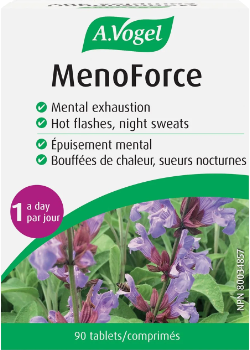
A VOGEL MENOFORCE FEMININE-HOT FLASH RELIEF FORMULA With 3400mg (extract equivalent) of sage leaf. In a clinical study on a sage leaf extract, 30 women reported an effective relief of hot flushes. Hot flushes and night sweats disappeared completely for 20 women and the other symptoms were greatly improved. The researchers mention that sage's action mechanism is not hormone-related since circulation hormone levels were not affected, which makes it an ideal choice for women concerned about excess estrogen levels. A Vogel's Menoforce Feminine tablets are easy to swallow, and come packaged in a convenient blister pack. [TABLET]
Each tablet contains:
Fresh Sage (Salvia officinalis) leaf (1:17) equivalent to 200mg dried leaf 3400mg
Other Ingredients:
Microcrystalline cellulose, sucrose laurate, hydrogenated cottonseed oil.
*Certified organically grown
Important Information:
Free of all common allergens, including: wheat, dairy, eggs, corn, soy, and yeast. See cautons below.
Dosage
Adults: Take one tablet once daily with water.
Swiss remedies from fresh, organic plants since 1923
A.Vogel, top formulators of Swiss-made herbal health products and Canada’s best-selling Cold & Flu support. A Vogel products include Echinaforce and the best menopausal women's supplement, Menoforce. Now they bring to you A.Vogel Allergy Relief, Pollinosan complex as well as their classic Biostrath Elixir, arnica gel for topical pain relief and natural eye drops. Buy now at
Sage With Age &
Menopause
Sage is a small perennial evergreen shrub and comes from the Mediterranean region. It is now well known as a culinary herb; raw, cooked or dried, and as such is also commercially grown in the US, Canada, Argentina, Germany and France...
Sage has been used medicinally by ancient Greeks, Romans and Egyptians. Egyptians used it as a fertility aid, while Greeks used it for its ability to stop bleeding and clean wounds, ulcers and snakebites. Sage was a sacred herb for Romans, harvested for solemn ceremony.Research has shown that sage possesses antibacterial, antifungal, antiviral, and astringent properties. As such, it is now widely used to treat
hemorrhoids, blood or phlegm in the urine, excessive breast milk or fluid in the abdomen (ascites). It is commonly used for colds, congestion and fever. Due to its antibacterial, antifungal and antiviral effects, it can compliment and support the immune system when dealing with infection. Research using sage for the treatment of Herpes have shown reduction in size, number, severity and time between outbreaks of both genital and oral
cold sores. Studies using sage have also demonstrated a reduction in pain associated with sore throat.
Sage has also been shown to have positive effects on memory and research is showing it has promise in the treatment of mild to moderate Alzheimer's disease. In North America, sage is taken as a dietary supplement to treat hot flashes, night sweats, and estrogen loss, as well as a tonic for fighting fatigue and nervous exhaustion, thus making it a common supplement for women suffering through menopause.
The typical and safe dose for dried sage leaf is 4-6 grams/day. As a liquid extract (1:2) 2-5 ml/day is recommended. There are no safety issues or contraindications with the use of sage. Due to a lack of research it is not recommended in pregnancy or lactation (unless it is used during weaning period to dry up milk supply).
Historical Overview
Sage (Salvia officinalis) is a shrub native of the Mediterranean basin. In ancient times, sage was traditionally considered a panacea (cure-all). As time went by some indications became more popular. In topical applications, sage is useful for inflammation of mucous membranes and tonsils. Orally, it helps to reduce excessive perspiration like that caused by severe malady (tuberculosis), it aids digestion and improves wound healing. For a long time, sages reputation as brain tonic was laughed at but, recently, its beneficial effect in Alzheimers disease was shown.
Actions & Pharmacology
Sage leaf contains tannins, bitter principles (diterpenes), steroids, flavonoids and a volatile oil rich in terpenes (thujone, camphor, etc.). It is recognized for its carminative (relieving flatulence), antispasmodic, anti-inflammatory, astringent, and anti-microbial properties. The antispasmodic and astringent effects may explain its usefulness against excessive perspiration and hot flushes. In a recent in vitro study, sage has shown an affinity to benzodiazepine brain receptors which could explain its calming effect. In another in vitro study, sage demonstrated antioxidant properties.
The German E Commission recognizes the use of sage (Salvia Officinalis) for dyspeptic symptoms (poor digestion without apparent stomach lesion) and excessive perspiration.
Cautions
Contraindication: known allergy to sage or one of the components. People suffering from epilepsy should refrain from taking large amounts of sage.
Menopause Feminine is not recommended during pregnancy and nursing.
No interaction has been reported.
Bioforce has published the results of a clinical trial using the sage extract Menopause Feminine (Menosan in Europe). During 8 weeks, 39 women taking either the extract or a placebo kept a personal diary of their symptoms. 75% of those receiving Menopause Feminine evaluated their condition as better or much better compared with 47% in the placebo group. The mean number of hot flushes reduced by 56.3% with Menopause Feminine and increased by 4.8% in the placebo group.
Carefully SelectedShips to the U.S.Wellness EssentialsTrusted Brands
Product Details
Sage With Age &
Menopause
Sage is a small perennial evergreen shrub and comes from the Mediterranean region. It is now well known as a culinary herb; raw, cooked or dried, and as such is also commercially grown in the US, Canada, Argentina, Germany and France...
Sage has been used medicinally by ancient Greeks, Romans and Egyptians. Egyptians used it as a fertility aid, while Greeks used it for its ability to stop bleeding and clean wounds, ulcers and snakebites. Sage was a sacred herb for Romans, harvested for solemn ceremony.Research has shown that sage possesses antibacterial, antifungal, antiviral, and astringent properties. As such, it is now widely used to treat
hemorrhoids, blood or phlegm in the urine, excessive breast milk or fluid in the abdomen (ascites). It is commonly used for colds, congestion and fever. Due to its antibacterial, antifungal and antiviral effects, it can compliment and support the immune system when dealing with infection. Research using sage for the treatment of Herpes have shown reduction in size, number, severity and time between outbreaks of both genital and oral
cold sores. Studies using sage have also demonstrated a reduction in pain associated with sore throat.
Sage has also been shown to have positive effects on memory and research is showing it has promise in the treatment of mild to moderate Alzheimer's disease. In North America, sage is taken as a dietary supplement to treat hot flashes, night sweats, and estrogen loss, as well as a tonic for fighting fatigue and nervous exhaustion, thus making it a common supplement for women suffering through menopause.
The typical and safe dose for dried sage leaf is 4-6 grams/day. As a liquid extract (1:2) 2-5 ml/day is recommended. There are no safety issues or contraindications with the use of sage. Due to a lack of research it is not recommended in pregnancy or lactation (unless it is used during weaning period to dry up milk supply).
Historical Overview
Sage (Salvia officinalis) is a shrub native of the Mediterranean basin. In ancient times, sage was traditionally considered a panacea (cure-all). As time went by some indications became more popular. In topical applications, sage is useful for inflammation of mucous membranes and tonsils. Orally, it helps to reduce excessive perspiration like that caused by severe malady (tuberculosis), it aids digestion and improves wound healing. For a long time, sages reputation as brain tonic was laughed at but, recently, its beneficial effect in Alzheimers disease was shown.
Actions & Pharmacology
Sage leaf contains tannins, bitter principles (diterpenes), steroids, flavonoids and a volatile oil rich in terpenes (thujone, camphor, etc.). It is recognized for its carminative (relieving flatulence), antispasmodic, anti-inflammatory, astringent, and anti-microbial properties. The antispasmodic and astringent effects may explain its usefulness against excessive perspiration and hot flushes. In a recent in vitro study, sage has shown an affinity to benzodiazepine brain receptors which could explain its calming effect. In another in vitro study, sage demonstrated antioxidant properties.
The German E Commission recognizes the use of sage (Salvia Officinalis) for dyspeptic symptoms (poor digestion without apparent stomach lesion) and excessive perspiration.
Cautions
Contraindication: known allergy to sage or one of the components. People suffering from epilepsy should refrain from taking large amounts of sage.
Menopause Feminine is not recommended during pregnancy and nursing.
No interaction has been reported.
Bioforce has published the results of a clinical trial using the sage extract Menopause Feminine (Menosan in Europe). During 8 weeks, 39 women taking either the extract or a placebo kept a personal diary of their symptoms. 75% of those receiving Menopause Feminine evaluated their condition as better or much better compared with 47% in the placebo group. The mean number of hot flushes reduced by 56.3% with Menopause Feminine and increased by 4.8% in the placebo group.
🌿
Daily Wellness
Easy to add to your everyday health routine.
✅
Carefully Selected
Chosen with quality and customer needs in mind.
💊
Simple to Use
Designed for convenient daily supplementation.
🚚
Ships to the U.S.
Fast, reliable shipping to U.S. customers.
Choosing a selection results in a full page refresh.