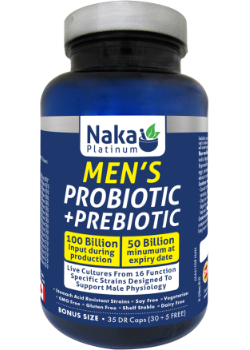
Naka Platinum Men's Probiotic + Prebiotic contains 50 billion minimum live cultures at the the time of expiry from 16 different stomach acid resistant strains specifically chosen to help support male physiology. This shelf stable probiotic + prebiotic has been specially formulated to help support intestinal and gastrointestinal health in men to maintain a healthy digestive system. By promoting a favorable gut flora, Probiotic + Prebiotic may stimulate the growth of healthy bacteria in the intestine and gut while providing gentle relief of constipation or irregularly. [DELAYED RELEASE CAPSULES]
Each capsule contains:
Lactobacillus acidophilus (La-14) 5 Billion CFU
Lacticaseibacillus rhamnosus (GG) 1.8 Billion CFU
Levilactobacillus brevis (Lbr-35) 1.1 Billion CFU
Lactobacillus delbrueckii subsp. bulgaricus (Lb-87) 0.3 Billion CFU
Lacticaseibacillus casei (Lc-11) 4.8 Billion CFU
Limosilactobacillus fermentum (SBS-1) 0.5 Billion CFU
Lactobacillus gasseri (Lg-36). 1.1 Billion CFU
Lacticaseibacillus paracasei (Lpc-37) 17.5 Billion CFU
Lactiplantibacillus plantarum (Lp-115) 2.2 Billion CFU
Ligilactobacillus salivarius (Ls-33) 1.7 Billion CFU
Bifidobacterium animalis subsp. lactis (Bl-04) 8.2 Billion CFU
Bifidobacterium animalis subsp. lactis (Bi-07) 1.5 Billion CFU
Bifidobacterium animalis subsp. lactis (HN-019) 1.8 Billion CFU
Bifidobacterium bifidum (Bb-06) 0.5 Billion CFU
Bifidobacterium breve (Bb-18) 1.5 Billion CFU
Bifidobacterium longum subsp. longum (Bl-05) 0.5 Billion CFU
Non-Medicinal Ingredients:
Fructooligosaccharides, Organic inulin, Magnesium stearate (vegetable source), Gellan gum and Hypromellose (capsule ingredient).
Important Information:
Consult a health care practitioner prior to use if you have fever, vomiting, bloody diarrhoea or severe abdominal pain. Stop use and consult a health care practitioner if symptoms of digestive upset (e.g. diarrhea) occur, worsen and/or persists beyond 3 days. Do not use this product if you have an immunecompromised condition (e.g. AIDS, lymphoma, patients undergoing long-term corticosteroid treatment). Sealed for your protection. Keep out of the reach of children. Do not use if safety seal is broken or missing. For freshness store in a cool, dry place. Refrigeration will extend expiry date.
Dosage
Men: 1 capsule per day. Take at least 2-3 hours before or after antibiotics.
Premium Quality & Canadian Made - 12 New Added
Founded in 1991, Naka’s success has been built upon introducing innovative supplements in liquid or easy-to-swallow capsule forms designed to meet the better health needs of consumers worldwide. Their most popular supplements include:
Naka Pro Collagen,
Naka Vital Greens,
Naka Magnesium Bisglycinate,
Naka Nutri Flex,
Naka Vital Greens
and Naka Probiotics.You can find Naka herbs and
buy Naka supplements
at
FOS PREBIOTIC
More and more we are understanding the importance of 'good bacteria' in our gut...
A balanced gut flora helps to promote health absorption and digestion, and significantly improves and regulates our immune function. What many people do not know is that FOS, or '
prebiotics
', can help to naturally increase our production of 'healthy bacteria', no live cells required.
Prebiotics are defined based on 3 criteria; 1) The (food)source must be non-digestable and resistant to gastric acidity, hydrolysis by intestinal digestive
enzymes, and gastrointestinal absorption. 2) It must be fermentable 3) should, in a selective way, stimulate growth and/or metabolic activity of intestinal bacteria, which it does at the expense of pathogenic bacteria.
Two specific fructooligosaccharides (FOS), inulin and oligofructose, are considered by Marcel Roberfroid, the man who both discovered and named prebiotics in 1995, to be the only sources to fully meet his definition of prebiotics.
Although a food cannot be considered a prebiotic, certain foods can be a rich source of prebiotic or have higher prebiotic potential. Foods with a high inulin content, for example include Jerusalem
artichoke, onion, garlic, and chicory root. These foods are said to selectively increase the production of both the lactic acid producing bacteria (Lactobacillus species) and the bifidobacterium species of 'beneficial' bacteria. FOS is a form of fibre, meaning it also has the added benefit of being able to regulate blood sugar, applicable not only to individuals with
diabetes
or prediabetic, but helpful for those looking to control cravings and weight gain. fibre has also been shown to help to lower cholesterol.
A synbiotic diet is one that is high in both prebiotic and probiotic foods/supplements. Pre and
probiotics
when taken together enhance each others' effects. This is why many companies are now including prebiotic fibre/FOS/inulin in with the live cells of a probiotic. Prebiotics can be taken this way, in capsule form, or in powder. Some companies are now combining these rich prebiotic substances with
protein, multi mineral combinations and
greens
to increased overall health.
Prebiotics / Fos – Quick Facts
Food Sources
· Jerusalem
artichoke, Onion, Garlic, Chicory Root.
Indications
· (Gi) Inflammation Or Other Immune Imbalance, Constipation,
Diarrhea, Malabsorption, Blood Sugar Imbalance,
High Cholesterol.
Optimum Dosage
· Unknown.
Works Well With
· Probiotic Supplements, Other Soluble And Insoluble Fibres, Like Flax
Important Information
· Remember When Increasing Fibre It Is Also Important To Equally Increase Water Intake.
Carefully SelectedShips to the U.S.Wellness EssentialsTrusted Brands
Product Details
FOS PREBIOTIC
More and more we are understanding the importance of 'good bacteria' in our gut...
A balanced gut flora helps to promote health absorption and digestion, and significantly improves and regulates our immune function. What many people do not know is that FOS, or '
prebiotics
', can help to naturally increase our production of 'healthy bacteria', no live cells required.
Prebiotics are defined based on 3 criteria; 1) The (food)source must be non-digestable and resistant to gastric acidity, hydrolysis by intestinal digestive
enzymes, and gastrointestinal absorption. 2) It must be fermentable 3) should, in a selective way, stimulate growth and/or metabolic activity of intestinal bacteria, which it does at the expense of pathogenic bacteria.
Two specific fructooligosaccharides (FOS), inulin and oligofructose, are considered by Marcel Roberfroid, the man who both discovered and named prebiotics in 1995, to be the only sources to fully meet his definition of prebiotics.
Although a food cannot be considered a prebiotic, certain foods can be a rich source of prebiotic or have higher prebiotic potential. Foods with a high inulin content, for example include Jerusalem
artichoke, onion, garlic, and chicory root. These foods are said to selectively increase the production of both the lactic acid producing bacteria (Lactobacillus species) and the bifidobacterium species of 'beneficial' bacteria. FOS is a form of fibre, meaning it also has the added benefit of being able to regulate blood sugar, applicable not only to individuals with
diabetes
or prediabetic, but helpful for those looking to control cravings and weight gain. fibre has also been shown to help to lower cholesterol.
A synbiotic diet is one that is high in both prebiotic and probiotic foods/supplements. Pre and
probiotics
when taken together enhance each others' effects. This is why many companies are now including prebiotic fibre/FOS/inulin in with the live cells of a probiotic. Prebiotics can be taken this way, in capsule form, or in powder. Some companies are now combining these rich prebiotic substances with
protein, multi mineral combinations and
greens
to increased overall health.
Prebiotics / Fos – Quick Facts
Food Sources
· Jerusalem
artichoke, Onion, Garlic, Chicory Root.
Indications
· (Gi) Inflammation Or Other Immune Imbalance, Constipation,
Diarrhea, Malabsorption, Blood Sugar Imbalance,
High Cholesterol.
Optimum Dosage
· Unknown.
Works Well With
· Probiotic Supplements, Other Soluble And Insoluble Fibres, Like Flax
Important Information
· Remember When Increasing Fibre It Is Also Important To Equally Increase Water Intake.
🌿
Daily Wellness
Easy to add to your everyday health routine.
✅
Carefully Selected
Chosen with quality and customer needs in mind.
💊
Simple to Use
Designed for convenient daily supplementation.
🚚
Ships to the U.S.
Fast, reliable shipping to U.S. customers.
Choosing a selection results in a full page refresh.