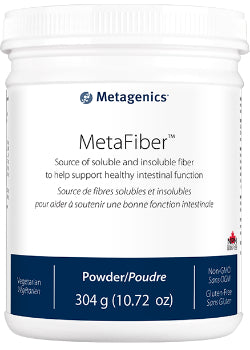
MetaFiber is a fibre blend drink mix designed to support healthy intestinal transit time and bowel regularity. One serving provides 6g of soluble and 6g of insoluble fiber and may provide gentle relief for occasional constipation. [POWDER]
Each serving contains:
Calories 5
Carbohydrate 7g
Fibre 6g
Insoluble Fibre 6g
Oat Fibre 6.3g
Apple Fibre 1.6g
Important Information:
Consult your healthcare practitioner if symptoms worsen or if laxative effect does not occur within seven days, or if you have symptoms such as abdominal pain, nausea, vomiting, or fever.
Dosage
Adults blend, shake, or briskly stir 1 level scoop (8g) of MetaFiber with 236 mL (8 fl. oz) of juice or other beverage as directed by your healthcare practitioner. Effects observed 12-72 hours after first dose and may take up to 3 days. Take 2 hours before or after taking other medications.
Premium Metagenics Formulas for Whole‑Body Health
For over 30 years, Metagenics has been dedicated to scientific discovery and bringing you the highest quality supplements. Some of Metagenics most popular supplements inlcude Metagenics Ultra Flora, Probiotics, Phytomulti, Clear Change, Ultra Glucose Control, Candibactin-BR and Candibactin-AR. From gluten-free to non-GMO, Metagenics aims to deliver clear and accurately labeled nutritional solutions with over 120 vegetarian supplements.
Fibre
The standard North American diet is largely deficient in fibre because of the refining process. It strips the fibrous coat off of grains and removes the skins of fruits and vegetables. Thus the food becomes easier to process but deficient in fibre and nutrients. Colon cell growths,
diabetes
and
high cholesterol
are just a few of the conditions that afflict millions of people and can be helped by proper fibre intake. There are several different types of fibre each with their own health benefits.
Bran, gums and mucilages are fibres that regulate blood sugar and lower cholesterol. They also bind to toxins and waste products in the intestines, ensuring that these harmful agents pass through the digestive tract without being reabsorbed by the body.
Cellulose is an indigestible fibre that is found in fruit and vegetable skins. Because it is not absorbed in the gastrointestinal tract it bulks the stool and acts as an intestinal cleanser. It helps to prevent and treat
hemorrhoids,
varicose veins, constipation and
colitis. It also binds to toxins so that they are not absorbed into the body
Hemicellulose is also an indigestible fibre that is found in fruit and vegetables. It regulates the water content of the stool. It is used as a treatment for weight loss, constipation, detoxification and the prevention of colon cell growths.
Pectin
slows the absorption of food after meals thereby decreasing the rate at which blood sugar enters the body. This is especially beneficial for people with diabetes whose bodies cannot properly take sugar into cells. Pectin, especially apple pectin, also binds to fats and bile acids. Thus it is used to prevent gallstones, and lower cholesterol. Citrus pectin has been studied for its ability to remove toxins from the body, reduce side effects from radiation therapy and limit tumour metastasis.
Lignin is a fibre that has an affinity for fats and bile acids. It binds to these substances in the intestines and prevents their absorption or resorption into the body. Lignin is used to lower cholesterol, prevent gallstones and treat diabetes and colon cell growths.
Benefits of a high fibre diet may include:
Helps maintain cholesterol levels already within the normal range
Supports healthy blood sugar levels when used as part of the diet
Improve bowel function
Feed intestinal bacteria
Decrease intestinal permeability
Intestinal Health
The intestine is the main absorptive area of the digestive tract. It is essentially a tube with a thin mucosal lining and lots of blood vessels on the inside and muscles around the outside. It has its own immune tissue called GALT, or gut-associated lymphoid tissue. The inner lining is filled with little fingers, or projection of the mucosa, which greatly increases its absorptive surface.
Lying on the membrane are many friendly organisms, which help our body with the digestive process. The small intestine attaches to the stomach. Near it's beginning, ducts from the liver and
pancreas
release digestive juices. These juices mix with the partially digested food from the stomach and continue the digestive process. Nutrients are absorbed through the thin intestinal wall and transported via the bloodstream, to where they are needed. The liver also excretes processed toxins and fats through the bile. These substances must be carried through the intestine without being absorbed.
The remainder of the food is pushed through into the large intestine. The main function of the large intestine is the preparation of stool for excretion. In order to do this the digested food must be dehydrated and compacted. The last bit of nutrients may also be absorbed here.
Some of the most important players in intestinal health are not part of our own body. Friendly intestinal bacteria, often called
probiotics, are an essential part of digestion. They break down food particles, manufacture vitamins and prevent the infection of the tract with other microbes. Each bowel movement actually contains millions of these friendly bacteria; they are in a constant state of renewal. Many concerns like
indigestion, gas, bloating and
constipation
can be due to an imbalance of the intestinal bacteria. It is easy to upset this balance by improper diet or taking medications like antibiotics.
Carefully SelectedShips to the U.S.Wellness EssentialsTrusted Brands
Product Details
Fibre
The standard North American diet is largely deficient in fibre because of the refining process. It strips the fibrous coat off of grains and removes the skins of fruits and vegetables. Thus the food becomes easier to process but deficient in fibre and nutrients. Colon cell growths,
diabetes
and
high cholesterol
are just a few of the conditions that afflict millions of people and can be helped by proper fibre intake. There are several different types of fibre each with their own health benefits.
Bran, gums and mucilages are fibres that regulate blood sugar and lower cholesterol. They also bind to toxins and waste products in the intestines, ensuring that these harmful agents pass through the digestive tract without being reabsorbed by the body.
Cellulose is an indigestible fibre that is found in fruit and vegetable skins. Because it is not absorbed in the gastrointestinal tract it bulks the stool and acts as an intestinal cleanser. It helps to prevent and treat
hemorrhoids,
varicose veins, constipation and
colitis. It also binds to toxins so that they are not absorbed into the body
Hemicellulose is also an indigestible fibre that is found in fruit and vegetables. It regulates the water content of the stool. It is used as a treatment for weight loss, constipation, detoxification and the prevention of colon cell growths.
Pectin
slows the absorption of food after meals thereby decreasing the rate at which blood sugar enters the body. This is especially beneficial for people with diabetes whose bodies cannot properly take sugar into cells. Pectin, especially apple pectin, also binds to fats and bile acids. Thus it is used to prevent gallstones, and lower cholesterol. Citrus pectin has been studied for its ability to remove toxins from the body, reduce side effects from radiation therapy and limit tumour metastasis.
Lignin is a fibre that has an affinity for fats and bile acids. It binds to these substances in the intestines and prevents their absorption or resorption into the body. Lignin is used to lower cholesterol, prevent gallstones and treat diabetes and colon cell growths.
Benefits of a high fibre diet may include:
Helps maintain cholesterol levels already within the normal range
Supports healthy blood sugar levels when used as part of the diet
Improve bowel function
Feed intestinal bacteria
Decrease intestinal permeability
Intestinal Health
The intestine is the main absorptive area of the digestive tract. It is essentially a tube with a thin mucosal lining and lots of blood vessels on the inside and muscles around the outside. It has its own immune tissue called GALT, or gut-associated lymphoid tissue. The inner lining is filled with little fingers, or projection of the mucosa, which greatly increases its absorptive surface.
Lying on the membrane are many friendly organisms, which help our body with the digestive process. The small intestine attaches to the stomach. Near it's beginning, ducts from the liver and
pancreas
release digestive juices. These juices mix with the partially digested food from the stomach and continue the digestive process. Nutrients are absorbed through the thin intestinal wall and transported via the bloodstream, to where they are needed. The liver also excretes processed toxins and fats through the bile. These substances must be carried through the intestine without being absorbed.
The remainder of the food is pushed through into the large intestine. The main function of the large intestine is the preparation of stool for excretion. In order to do this the digested food must be dehydrated and compacted. The last bit of nutrients may also be absorbed here.
Some of the most important players in intestinal health are not part of our own body. Friendly intestinal bacteria, often called
probiotics, are an essential part of digestion. They break down food particles, manufacture vitamins and prevent the infection of the tract with other microbes. Each bowel movement actually contains millions of these friendly bacteria; they are in a constant state of renewal. Many concerns like
indigestion, gas, bloating and
constipation
can be due to an imbalance of the intestinal bacteria. It is easy to upset this balance by improper diet or taking medications like antibiotics.
🌿
Daily Wellness
Easy to add to your everyday health routine.
✅
Carefully Selected
Chosen with quality and customer needs in mind.
💊
Simple to Use
Designed for convenient daily supplementation.
🚚
Ships to the U.S.
Fast, reliable shipping to U.S. customers.
Choosing a selection results in a full page refresh.