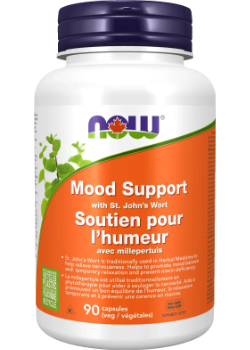
NOW® Mood Support is a unique, nutritional supplement that combines vitamins, minerals, amino acids and herbal extracts that aid in the support of a healthy nervous system and a positive, balanced mood state. Uniquely uses powerful amino acids as the basis for formula, where most products use Herbs or EFA’s for their mood formulas. Mood Support’s comprehensive formula is unparalleled in the market. [VCAPS]
Each capsule contains:
Thiamine (Vitamin B1) (as Thiamine Hydrochloride) 1 mg
Niacinamide (Vitamin B3) 12.5 mg
Vitamin B6 (as Pyridoxine Hydrochloride) 5 mg
Folic Acid 200 mcg
Vitamin B12 (as Cyanocobalamin) 100 mcg
Pantothenic Acid (Vitamin B5) (Calciumd-pantothenate) 25 mg
Magnesium (Magnesium Oxide) 25 mg
Zinc (Zinc L-methionine) 2.5 mg
Manganese (Manganese HVP chelate) 1 mg
5-hydroxytryptophan (Griffonia simplicifolia Seed) 10 mg
Taurine (free-form) 62.5 mg
L-Theanine 25 mg
St. John’s Wort (Hypericum perforatum herb tops) (3-6:1 Extract)(standardized to 0.68 mg Hypericin) 225 mg
Valerian (Valerian officinalis) ( Root) 25 mg
Holy Basil(Ocimum tenuliflorun Leaf)(8-15:1 Extract) (standardized to contain 1 mg Ursolic Acid) 50 mg
GABA(Gamma-aminobutyric Acid) 125 mg
Non-Medicinal Ingredients:
Veg Capsule (hypromellose, water), Cellulose, Magnesium Stearate (vegetable source), Silica, Stearic Acid (vegetable source)
Important Information:
Keep out of reach of children. Please see below for more information.
Dosage
Adult Dosage: Take 2 capsules twice daily with food, a few hours before or after taking other medications or natural health products
Since 1968 NOW has been a leader in the natural products industry. NOW Foods is an award-winning and highly respected manufacturer of vitamins, minerals, dietary supplements and natural foods. Now Foods brings you over 1600 Natural Foods, Supplements, Sports Nutrition and Personal Care Products. NOW supplements are high quality products at affordable prices.
Risk Information:
Do not use if you are pregnant, have scleroderma, taking antidepressant [e.g. selective
serotonin
reuptake inhibitors (SSRI)], cardiovascular, contraceptive medications, blood thinners, anti-HIV agents and/or medications to suppress the immune system (immunosuppressive medications), products that cause drowsiness, or with alcohol. Consult a health care practitioner prior to use if you are breastfeeding, taking carbidopa or drugs/supplements with serotonergic activity (e.g. L-tryptophan, SAMe, St. John’s wort, antidepressants, pain killers, over the counter cough and cold medication containing dextromethorphan, anti-nausea medication and anti-migraine medication) or if you are taking antianxiety or seizure medications, antihistamines, bronchodilators, muscle relaxants and/or opiates, have a heart condition or diabetes, if you are taking any heart or blood pressure medication or if symptoms persist or worsen. Stop use and consult a health care practitioner if you experience any of the following symptoms within a few hours after taking this product:
changes in mental state such as restlessness or confusion, increased heart rate, enlarged pupils, loss of muscle coordination, sweating, shivering and/or gastrointestinal symptoms such as nausea, vomiting, diarrhea. Avoid prolonged exposure to sunlight, ultraviolet light (UV) or UV therapy. Some people may experience diarrhea, nausea, vomiting and abdominal pain, restlessness and/or headaches and drowsiness. Exercise caution if operating heavy machinery, driving a motor vehicle or involved in activities requiring mental alertness. Stop use if hypersensitivity/allergy occurs.
ST. JOHN'S WORT USES
St. John's Wort, named after St. John the Baptist, is a perennial herb native to Europe but found in many parts of the world today. Its cheerful yellow flowers, resembling mini-sunbursts, bloom around the summer solstice, adding colour to meadows and fields. Interestingly, St. John’s Wort flowers release a red pigment when crushed, a phenomenon aptly named "solar infusion." This quality symbolizes the sun's energy encapsulated within the plant. The St. John’s Wort plant gets its scientific name, Hypericum perforatum, from the Greek words "hyper" (above) and "eikon" (picture), alluding to St. John's Worts traditional uses as a protective charm hung above doors and windows.
The medicinal use of St. John's Wort dates back centuries. Notably, it was used by the Greeks to treat a variety of ailments, and throughout the Middle Ages, it gained a reputation as a herb with protective qualities. In traditional folk medicine, St. John's Wort was often used to alleviate conditions such as wounds, burns, and nervous disorders.
A complex biochemical makeup lies at the heart of St. John's Wort's healing potential. The herb contains numerous bioactive compounds, including hypericin, hyperforin, and flavonoids. Hypericin, in particular, has garnered attention for its robust therapeutic effects, although the interplay of the various components (otherwise known as "synergy") is likely responsible for the herb's overall efficacy.
Key Health Benefits & Uses For St. John's Wort
While St. John's Wort has a rich historical tapestry, it still figures prominently in modern herbal medicine. Here are some of the most celebrated uses of St. John’s Wort today:
Antidepressant
– St. John's Wort is renowned for its ability to alleviate mild to moderate depression and anxiety. In fact, many studies have shown that St. John's Wort is not only effective at fighting mild to moderate depression, obsessive-compulsive disorder (OCD), and anxiety by rebalancing neurotransmitters in the brain but also has far fewer potential side effects than most other prescription antidepressants, such as loss of sex drive. Also noteworthy is the fact that John's Wort is non-habit-forming.
Anti-Inflammatory
– St. John's Wort possesses scientifically demonstrated antibacterial and anti-inflammatory effects. Indeed, research has shown that the active compounds in the plant, such as hyperforin and hypericin, can effectively help modulate the immune response and reduce pro-inflammatory cytokines while stimulating anti-inflammatory cytokines. This makes it a valuable remedy for
osteoarthritis,
rheumatoid arthritis, inflammatory bowel disease,
asthma, gout, acne, eczema,
dermatitis, and many other inflammatory disorders.
Antiviral
– Research on the antiviral potential of St. John's Wort has shown that it possesses considerable antiviral properties against a whole host of viruses, but perhaps most notably, those affecting the respiratory tract, including infectious
bronchitis. In recent years, it has also shown tremendous potential in studies as an antiviral agent against severe acute respiratory syndrome coronavirus 2 (SARS-CoV-2) infection.
PMS
&
Menopause
Symptom Relief
– Given its demonstrated benefits in lifting moods and relieving depressive symptoms, it should come as no surprise that St. John's Wort is commonly recommended to soothe PMS and menopausal symptoms, most notably depression,
chronic fatigue
and hormonal imbalance. In menopause, in particular, research has shown that St. John's Wort supplementation may result in a substantial improvement in both psychological and psychosomatic symptoms in over 76% of women.
Skin Health
– St. John's Wort's soothing and anti-inflammatory qualities have made it a popular remedy for skin ailments, including burns, wounds, and eczema. It can effectively relieve skin irritations, reduce redness, and promote overall health. St. John's Wort-infused oils, ointments, and creams are also ideal for topical application to aid in wound healing and alleviate symptoms of conditions like eczema, dermatitis, and others.
Who Should Consider Using St. John's Wort?
Incorporating St. John's Wort into one's daily regimen may be especially beneficial for individuals grappling with mood disorders, including mild to moderate depression, anxiety or mood swings. It may also be an excellent idea for those looking to support their neurotransmitter balance, such as serotonin, which plays a crucial role in mood regulation, and dopamine, which is intimately involved in pleasure, satisfaction and motivation.
Moreover, those dealing with seasonal affective disorder (SAD) may find John's Wort especially beneficial to tame symptoms such as lethargy, low mood and moodiness during the darker months. In addition, those trying to quit drinking may be interested in St John's Wort for its ability to reduce alcohol withdrawal symptoms and prevent cravings.
St-John’s Wort Supplement Varieties
St. John's Wort is available in various forms and potencies, including capsules and tablets, which offer a convenient and standardized dose. St. John's Wort is also frequently found in tincture form, which is convenient and portable and offers customizable dosing and ease of administration. Another advantage of tinctures is that the alcohol used for extraction is a highly effective solvent that can extract a broad spectrum of plant constituents, including water-soluble and alcohol-soluble compounds. This makes tinctures a superior way to capture all of the medicinal properties of a plant.
Herbal teas are another option that, while milder in effect, offers a soothing mode of administration. Oils, ointments, and salves infused with St. John's Wort extract are yet another option and ideal for topical use to address all sorts of skin conditions.
Quality supplements typically specify the concentration of active compounds, such as hypericin, which indicates the formulation's quality and efficacy.
Final Considerations
Some individuals may experience mild and transient side effects, such as gastrointestinal discomfort, dizziness, or skin sensitivity to sunlight (photosensitivity).
One of the most significant concerns is St. John's Wort's potential to interact with various medications, including antidepressants, birth control pills, and anticoagulants, reducing their effectiveness. Additionally, the herb may induce the metabolism of certain drugs, altering their blood concentrations and potentially leading to inadequate treatment outcomes. Individuals with pre-existing medical conditions, particularly those affecting the liver or with a history of bipolar disorder, should exercise caution when considering St. John's Wort, and consultation with a healthcare professional is essential to assess its safety and potential interactions.
Pregnant and breastfeeding women are advised to avoid its use due to limited safety data in these populations.
Carefully SelectedShips to the U.S.Wellness EssentialsTrusted Brands
Product Details
Risk Information:
Do not use if you are pregnant, have scleroderma, taking antidepressant [e.g. selective
serotonin
reuptake inhibitors (SSRI)], cardiovascular, contraceptive medications, blood thinners, anti-HIV agents and/or medications to suppress the immune system (immunosuppressive medications), products that cause drowsiness, or with alcohol. Consult a health care practitioner prior to use if you are breastfeeding, taking carbidopa or drugs/supplements with serotonergic activity (e.g. L-tryptophan, SAMe, St. John’s wort, antidepressants, pain killers, over the counter cough and cold medication containing dextromethorphan, anti-nausea medication and anti-migraine medication) or if you are taking antianxiety or seizure medications, antihistamines, bronchodilators, muscle relaxants and/or opiates, have a heart condition or diabetes, if you are taking any heart or blood pressure medication or if symptoms persist or worsen. Stop use and consult a health care practitioner if you experience any of the following symptoms within a few hours after taking this product:
changes in mental state such as restlessness or confusion, increased heart rate, enlarged pupils, loss of muscle coordination, sweating, shivering and/or gastrointestinal symptoms such as nausea, vomiting, diarrhea. Avoid prolonged exposure to sunlight, ultraviolet light (UV) or UV therapy. Some people may experience diarrhea, nausea, vomiting and abdominal pain, restlessness and/or headaches and drowsiness. Exercise caution if operating heavy machinery, driving a motor vehicle or involved in activities requiring mental alertness. Stop use if hypersensitivity/allergy occurs.
ST. JOHN'S WORT USES
St. John's Wort, named after St. John the Baptist, is a perennial herb native to Europe but found in many parts of the world today. Its cheerful yellow flowers, resembling mini-sunbursts, bloom around the summer solstice, adding colour to meadows and fields. Interestingly, St. John’s Wort flowers release a red pigment when crushed, a phenomenon aptly named "solar infusion." This quality symbolizes the sun's energy encapsulated within the plant. The St. John’s Wort plant gets its scientific name, Hypericum perforatum, from the Greek words "hyper" (above) and "eikon" (picture), alluding to St. John's Worts traditional uses as a protective charm hung above doors and windows.
The medicinal use of St. John's Wort dates back centuries. Notably, it was used by the Greeks to treat a variety of ailments, and throughout the Middle Ages, it gained a reputation as a herb with protective qualities. In traditional folk medicine, St. John's Wort was often used to alleviate conditions such as wounds, burns, and nervous disorders.
A complex biochemical makeup lies at the heart of St. John's Wort's healing potential. The herb contains numerous bioactive compounds, including hypericin, hyperforin, and flavonoids. Hypericin, in particular, has garnered attention for its robust therapeutic effects, although the interplay of the various components (otherwise known as "synergy") is likely responsible for the herb's overall efficacy.
Key Health Benefits & Uses For St. John's Wort
While St. John's Wort has a rich historical tapestry, it still figures prominently in modern herbal medicine. Here are some of the most celebrated uses of St. John’s Wort today:
Antidepressant
– St. John's Wort is renowned for its ability to alleviate mild to moderate depression and anxiety. In fact, many studies have shown that St. John's Wort is not only effective at fighting mild to moderate depression, obsessive-compulsive disorder (OCD), and anxiety by rebalancing neurotransmitters in the brain but also has far fewer potential side effects than most other prescription antidepressants, such as loss of sex drive. Also noteworthy is the fact that John's Wort is non-habit-forming.
Anti-Inflammatory
– St. John's Wort possesses scientifically demonstrated antibacterial and anti-inflammatory effects. Indeed, research has shown that the active compounds in the plant, such as hyperforin and hypericin, can effectively help modulate the immune response and reduce pro-inflammatory cytokines while stimulating anti-inflammatory cytokines. This makes it a valuable remedy for
osteoarthritis,
rheumatoid arthritis, inflammatory bowel disease,
asthma, gout, acne, eczema,
dermatitis, and many other inflammatory disorders.
Antiviral
– Research on the antiviral potential of St. John's Wort has shown that it possesses considerable antiviral properties against a whole host of viruses, but perhaps most notably, those affecting the respiratory tract, including infectious
bronchitis. In recent years, it has also shown tremendous potential in studies as an antiviral agent against severe acute respiratory syndrome coronavirus 2 (SARS-CoV-2) infection.
PMS
&
Menopause
Symptom Relief
– Given its demonstrated benefits in lifting moods and relieving depressive symptoms, it should come as no surprise that St. John's Wort is commonly recommended to soothe PMS and menopausal symptoms, most notably depression,
chronic fatigue
and hormonal imbalance. In menopause, in particular, research has shown that St. John's Wort supplementation may result in a substantial improvement in both psychological and psychosomatic symptoms in over 76% of women.
Skin Health
– St. John's Wort's soothing and anti-inflammatory qualities have made it a popular remedy for skin ailments, including burns, wounds, and eczema. It can effectively relieve skin irritations, reduce redness, and promote overall health. St. John's Wort-infused oils, ointments, and creams are also ideal for topical application to aid in wound healing and alleviate symptoms of conditions like eczema, dermatitis, and others.
Who Should Consider Using St. John's Wort?
Incorporating St. John's Wort into one's daily regimen may be especially beneficial for individuals grappling with mood disorders, including mild to moderate depression, anxiety or mood swings. It may also be an excellent idea for those looking to support their neurotransmitter balance, such as serotonin, which plays a crucial role in mood regulation, and dopamine, which is intimately involved in pleasure, satisfaction and motivation.
Moreover, those dealing with seasonal affective disorder (SAD) may find John's Wort especially beneficial to tame symptoms such as lethargy, low mood and moodiness during the darker months. In addition, those trying to quit drinking may be interested in St John's Wort for its ability to reduce alcohol withdrawal symptoms and prevent cravings.
St-John’s Wort Supplement Varieties
St. John's Wort is available in various forms and potencies, including capsules and tablets, which offer a convenient and standardized dose. St. John's Wort is also frequently found in tincture form, which is convenient and portable and offers customizable dosing and ease of administration. Another advantage of tinctures is that the alcohol used for extraction is a highly effective solvent that can extract a broad spectrum of plant constituents, including water-soluble and alcohol-soluble compounds. This makes tinctures a superior way to capture all of the medicinal properties of a plant.
Herbal teas are another option that, while milder in effect, offers a soothing mode of administration. Oils, ointments, and salves infused with St. John's Wort extract are yet another option and ideal for topical use to address all sorts of skin conditions.
Quality supplements typically specify the concentration of active compounds, such as hypericin, which indicates the formulation's quality and efficacy.
Final Considerations
Some individuals may experience mild and transient side effects, such as gastrointestinal discomfort, dizziness, or skin sensitivity to sunlight (photosensitivity).
One of the most significant concerns is St. John's Wort's potential to interact with various medications, including antidepressants, birth control pills, and anticoagulants, reducing their effectiveness. Additionally, the herb may induce the metabolism of certain drugs, altering their blood concentrations and potentially leading to inadequate treatment outcomes. Individuals with pre-existing medical conditions, particularly those affecting the liver or with a history of bipolar disorder, should exercise caution when considering St. John's Wort, and consultation with a healthcare professional is essential to assess its safety and potential interactions.
Pregnant and breastfeeding women are advised to avoid its use due to limited safety data in these populations.
🌿
Daily Wellness
Easy to add to your everyday health routine.
✅
Carefully Selected
Chosen with quality and customer needs in mind.
💊
Simple to Use
Designed for convenient daily supplementation.
🚚
Ships to the U.S.
Fast, reliable shipping to U.S. customers.
Choosing a selection results in a full page refresh.