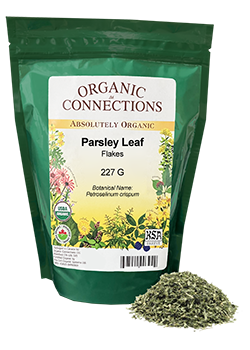
Parsley is a well known herb that’s green in colour, has a long skinny stem and grows branches with trios of three pointed leaves with serrated edges. Often used in Italian seasoning blends, with meat dishes or potatoes, it has also historically been used for its antioxidant benefits to support overall health and promote heart health. Organic Connections harvests certified organic parsley, dehydrates it and uses the flakes to provide a high quality bulk herb. It can be used for cooking, or blended with other herbs to make a capsule or tea. [FLAKES]
Contains:
Organic Parsley
Important Information:
Store in an airtight container and keep in a cool, dry place. Keep out of reach of children
Dosage
Add to pasta, garlic toast, rice and potato dishes, soups, vegetables, sauces, gravies, dressings, stuffing, fish, eggs, meats. Add it directly to your favourite dishes, or reconstitute it first by soaking in ice water for 5 to 10 minutes for an even fresher real bite.
Certified Organic Loose Herbal Teas & Remedies
Organic Connections makes quality food supplements including: Organic ground Cinnamon powder, both Ceylon and Cassia and Organic Slippery Elm Bark powder to provide fibre and support intestinal health. Organic Connections believes in quality, natural and organic ingredients to provide the best in natural health.
Parsley
By: Naturopathic Doctor ( N.D.)
Next time you're cooking with parsley keep in mind you're also doing your body a favour...
Parsley has been added to food, and used as a garnish, for centuries for several reasons. Firstly it has a pleasant taste and aroma. Secondly the oils contained in Parsley are antibacterial and antifungal, which was important in the days prior to the advent of refrigeration. Thirdly parsley sprigs, when chewed after a meal, decreased breath odour. These realizations are the basis for our use of parsley today as a medicinal agent.
Parsley is recommended for fungal infections (like thrush in adults), bacterial infections (especially in the digestive, urinary and respiratory tract) and bad breath. Additionally parsley contains many different nutrients including
chlorophyll
(an internal deodorizer),
vitamin C
and
vitamin K.
Parsley can be used as a raw leaves, dried herb, encapsulated oil or liquid oil. Fresh parsley can be added to dishes or chewed after a meal. The oil contains volatile compounds that can be toxic in high doses and should be used cautiously. A popular way to use parsley oil is as a gargle. Parsley may be found in formulas for urinary tract or respiratory tract health.
Parsley, when used as a food, has very few side effects. Most side effects and cautions are relevant only when parsley supplements are used. Parsley contains volatile oils (apiole and myristicin) that are toxic in high doses. Parsley supplements should be used with caution by those with impaired liver and kidney function, individuals taking MAO inhibitors or warfarin and individuals with blood disorders.
Parsley– Quick Facts
Parts Used
· Leaves, Oil.
Applications
·
Halitosis, Fungal And Bacterial Infections
Optimum Dosage
· Oil, Dilute 1-3 Drops Of Oil In Water As A Gargle, Capsules, 2-6 Capsules Daily. (Clinical Doses May Be Higher As Recommended By Your Practitioner).
Works Well With
·
Alfalfa,
chlorophyll,
Colloidal Silver,
Grapefruit Seed Extract,
Fenugreek
Important Information
· Those On Mao Inhibitors Or Warfarin Should Not Use Parsley.
· Toxicity Of Parsley Capsules Is Very Rare But May Cause Liver, Kidney And Liver Damage.
Carefully SelectedShips to the U.S.Wellness EssentialsTrusted Brands
Product Details
Parsley
By: Naturopathic Doctor ( N.D.)
Next time you're cooking with parsley keep in mind you're also doing your body a favour...
Parsley has been added to food, and used as a garnish, for centuries for several reasons. Firstly it has a pleasant taste and aroma. Secondly the oils contained in Parsley are antibacterial and antifungal, which was important in the days prior to the advent of refrigeration. Thirdly parsley sprigs, when chewed after a meal, decreased breath odour. These realizations are the basis for our use of parsley today as a medicinal agent.
Parsley is recommended for fungal infections (like thrush in adults), bacterial infections (especially in the digestive, urinary and respiratory tract) and bad breath. Additionally parsley contains many different nutrients including
chlorophyll
(an internal deodorizer),
vitamin C
and
vitamin K.
Parsley can be used as a raw leaves, dried herb, encapsulated oil or liquid oil. Fresh parsley can be added to dishes or chewed after a meal. The oil contains volatile compounds that can be toxic in high doses and should be used cautiously. A popular way to use parsley oil is as a gargle. Parsley may be found in formulas for urinary tract or respiratory tract health.
Parsley, when used as a food, has very few side effects. Most side effects and cautions are relevant only when parsley supplements are used. Parsley contains volatile oils (apiole and myristicin) that are toxic in high doses. Parsley supplements should be used with caution by those with impaired liver and kidney function, individuals taking MAO inhibitors or warfarin and individuals with blood disorders.
Parsley– Quick Facts
Parts Used
· Leaves, Oil.
Applications
·
Halitosis, Fungal And Bacterial Infections
Optimum Dosage
· Oil, Dilute 1-3 Drops Of Oil In Water As A Gargle, Capsules, 2-6 Capsules Daily. (Clinical Doses May Be Higher As Recommended By Your Practitioner).
Works Well With
·
Alfalfa,
chlorophyll,
Colloidal Silver,
Grapefruit Seed Extract,
Fenugreek
Important Information
· Those On Mao Inhibitors Or Warfarin Should Not Use Parsley.
· Toxicity Of Parsley Capsules Is Very Rare But May Cause Liver, Kidney And Liver Damage.
🌿
Daily Wellness
Easy to add to your everyday health routine.
✅
Carefully Selected
Chosen with quality and customer needs in mind.
💊
Simple to Use
Designed for convenient daily supplementation.
🚚
Ships to the U.S.
Fast, reliable shipping to U.S. customers.
Choosing a selection results in a full page refresh.