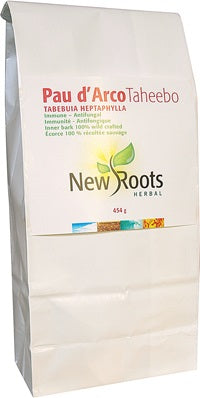
NEW ROOTS PAU D'ARCO TAHEEBO LOOSE TEANew RootsHerbal's brings youPau d'Arco Taheebotea which is beneficial for many ailments. Pau d'arco is confirmed as being an antiparisitic against various parasites, including malaria, schistosoma, and trypanosoma. Additionally, the herb has even demonstrated usefulness as an anti-inflammatory. Candida albicans, a fungus which causes yeast infections, has also been treated. Pau d'arco bark has active principles, mainly lapachol, quercetin and other flavonoids. Once the pau d'arco inner bark is dried and shredded it can be made into a tea which has a slight bitter or sour taste, and is brownish-colored. [LOOSE TEA]
Contains
Pau d’arco taheebo (Tabebuia heptaphylla) (inner bark), harvested in an ecologically friendly manner, only in a high-altitude mountain region. 100% wild-crafted.
Important Information:
Free of all common allergens, including: wheat, dairy, eggs, corn, and yeast.
Dosage
Add 3–4 teaspoons of powder to 600 ml of water. Boil for five minutes, then let simmer for 20 minutes. Thereafter, drink as a tea. Use purified water only. Take 2–3 times a day or as directed by your health-care practitioner.
Proudly Manufactured In Canada & Available
New Roots Herbal offers high-quality natural health products like their best-selling probiotics, digestive enzymes, chill pills, strong bones, acidophilus ultra and black cumin seed oil among hundreds more herbal remedies. Founded in 1985 New Roots Canada delivers formulas that were designed to contribute to the prevention and cure of disease at their core. You can buy all New Roots supplements at ca
PAU D'ARCO LOOSE TEA
Pau d'arco is an herb known by many names. The reason for this is simple: it was a deeply prized herb known by many of the indigenous tribes of South America. They were well aware of pau d'arco's numerous health benefits and used for health problems..
Pau d'arco tea or tincture concoctions have had beneficial effects.Candida albicans, a fungus which causes yeast infections, has also been treated by the pau d'arco herb. Clinical studies also showed strong in vitro activity against various other bacteria, fungi and yeast, including: Aspergillus, Staphylococcus aureus, Streptococcus, Helicobacter pylori (common cause of stomach ulcers), Bucella, tuberculosis, pneumonia, and dysentery. Antiviral properties have been displayed in vitro by pau d'arco against viruses such as herpes I and II, influenza, polio virus and vesicular stomatitis virus.
Pau d'arco is also confirmed as being an antiparisitic against various parasites, including malaria, schistosoma, and trypanosoma. Additionally, the herb has even demonstrated usefulness as an anti-inflammatory. Pau d'arco bark has active principles, mainly lapachol, quercetin and other flavonoids. Once the pau d'arco inner bark is dried and shredded it can be made into a tea which has a slight bitter or sour taste, and is brownish-colored.
Pau D'Arco
The Pau D'Arco tree is a tropical evergreen that grows in Central America, South America and the Caribbean. The medicinal effects of Pau D'Arco are attributed to lapachol. Lapachol suppoerts healthy cell growth. However lapachol may be toxic in doses that are needed to have an anticancer effect.
Pau D'Arco has also been found to have antiviral activity against herpes, the virus that causes
cold sores, and anti-protozoal activity against malaria. Topically, Pau D'Arco tea can be used to treat bacterial and fungal infections, insect or snakebites, minor skin injuries and
psoriasis.
Pau D'Arco's most medicinally effective part is the inner bark. Unfortunately harvesting the inner bark often results in the death of the tree. Increased demand for this tree has made Pau D'Arco an endangered species in some South and Central American countries. You may want to inquire as to the harvesting practices the company that provides the raw material for you.
Pau D'Arco supplements are made from a variety of species in the genus Tahebuia. Some supplements are made from the inner bark while others are a mixture of the bark with other less active plant parts. Few Pau D'Arco supplements are standardized to the lapachol content. All of these factors make it difficult to use Pau D'Arco safely. Due to the toxicity of lapachol internal use of Pau D'Arco is best undertaken with the guidance of a health professional. Pau D'Arco is available as dried bark, for tea, and encapsulated tree parts. Tea is traditionally used for its medicinal properties but very few of the medicinally active components of Pau D'Arco are water-soluble. Encapsulated dried bark, that is standardized, is the best supplemental form of Pau D'Arco.
Individuals with active bleeding or blood disorders should not use pau d'arco. Pau D'Arco interacts with blood thinners, aspirin and any herbal product that thins the blood. Pau D'Arco is not safe for use in pregnant and nursing women. High doses of lapachol can lead to anemia,
diarrhea, dizziness, nausea and vomiting.
Carefully SelectedShips to the U.S.Wellness EssentialsTrusted Brands
Product Details
PAU D'ARCO LOOSE TEA
Pau d'arco is an herb known by many names. The reason for this is simple: it was a deeply prized herb known by many of the indigenous tribes of South America. They were well aware of pau d'arco's numerous health benefits and used for health problems..
Pau d'arco tea or tincture concoctions have had beneficial effects.Candida albicans, a fungus which causes yeast infections, has also been treated by the pau d'arco herb. Clinical studies also showed strong in vitro activity against various other bacteria, fungi and yeast, including: Aspergillus, Staphylococcus aureus, Streptococcus, Helicobacter pylori (common cause of stomach ulcers), Bucella, tuberculosis, pneumonia, and dysentery. Antiviral properties have been displayed in vitro by pau d'arco against viruses such as herpes I and II, influenza, polio virus and vesicular stomatitis virus.
Pau d'arco is also confirmed as being an antiparisitic against various parasites, including malaria, schistosoma, and trypanosoma. Additionally, the herb has even demonstrated usefulness as an anti-inflammatory. Pau d'arco bark has active principles, mainly lapachol, quercetin and other flavonoids. Once the pau d'arco inner bark is dried and shredded it can be made into a tea which has a slight bitter or sour taste, and is brownish-colored.
Pau D'Arco
The Pau D'Arco tree is a tropical evergreen that grows in Central America, South America and the Caribbean. The medicinal effects of Pau D'Arco are attributed to lapachol. Lapachol suppoerts healthy cell growth. However lapachol may be toxic in doses that are needed to have an anticancer effect.
Pau D'Arco has also been found to have antiviral activity against herpes, the virus that causes
cold sores, and anti-protozoal activity against malaria. Topically, Pau D'Arco tea can be used to treat bacterial and fungal infections, insect or snakebites, minor skin injuries and
psoriasis.
Pau D'Arco's most medicinally effective part is the inner bark. Unfortunately harvesting the inner bark often results in the death of the tree. Increased demand for this tree has made Pau D'Arco an endangered species in some South and Central American countries. You may want to inquire as to the harvesting practices the company that provides the raw material for you.
Pau D'Arco supplements are made from a variety of species in the genus Tahebuia. Some supplements are made from the inner bark while others are a mixture of the bark with other less active plant parts. Few Pau D'Arco supplements are standardized to the lapachol content. All of these factors make it difficult to use Pau D'Arco safely. Due to the toxicity of lapachol internal use of Pau D'Arco is best undertaken with the guidance of a health professional. Pau D'Arco is available as dried bark, for tea, and encapsulated tree parts. Tea is traditionally used for its medicinal properties but very few of the medicinally active components of Pau D'Arco are water-soluble. Encapsulated dried bark, that is standardized, is the best supplemental form of Pau D'Arco.
Individuals with active bleeding or blood disorders should not use pau d'arco. Pau D'Arco interacts with blood thinners, aspirin and any herbal product that thins the blood. Pau D'Arco is not safe for use in pregnant and nursing women. High doses of lapachol can lead to anemia,
diarrhea, dizziness, nausea and vomiting.
🌿
Daily Wellness
Easy to add to your everyday health routine.
✅
Carefully Selected
Chosen with quality and customer needs in mind.
💊
Simple to Use
Designed for convenient daily supplementation.
🚚
Ships to the U.S.
Fast, reliable shipping to U.S. customers.
Choosing a selection results in a full page refresh.