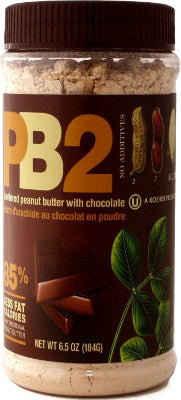
85% less fat calories than traditional peanut butter
All natural with no artificial flavours, sweeteners, or preservatives.
Made with high quality peanuts that are slowroasted and pressed to remove the oil
A traditional chocolate and peanut butter mixture that tastes wonderful in recipes that call for the use of peanut butter.
Depending upon how PB2 is mixed, each jar is approximately equivalent to an 18 ounce jar of regular peanut butter.
Quantity
Couldn't load pickup availability
PB2 Powdered Peanut Butter (Chocolate) - 184g
$10.49
Bell Plantation PB2 Powdered Peanut Butter (Chocolate) - 184g is a dietary supplement in powder form, intended for adults as part of a daily wellness routine.
SAVOR THE SECRET OF PB2!For Bell Plantation’s PB2 Powdered Peanut Butter, Superior quality peanuts are first slow roasted then pressed to remove 85% of the fat and oil. The finest cocoa beans are then blended in for a natural roasted peanut butter and chocolate flavour that’s rich in taste, easy to enjoy and wonderfully healthy! Peanut butter has always been a staple for the health conscious and physically active. But even peanut butter can be improved. PB2 Powered Peanut Butter reduces fat through a chemical-free process. Like all Bell Plantation products, PB2 is all natural, preservative free, and contains no artificial sweeteners, which makes them a sweet alternative for active lifestyles, dieters, and moms who want healthy snacks for their kids. [POWDER]
2 tbsp (12g) contains:
Calories 45
Fat 1g 1.5%
Saturated 0g 0%
Trans 0g 0%
Cholesterol 0mg 3%
Sodium 70mg 2%
Carbohydrate 6g 4%
Fibre 1g
Sugars 3g
Protein 4g
Vitamin A 0%
Vitamin C 0%
Calcium 0%
Iron 2%
Ingredients:
Roasted peanuts, cocoa powder, sugar, salt
Important Information:
Contains peanuts. All natural, kosher, gluten free.
Dosage
Mix 2 tbsp. of Chocolate PB2 with 1tsbp. of water and stir until smooth. Prepare as needed.
Bell Plantation, innovators of Canada’s best selling powdered Peanut Butter, available in original & chocolate. These powders are made from superior quality peanuts where 85% of the fat & oil is removed, a perfect edition to smoothies and baking. Discover Bell Plantation for the secret of PB2.
NUTS
For those of you who shy away from nuts due to fat content, take another look at the many health benefits of regular NUT consumption (in moderation, of course!) Let's crack the hard outer shell and get to the heart of these delicious and addictive treats. Here's everything you've ever wanted to know about nuts...
Nuts are a tasty way to lower your lower blood cholesterol
Why we're nuts about NUTS
Given the size of the average nut, it is amazing all the nutrients that can be packed into such as small package. Nuts such as almonds, walnuts, hazelnuts, macadamia nuts, pecans, pistachios and more... are a good source of
protein, fibre,
omega 3
and omega 9 fatty acids.
They are also high in
vitamin E, folate,
calcium,
magnesium
and
potassium. These nutritional properties make nuts a great choice for those looking for heart healthy foods, and those interested in both diabetes prevention & immune health.
I heart walnuts
The polyunsaturated fatty acids in nuts have been shown to help lower blood cholesterol, as well as possessing anti-inflammatory properties. The phytosterol content inhibits accumulation of fat in the artery walls, decreasing risk of heart attack and stroke.
Arginine, an amino acid found in a number of nuts is a precursor to nitric oxide, which acts to dilate blood vessels and help lower blood pressure.
calcium,
magnesium
and potassium also support healthy blood pressure. Nuts are high in
antioxidants, helping to prevent free radical damage to heart cells. Folate can decrease homocysteine levels, helping to prevent stroke, heart attack and other cardiovascular events. There is no denying that our hearts beat for nuts.
No nuts for you!
Despite all the pros of regular nut consumption (in moderation – I just had to say it again!), there are some individuals who would most likely benefit from avoiding them. There are certain foods that are more likely to cause a flare-up of Inflammatory Bowel diseases, like Crohns, Colitis and Diverticulitis, and nuts are one of these foods. Not all who suffer from these issues will find that they need to avoid nuts, but these individuals should always use caution when consuming nuts and be aware of any symptoms or exacerbation that can develop with their consumption. There is also some debate on how early nuts should be introduced into the diet. Especially when talking peanuts. Nuts tend to have a high allergenic potential, which at one time was a reason for delaying their introduction. Now, some research proposes that a delay is not necessary and may actually lead to a higher risk of allergy. The consensus seems to be that there is no consensus. Professionals say anytime between 12 and 36 months, nuts and nut butters can be introduced into the diet.
Raw versus Roasted... the debate continues.
When comparing nutritional information of raw versus roasted nuts, there is no denying that raw will always come out on top. That being said, these differences aren't as significant as some would believe and at the end of the day, dry roasted nuts still have nutritional value. The real difference between raw versus roasted nuts has very little to do with the protein, fibre or fat content of the nut itself, but rather the stability or shelf life, and perhaps equally as important is how the nuts are roasted – with or without oil, added salt, at what temperature, etc.
The natural unsaturated oils on nuts, as good for us as they may be, are fragile and oxidize quickly when exposed to heat, light and air. Because of this roasted nuts tend to have a much shorter shelf live and can become rancid much faster than raw nuts. Storing all nuts in an airtight container either in the fridge or freezer can help to delay this process.
Some nuts are roasted in oil, which most definitely adds to the fat content of the nut, and decreases nutritional value, as most times these oils are hydrogenated. Many roasted nuts are also salted, HEAVILY. Again this isn't great news for individuals looking to keep their salt intake to a minimum. Some nuts are also roasted at high temperatures. One rather alarming problem with this is that asparagine, an amino acid present in some nuts, specifically high in almonds, produces a by-product called acrylamide when processed or heated to high temperatures (above 120 degrees Celsius). In animal studies, acrylamide has been associated with an increased risk of developing several types of unhealthy cells. One way to avoid aspargine exposure, as well as ensure there is no oil or salt added to your roasted nuts, is to simply roast them yourself. If you do this at a low temperature over a longer period of time, you still get the roasted flavour that many prefer, while maintaining as many nutrients as possible.
Roasted nuts are also easier to digest than raw nuts, which may be good or bad depending on how you look at it. For individuals with compromised digestion to begin with, roasted nuts may prove an easier option. That being said, raw nuts that require a longer time and more energy to digest, can help to stabilize blood sugar and cause us to feel satiated for a longer period of time. This is one bonus for those eating nuts as a way to keep off or even help to lose a little extra weight.
Freshness guaranteed
Generally speaking nuts do have a season. They are usually harvested and at their most fresh and enjoyable in fall. Raw unshelled nuts have the longest shelf life and can be kept for up to one year if stored in a cool place. Even with raw nuts, once they are shelled, they are more prone to oxidization and becoming rancid. Again, be sure to store all unshelled nuts (roasted or raw) in an airtight container in the fridge or freezer. Take a look at the type of packaging and dates on all raw nuts, as well as the processing/roasting methods of all pre-packaged roasted nuts (look for added oils, sugars and preservatives- and avoid!). Use caution when buying nuts in bulk or from large bins, as it is hard know how long the nuts have been there and many of these containers are not airtight leaving their contents are more susceptible to oxidation.
Peanuts are no nut at all.
Few people realize that peanuts are actually not a nut or even a seed at all, but rather a legume and as such grow underground. Peanuts are rich in nutrients and contain about 25% protein, a little more than the average 'true nut'. That being said, there are some concerns about peanut consumption. Peanuts tend to be processed at even higher temperatures than other nuts. This is because peanuts are at a higher risk of being contaminated with the mold Aspergillus flavus, which produces a potentially harmful substance called aflatoxin. The high temperatures and processing methods may ensure these microorganisms are killed, but may also negate some of their nutritional properties. Peanut allergies are also quite common today, and many schools ban any peanut products from entering the schools, as even the smell of peanuts can cause anaphylactic shock in some individuals. It has been hypothesized that North American roasting techniques increase the allergen potential of peanuts by making specific allergens in peanuts more difficult to digest.
If you'd prefer to avoid peanuts, but are still looking for something to compliment that honey or jam, think other nut butters, such as almond butter, cashew butter, hazelnut butter and more. Nut butters come in both raw and roasted varieties. Read the label so you know what you are getting. Almond butter is great served with quartered apples, or as an added protein in your morning smoothie. Give them a try!
Moderation
Despite all the many health benefits of the NUT, I must once again remind you that, as with most delicious treats, nuts should always be consumed in moderation. One serving of nuts depends on the nut in question. For instance, one serving of almonds is equal to about 24 almonds. One serving of pistachios contains about 47, while a serving of walnuts consists of roughly 14 walnut halves.
Nuts may be high in many nutrients, but they also contain calories and fat, so be sure that you are taking some empty calories or refined carbohydrates out of your diet and substituting these protein, fibre and nutrient packed pieces in their place. Just always remember the rule of moderation. You can have too much of a good thing!
Carefully SelectedShips to the U.S.Wellness EssentialsTrusted Brands
Product Details
NUTS
For those of you who shy away from nuts due to fat content, take another look at the many health benefits of regular NUT consumption (in moderation, of course!) Let's crack the hard outer shell and get to the heart of these delicious and addictive treats. Here's everything you've ever wanted to know about nuts...
Nuts are a tasty way to lower your lower blood cholesterol
Why we're nuts about NUTS
Given the size of the average nut, it is amazing all the nutrients that can be packed into such as small package. Nuts such as almonds, walnuts, hazelnuts, macadamia nuts, pecans, pistachios and more... are a good source of
protein, fibre,
omega 3
and omega 9 fatty acids.
They are also high in
vitamin E, folate,
calcium,
magnesium
and
potassium. These nutritional properties make nuts a great choice for those looking for heart healthy foods, and those interested in both diabetes prevention & immune health.
I heart walnuts
The polyunsaturated fatty acids in nuts have been shown to help lower blood cholesterol, as well as possessing anti-inflammatory properties. The phytosterol content inhibits accumulation of fat in the artery walls, decreasing risk of heart attack and stroke.
Arginine, an amino acid found in a number of nuts is a precursor to nitric oxide, which acts to dilate blood vessels and help lower blood pressure.
calcium,
magnesium
and potassium also support healthy blood pressure. Nuts are high in
antioxidants, helping to prevent free radical damage to heart cells. Folate can decrease homocysteine levels, helping to prevent stroke, heart attack and other cardiovascular events. There is no denying that our hearts beat for nuts.
No nuts for you!
Despite all the pros of regular nut consumption (in moderation – I just had to say it again!), there are some individuals who would most likely benefit from avoiding them. There are certain foods that are more likely to cause a flare-up of Inflammatory Bowel diseases, like Crohns, Colitis and Diverticulitis, and nuts are one of these foods. Not all who suffer from these issues will find that they need to avoid nuts, but these individuals should always use caution when consuming nuts and be aware of any symptoms or exacerbation that can develop with their consumption. There is also some debate on how early nuts should be introduced into the diet. Especially when talking peanuts. Nuts tend to have a high allergenic potential, which at one time was a reason for delaying their introduction. Now, some research proposes that a delay is not necessary and may actually lead to a higher risk of allergy. The consensus seems to be that there is no consensus. Professionals say anytime between 12 and 36 months, nuts and nut butters can be introduced into the diet.
Raw versus Roasted... the debate continues.
When comparing nutritional information of raw versus roasted nuts, there is no denying that raw will always come out on top. That being said, these differences aren't as significant as some would believe and at the end of the day, dry roasted nuts still have nutritional value. The real difference between raw versus roasted nuts has very little to do with the protein, fibre or fat content of the nut itself, but rather the stability or shelf life, and perhaps equally as important is how the nuts are roasted – with or without oil, added salt, at what temperature, etc.
The natural unsaturated oils on nuts, as good for us as they may be, are fragile and oxidize quickly when exposed to heat, light and air. Because of this roasted nuts tend to have a much shorter shelf live and can become rancid much faster than raw nuts. Storing all nuts in an airtight container either in the fridge or freezer can help to delay this process.
Some nuts are roasted in oil, which most definitely adds to the fat content of the nut, and decreases nutritional value, as most times these oils are hydrogenated. Many roasted nuts are also salted, HEAVILY. Again this isn't great news for individuals looking to keep their salt intake to a minimum. Some nuts are also roasted at high temperatures. One rather alarming problem with this is that asparagine, an amino acid present in some nuts, specifically high in almonds, produces a by-product called acrylamide when processed or heated to high temperatures (above 120 degrees Celsius). In animal studies, acrylamide has been associated with an increased risk of developing several types of unhealthy cells. One way to avoid aspargine exposure, as well as ensure there is no oil or salt added to your roasted nuts, is to simply roast them yourself. If you do this at a low temperature over a longer period of time, you still get the roasted flavour that many prefer, while maintaining as many nutrients as possible.
Roasted nuts are also easier to digest than raw nuts, which may be good or bad depending on how you look at it. For individuals with compromised digestion to begin with, roasted nuts may prove an easier option. That being said, raw nuts that require a longer time and more energy to digest, can help to stabilize blood sugar and cause us to feel satiated for a longer period of time. This is one bonus for those eating nuts as a way to keep off or even help to lose a little extra weight.
Freshness guaranteed
Generally speaking nuts do have a season. They are usually harvested and at their most fresh and enjoyable in fall. Raw unshelled nuts have the longest shelf life and can be kept for up to one year if stored in a cool place. Even with raw nuts, once they are shelled, they are more prone to oxidization and becoming rancid. Again, be sure to store all unshelled nuts (roasted or raw) in an airtight container in the fridge or freezer. Take a look at the type of packaging and dates on all raw nuts, as well as the processing/roasting methods of all pre-packaged roasted nuts (look for added oils, sugars and preservatives- and avoid!). Use caution when buying nuts in bulk or from large bins, as it is hard know how long the nuts have been there and many of these containers are not airtight leaving their contents are more susceptible to oxidation.
Peanuts are no nut at all.
Few people realize that peanuts are actually not a nut or even a seed at all, but rather a legume and as such grow underground. Peanuts are rich in nutrients and contain about 25% protein, a little more than the average 'true nut'. That being said, there are some concerns about peanut consumption. Peanuts tend to be processed at even higher temperatures than other nuts. This is because peanuts are at a higher risk of being contaminated with the mold Aspergillus flavus, which produces a potentially harmful substance called aflatoxin. The high temperatures and processing methods may ensure these microorganisms are killed, but may also negate some of their nutritional properties. Peanut allergies are also quite common today, and many schools ban any peanut products from entering the schools, as even the smell of peanuts can cause anaphylactic shock in some individuals. It has been hypothesized that North American roasting techniques increase the allergen potential of peanuts by making specific allergens in peanuts more difficult to digest.
If you'd prefer to avoid peanuts, but are still looking for something to compliment that honey or jam, think other nut butters, such as almond butter, cashew butter, hazelnut butter and more. Nut butters come in both raw and roasted varieties. Read the label so you know what you are getting. Almond butter is great served with quartered apples, or as an added protein in your morning smoothie. Give them a try!
Moderation
Despite all the many health benefits of the NUT, I must once again remind you that, as with most delicious treats, nuts should always be consumed in moderation. One serving of nuts depends on the nut in question. For instance, one serving of almonds is equal to about 24 almonds. One serving of pistachios contains about 47, while a serving of walnuts consists of roughly 14 walnut halves.
Nuts may be high in many nutrients, but they also contain calories and fat, so be sure that you are taking some empty calories or refined carbohydrates out of your diet and substituting these protein, fibre and nutrient packed pieces in their place. Just always remember the rule of moderation. You can have too much of a good thing!
🌿
Daily Wellness
Easy to add to your everyday health routine.
✅
Carefully Selected
Chosen with quality and customer needs in mind.
💊
Simple to Use
Designed for convenient daily supplementation.
🚚
Ships to the U.S.
Fast, reliable shipping to U.S. customers.
Choosing a selection results in a full page refresh.