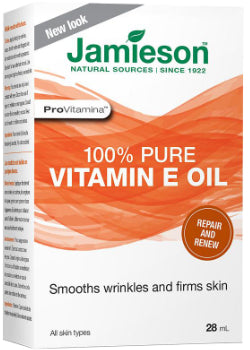
IMPROVE THE LOOK OF STRESSED SKIN ProVitamina Pure Vitamin E Oil from Jamieson is applied directly to wrinkles, scars, stretch marks and chapped skin to moisturize and smooth its appearance. Made with 100% pure Vitamin E oil, this ProVitamina product from Jamieson is clinically proven to soothe, revitalize and protect tired and dehydrated skin, while smoothing wrinkles and firming skin. [LIQUID]
Contains:
Pure Vitamin E (Tocopheryl acetate)
Important Information:
No colours added. Hypoallergenic and Paraben-free. For external use only. Avoid contact with eyes. Discontinue use if signs of irritation or rash appear. Consult a doctor if skin sensitivity occurs. Keep out of reach of children and animals.
Dosage
To Use: With supplied wand, apply directly to wrinkles, scars, stretch marks and chapped skin to moisturize and smooth appearance. Excellent for use after hair removal. Use morning and night on freshly cleansed skin.
Jamieson Supplements for Whole-Family Health & Wellness
Jamieson has consistently been voted Canada’s most trusted brand of vitamins.
Jamieson vitamins and supplements
most popular natural health products include Jamieson probiotic, multivitamin, Jamieson vitamin C, Omega 3 and D3, plus many more! They provide consumers with the purest, safest and most effective natural health solutions available.
Shop Jamieson right here
at ca
Vitamin E
Vitamin E is a powerful antioxidant that can prevent and treat many conditions associated with aging such as cardiovascular disease, cataracts, and Alzheimer's...
Vitamin E is a group of fat-soluble vitamins that act as
antioxidants
and thus neutralize free radicals. Free radicals are unstable molecules with an unpaired electron that are extremely reactive and damage surrounding cell membranes, fats, and fat soluble vitamins and nutrients. We encounter free radicals through environmental exposures, such as cigarette smoke, air pollution, and ultraviolet radiation from the sun (UV rays).
In doses less than 150IU per day, Vitamin E has been shown to increase life-span (by reducing all-cause mortality). Vitamin E is well known for the prevention of cardiovascular disease in a few different ways. First, it decreases platelet aggregation (clot formation), thus allowing the blood to flow more freely and bring more oxygen to the tissues. Also, as an antioxidant, vitamin E protects our artery walls from damage and prevents the oxidation of LDL cholesterol, both of which contribute to arterial plaque formation when left untreated.
Antioxidant properties allow vitamin E to be useful in potentially helping to prevent cell growths by reducing free radical damage to cellular genetic material. Vitamin E is also believed to be an anti-aging vitamin because its antioxidant effects reduce the cell damage that can lead to visible aging. Cataracts are caused by free radical damage of the lens of the eye and therefore vitamin E can help to prevent this damage. It has also been shown to be anti-inflammatory by inhibiting inflammatory pathways in the body. Vitamin E has been found to be protective against Alzheimer's disease, atherosclerosis, and diabetes mediated liver damage, as well as
PMS. It is also used to treat many existing conditions including infertility, fibrocystic breasts, anemia, and topically for scars.
Subtypes of Vitamin E
There are two groups of compounds that make up vitamin E: tocopherols and
tocotrienols. Each group contains four different forms that are named by the Greek letters alpha, beta, gamma and delta. The most biologically prevalent of these forms is the naturally sourced d-alpha-tocopherol.
Although previously overlooked due to their lower levels, recent research has brought
tocotrienols
into the spotlight. It has been found that tocotrienols possess powerful neuroprotective, and cholesterol-lowering properties outside those exhibited by tocopherols.
Recent research suggests that the various forms of vitamin E are not redundant in their health benefits, and thus a supplement containing all subgroups of both tocopherols and tocotrienols is preferred for general supplementation, although specific conditions can be targeted with certain subgroups.
Natural vs. Synthetic Vitamin E
Synthetic alpha-tocopherols are listed as "dl" (dl-alpha-tocopherols), as opposed to their natural d-alpha-tocopherol counterparts. These synthetic mixtures contain equal amounts of eight different stereoisomers of alpha-tocopherol, four of which are absorbed, and only one of which is the naturally occurring d-alpha-tocopherol. Thus, although synthetic alpha-tocopherols are less expensive, they are half as active by dose as naturally sourced options and may have different side-effects (see below).
Controversy
There has been some controversy about the beneficial effects of vitamin E and whether or not supplementation may actually be detrimental. One well publicized study showed that high-dose vitamin E supplementation was associated with a slightly reduced life span (increased risk of all-cause mortality). Another study showed that vitamin E supplementation may be implicated in increased risk of prostate cell growths after over one year of stopping supplementation. Co-supplementation with
selenium
eliminated this increased risk and an opposing study found that high blood levels of alpha and gamma-tocopherols in men was associated with a 50% lower risk of prostate cell growths. It goes without saying that further research is required. It is also interesting to note that the negative prostate study involved the use of synthetic vitamin E and the all-cause mortality study failed to specify the type of vitamin E used. Thus, whether or not the negative effects are unique to the synthetic forms has yet to be determined, but in any case males supplementing with vitamin E in higher doses should co-supplement with
selenium
to avoid possible negative effects.
It is also interesting to note that it has only been in the last few years that vitamin E research has begun studying each subset of tocopherol and tocotrienols separately. Thus, although high dosages of one form of vitamin E may be detrimental, others may actually elicit positive effects (e.g. High dose alpha-tocopherol vs. alpha-tocotrienols) and dosage recommendations for each will be different.
Formulations
Vitamin E is available in an oil or water (dry tablet) base. Because vitamin E is fat-soluble, it is preferable to have it in an oil base to promote absorption. The water-based supplement is beneficial for those who do not digest fats well, for example those with gallbladder dysfunction, and those whose conditions are aggravated by fats, for example acne sufferers.
VITAMIN E– QUICK FACTS
FOOD SOURCES
· Cold-pressed vegetable oils, green leafy vegetables, legumes, nuts, seeds, whole grains, eggs.
DEFICIENCY SYMPTOMS
· Infertility, anemia, menstrual problems, neuromuscular impairment.
OPTIMUM DOSAGE
· 10 – 200IU daily. (Clinical doses may be higher as recommended by your practitioner).
WORKS WELL WITH
·
Zinc,
vitamin C,
vitamin A, selenium.
IMPORTANT INFORMATION
· Vitamin E is a blood-thinning agent and should be used cautiously by those on blood thinning medication.
· Check with your health care provider before taking vitamin E if you suffer from diabetes, hyperthyroidism or hypertension. Daily dosing of (400IU or more) synthetic vitamin E without co-supplementation of selenium can actually increase the risk of prostate cell growths, and death.
· High dose supplementation early in pregnancy may cause birth defects.
· Signs of vitamin E toxicity include an increase in bleeding tendency, tiredness, weakness, headache, and nausea.
Carefully SelectedShips to the U.S.Wellness EssentialsTrusted Brands
Product Details
Vitamin E
Vitamin E is a powerful antioxidant that can prevent and treat many conditions associated with aging such as cardiovascular disease, cataracts, and Alzheimer's...
Vitamin E is a group of fat-soluble vitamins that act as
antioxidants
and thus neutralize free radicals. Free radicals are unstable molecules with an unpaired electron that are extremely reactive and damage surrounding cell membranes, fats, and fat soluble vitamins and nutrients. We encounter free radicals through environmental exposures, such as cigarette smoke, air pollution, and ultraviolet radiation from the sun (UV rays).
In doses less than 150IU per day, Vitamin E has been shown to increase life-span (by reducing all-cause mortality). Vitamin E is well known for the prevention of cardiovascular disease in a few different ways. First, it decreases platelet aggregation (clot formation), thus allowing the blood to flow more freely and bring more oxygen to the tissues. Also, as an antioxidant, vitamin E protects our artery walls from damage and prevents the oxidation of LDL cholesterol, both of which contribute to arterial plaque formation when left untreated.
Antioxidant properties allow vitamin E to be useful in potentially helping to prevent cell growths by reducing free radical damage to cellular genetic material. Vitamin E is also believed to be an anti-aging vitamin because its antioxidant effects reduce the cell damage that can lead to visible aging. Cataracts are caused by free radical damage of the lens of the eye and therefore vitamin E can help to prevent this damage. It has also been shown to be anti-inflammatory by inhibiting inflammatory pathways in the body. Vitamin E has been found to be protective against Alzheimer's disease, atherosclerosis, and diabetes mediated liver damage, as well as
PMS. It is also used to treat many existing conditions including infertility, fibrocystic breasts, anemia, and topically for scars.
Subtypes of Vitamin E
There are two groups of compounds that make up vitamin E: tocopherols and
tocotrienols. Each group contains four different forms that are named by the Greek letters alpha, beta, gamma and delta. The most biologically prevalent of these forms is the naturally sourced d-alpha-tocopherol.
Although previously overlooked due to their lower levels, recent research has brought
tocotrienols
into the spotlight. It has been found that tocotrienols possess powerful neuroprotective, and cholesterol-lowering properties outside those exhibited by tocopherols.
Recent research suggests that the various forms of vitamin E are not redundant in their health benefits, and thus a supplement containing all subgroups of both tocopherols and tocotrienols is preferred for general supplementation, although specific conditions can be targeted with certain subgroups.
Natural vs. Synthetic Vitamin E
Synthetic alpha-tocopherols are listed as "dl" (dl-alpha-tocopherols), as opposed to their natural d-alpha-tocopherol counterparts. These synthetic mixtures contain equal amounts of eight different stereoisomers of alpha-tocopherol, four of which are absorbed, and only one of which is the naturally occurring d-alpha-tocopherol. Thus, although synthetic alpha-tocopherols are less expensive, they are half as active by dose as naturally sourced options and may have different side-effects (see below).
Controversy
There has been some controversy about the beneficial effects of vitamin E and whether or not supplementation may actually be detrimental. One well publicized study showed that high-dose vitamin E supplementation was associated with a slightly reduced life span (increased risk of all-cause mortality). Another study showed that vitamin E supplementation may be implicated in increased risk of prostate cell growths after over one year of stopping supplementation. Co-supplementation with
selenium
eliminated this increased risk and an opposing study found that high blood levels of alpha and gamma-tocopherols in men was associated with a 50% lower risk of prostate cell growths. It goes without saying that further research is required. It is also interesting to note that the negative prostate study involved the use of synthetic vitamin E and the all-cause mortality study failed to specify the type of vitamin E used. Thus, whether or not the negative effects are unique to the synthetic forms has yet to be determined, but in any case males supplementing with vitamin E in higher doses should co-supplement with
selenium
to avoid possible negative effects.
It is also interesting to note that it has only been in the last few years that vitamin E research has begun studying each subset of tocopherol and tocotrienols separately. Thus, although high dosages of one form of vitamin E may be detrimental, others may actually elicit positive effects (e.g. High dose alpha-tocopherol vs. alpha-tocotrienols) and dosage recommendations for each will be different.
Formulations
Vitamin E is available in an oil or water (dry tablet) base. Because vitamin E is fat-soluble, it is preferable to have it in an oil base to promote absorption. The water-based supplement is beneficial for those who do not digest fats well, for example those with gallbladder dysfunction, and those whose conditions are aggravated by fats, for example acne sufferers.
VITAMIN E– QUICK FACTS
FOOD SOURCES
· Cold-pressed vegetable oils, green leafy vegetables, legumes, nuts, seeds, whole grains, eggs.
DEFICIENCY SYMPTOMS
· Infertility, anemia, menstrual problems, neuromuscular impairment.
OPTIMUM DOSAGE
· 10 – 200IU daily. (Clinical doses may be higher as recommended by your practitioner).
WORKS WELL WITH
·
Zinc,
vitamin C,
vitamin A, selenium.
IMPORTANT INFORMATION
· Vitamin E is a blood-thinning agent and should be used cautiously by those on blood thinning medication.
· Check with your health care provider before taking vitamin E if you suffer from diabetes, hyperthyroidism or hypertension. Daily dosing of (400IU or more) synthetic vitamin E without co-supplementation of selenium can actually increase the risk of prostate cell growths, and death.
· High dose supplementation early in pregnancy may cause birth defects.
· Signs of vitamin E toxicity include an increase in bleeding tendency, tiredness, weakness, headache, and nausea.
🌿
Daily Wellness
Easy to add to your everyday health routine.
✅
Carefully Selected
Chosen with quality and customer needs in mind.
💊
Simple to Use
Designed for convenient daily supplementation.
🚚
Ships to the U.S.
Fast, reliable shipping to U.S. customers.
Choosing a selection results in a full page refresh.