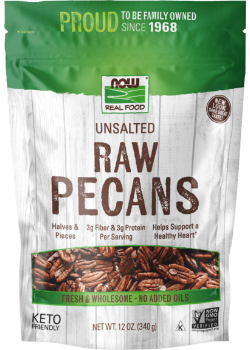
Ah, the Pecan, a favourite of nut lovers around the world, and for good reason. Not only are Pecans super-tasty, they’re loaded with nutrients, making them an ideal snack food for kids and adults alike. NOW® Real Food Raw Pecans are naturally free of sodium and sugar, and they’re a natural source of healthy fatty acids. Because you are what you eat, NOW® Real Food has been committed to providing delicious, healthy, natural and organic foods since 1968. [NUTS]
1/3 cup (28g) contains:
Calories 190
Fat 19g
Saturated 1.5g
Trans 0g
Cholesterol 0mg
Sodium 0mg
Carbohydrate 5g
Fibre 2g
Sugars 0g
Protein 6g
Vitamin A 0mcg
Vitamin C 0mcg
Calcium 0mg
Iron 3%
Magnesium 9%
Zinc 10%
Ingredient:
Raw Pecans
Important Information:
Keep out of reach of children. Refrigeration Recommended after opening.
Dosage
Roast them for snacking, chop them up for a healthy addition to your favourite recipe, or just eat them right out of the bag.
Since 1968 NOW has been a leader in the natural products industry. NOW Foods is an award-winning and highly respected manufacturer of vitamins, minerals, dietary supplements and natural foods. Now Foods brings you over 1600 Natural Foods, Supplements, Sports Nutrition and Personal Care Products. NOW supplements are high quality products at affordable prices.
PECANS – A QUICK AND EASY NUTRITIOUS SNACK
With the publicity of nut allergies, nuts have received a bad rap for being allergenic. Taking another look at the nutritional value of nuts we see that for those who are not allergic to them they offer a rich source of nutrients and culinary versatility to be added to salads, nut butters, shakes and your favorite yogurt.
What Are Pecans?
Pecans are a species of Hickory, Juglandaceae, native to Mexico, Southcentral and Southeastern United States. They are a tree nut known to Aborigines of North and South America for centuries. In the Algonquian language Pecan means 'nut requiring a rock to open'... Well thankfully we now have nut crackers and we can buy freshly hulled Pecans to eat.
There are more than 500 varieties of Pecans available world wide. Most common varieties are Desirable, Moreland, Stuart and Cape Fear.
Pecans, like other nuts, are a rich source of vitamins, minerals,
antioxidants,
protein
and healthy fats.
What Are Pecans Used For?
Pecans provide a rich source of energy (690 cal/100g) of healthy protein, fats, antioxidants, minerals, vitamins and nutrients.
Pecans are abundant in monounsaturated fatty acids called Oleic Acid. Oleic Acid helps reduce “bad” LDL Lipoprotein cholesterol from your blood and at the same time increases “good” HDL Lipoprotein cholesterol in your blood. Positively affecting your blood lipid profile minimizes the degree of cardiovascular disease that can develop over time.
Ellagic Acid is a potent polyphenolic antioxidant in Pecans. Other antioxidants in Pecans are Lutein,
Beta Carotene, Zeaxanthin, and
Vitamin E. Antioxidants are critical in keeping your cells healthy and free from oxidative damage. This includes your cardiovascular system, heart, brain, skin and all cell membranes. As such, antioxidants are important for cancer prevention. Specifically, Ellagic Acid prevents DNA binding to certain carcinogens such as nitrosamines and polycyclic aromatic hydrocarbons.
Pecan Vitamin E content is very high at 25g per 100g. Vitamin E is a powerful lipid-soluble antioxidant, which protects your cell membranes, mucus membranes and skin from oxidative cellular damage.
Pecans are rich in minerals, including
Calcium,
Magnesium, Iron,
Potassium, Manganese,
Selenium, and
Zinc. Minerals are important for structural tissues in your body, like your bones, nails, teeth, tendons, ligaments and muscles. They are also key co-factors for almost all enzyme systems in your body.
Pecans are an excellent source of B Vitamins like Riboflavin,
Niacin, Thiamine, Pantothenic Acid, B6 and Folate. B Vitamins work together for nerve transmission, hormone health and as co-factors in energy metabolism in your body.
How Do You Use Pecans?
Pecans are a great snacking nut. A quick handful along with a piece of fruit makes for a perfect combination of carbohydrate, protein and fat....along with all the antioxidants, vitamins and minerals Pecans offer.
Gently toasted with a bit of melted
coconut oil, cinnamon and nutmeg or a spicy
cayenne
pepper mix makes for a yummy treat to be eaten solo or sprinkled on a green or fruit salad.
If no time for toasting, raw Pecans on salads or on rice and quinoa mixtures is also a great way to eat Pecans.
Some use Pecans in deserts, on yogurt or on hot cereals. It's all good...! Or grind them up to make a wonderful Pecan nut butter for flat breads.
What Kind Should I Get?
Pecans should taste fresh – a rich buttery, mellow nutty flavour. If the flavour is sharp or bitter it is likely that the fats have gone rancid.
Each nut is a red brown oblong shape about 1 – 3 inches in length and 0.5-1 inch in breadth. The husk splits off into four sections at maturity to release an edible kernel – what we think of as the nut. Pecans are generally harvested in October through December. Raw nuts are then dehydrated for preservation. Some are kept raw, others are roasted and optionally salted.
The fragile oils are kept freshest when Pecans are left raw. And to continue preservation they are ideally stored in the fridge. Once roasted, Pecans can go rancid quickly.
Further, it is best to eat Pecans without salt added. Many studies have confirmed the use of salt is not advised as it can contribute to swelling and elevated blood pressure.
Alternatives
Pecans are tree nuts and as such they can be allergenic to some people. If you know or suspect you may have a tree nut allergy you will want to avoid Pecans.
If you are unsure, food allergy and sensitivity testing can be done through your ND or MD.
Alternatives to Pecans are seeds like pumpkin, sesame, chia, and sunflower. Raw seeds can also provide healthy fats, minerals and antioxidants to benefit your health.
Carefully SelectedShips to the U.S.Wellness EssentialsTrusted Brands
Product Details
PECANS – A QUICK AND EASY NUTRITIOUS SNACK
With the publicity of nut allergies, nuts have received a bad rap for being allergenic. Taking another look at the nutritional value of nuts we see that for those who are not allergic to them they offer a rich source of nutrients and culinary versatility to be added to salads, nut butters, shakes and your favorite yogurt.
What Are Pecans?
Pecans are a species of Hickory, Juglandaceae, native to Mexico, Southcentral and Southeastern United States. They are a tree nut known to Aborigines of North and South America for centuries. In the Algonquian language Pecan means 'nut requiring a rock to open'... Well thankfully we now have nut crackers and we can buy freshly hulled Pecans to eat.
There are more than 500 varieties of Pecans available world wide. Most common varieties are Desirable, Moreland, Stuart and Cape Fear.
Pecans, like other nuts, are a rich source of vitamins, minerals,
antioxidants,
protein
and healthy fats.
What Are Pecans Used For?
Pecans provide a rich source of energy (690 cal/100g) of healthy protein, fats, antioxidants, minerals, vitamins and nutrients.
Pecans are abundant in monounsaturated fatty acids called Oleic Acid. Oleic Acid helps reduce “bad” LDL Lipoprotein cholesterol from your blood and at the same time increases “good” HDL Lipoprotein cholesterol in your blood. Positively affecting your blood lipid profile minimizes the degree of cardiovascular disease that can develop over time.
Ellagic Acid is a potent polyphenolic antioxidant in Pecans. Other antioxidants in Pecans are Lutein,
Beta Carotene, Zeaxanthin, and
Vitamin E. Antioxidants are critical in keeping your cells healthy and free from oxidative damage. This includes your cardiovascular system, heart, brain, skin and all cell membranes. As such, antioxidants are important for cancer prevention. Specifically, Ellagic Acid prevents DNA binding to certain carcinogens such as nitrosamines and polycyclic aromatic hydrocarbons.
Pecan Vitamin E content is very high at 25g per 100g. Vitamin E is a powerful lipid-soluble antioxidant, which protects your cell membranes, mucus membranes and skin from oxidative cellular damage.
Pecans are rich in minerals, including
Calcium,
Magnesium, Iron,
Potassium, Manganese,
Selenium, and
Zinc. Minerals are important for structural tissues in your body, like your bones, nails, teeth, tendons, ligaments and muscles. They are also key co-factors for almost all enzyme systems in your body.
Pecans are an excellent source of B Vitamins like Riboflavin,
Niacin, Thiamine, Pantothenic Acid, B6 and Folate. B Vitamins work together for nerve transmission, hormone health and as co-factors in energy metabolism in your body.
How Do You Use Pecans?
Pecans are a great snacking nut. A quick handful along with a piece of fruit makes for a perfect combination of carbohydrate, protein and fat....along with all the antioxidants, vitamins and minerals Pecans offer.
Gently toasted with a bit of melted
coconut oil, cinnamon and nutmeg or a spicy
cayenne
pepper mix makes for a yummy treat to be eaten solo or sprinkled on a green or fruit salad.
If no time for toasting, raw Pecans on salads or on rice and quinoa mixtures is also a great way to eat Pecans.
Some use Pecans in deserts, on yogurt or on hot cereals. It's all good...! Or grind them up to make a wonderful Pecan nut butter for flat breads.
What Kind Should I Get?
Pecans should taste fresh – a rich buttery, mellow nutty flavour. If the flavour is sharp or bitter it is likely that the fats have gone rancid.
Each nut is a red brown oblong shape about 1 – 3 inches in length and 0.5-1 inch in breadth. The husk splits off into four sections at maturity to release an edible kernel – what we think of as the nut. Pecans are generally harvested in October through December. Raw nuts are then dehydrated for preservation. Some are kept raw, others are roasted and optionally salted.
The fragile oils are kept freshest when Pecans are left raw. And to continue preservation they are ideally stored in the fridge. Once roasted, Pecans can go rancid quickly.
Further, it is best to eat Pecans without salt added. Many studies have confirmed the use of salt is not advised as it can contribute to swelling and elevated blood pressure.
Alternatives
Pecans are tree nuts and as such they can be allergenic to some people. If you know or suspect you may have a tree nut allergy you will want to avoid Pecans.
If you are unsure, food allergy and sensitivity testing can be done through your ND or MD.
Alternatives to Pecans are seeds like pumpkin, sesame, chia, and sunflower. Raw seeds can also provide healthy fats, minerals and antioxidants to benefit your health.
🌿
Daily Wellness
Easy to add to your everyday health routine.
✅
Carefully Selected
Chosen with quality and customer needs in mind.
💊
Simple to Use
Designed for convenient daily supplementation.
🚚
Ships to the U.S.
Fast, reliable shipping to U.S. customers.
Choosing a selection results in a full page refresh.