

1
/
of
1
AOR
Rhodiola Rosea With Ginseng - 60 V-Caps - AOR
Rhodiola Rosea With Ginseng - 60 V-Caps - AOR
Regular price
$46.71 USD
Regular price
Sale price
$46.71 USD
Shipping calculated at checkout.
Availability
Out of stock
- With Ginseng
- Support for the adrenal glands.
- Immune enhancing benefits.
- Helps to prevent burnout.
- A good choice for those experience high stress levels and feel angry or irritable.
Quantity
Couldn't load pickup availability

Rhodiola Rosea With Ginseng - 60 V-Caps - AOR
$46.71
AOR Rhodiola Rosea With Ginseng - 60 V-Caps - AOR is a dietary supplement in capsule form, intended for adults as part of a daily wellness routine.
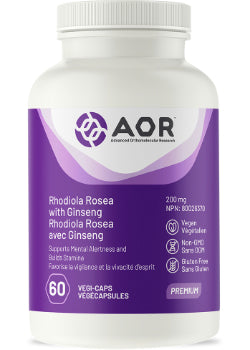
RHODIOLA ROSEA FROM AOR OFFERS POTENT ADAPTOGENIC PROPERTIES.Containing 100mg of each Rhodiola and Ginseng per capsule AOR Rhodiola With Ginseng has also been shown to offer immune enhancing benefits, those who supplement regularly report an increased sense of well being, lessened mental fatigue and better ability to deal with stress and prevent burnout. Rhodiola is a powerful adaptogen particularly useful for those feel stressed and respond with anger or anxiousness. [VCAPS]
Each capsule contains:
Rhodiola rosea (min. 3% rosavin, 1% salidroside) 100mg
Panax Ginseng 100mg
Non-medicinal Ingredients:
sodium stearyl fumarate. Capsule: hypromellose.
Important Information:
Contains no wheat, gluten, corn, nuts, peanuts, sesame seeds, sulphites, mustard, soy, dairy, eggs, fish, shellfish or any animal byproduct. Consult a health care practitioner prior to use if you are pregnant or breastfeeding, have diabetes, if you’re taking antidepressant medications, blood thinners, digoxin, or for use beyond three months. Some people may experience insomnia, anxiety, or headaches, in which case discontinue use.
Rhodiola rosea (min. 3% rosavin, 1% salidroside) 100mg
Panax Ginseng 100mg
Non-medicinal Ingredients:
sodium stearyl fumarate. Capsule: hypromellose.
Important Information:
Contains no wheat, gluten, corn, nuts, peanuts, sesame seeds, sulphites, mustard, soy, dairy, eggs, fish, shellfish or any animal byproduct. Consult a health care practitioner prior to use if you are pregnant or breastfeeding, have diabetes, if you’re taking antidepressant medications, blood thinners, digoxin, or for use beyond three months. Some people may experience insomnia, anxiety, or headaches, in which case discontinue use.
Dosage
Take one capsule twice daily, or as directed by a qualified health care practitioner. For occasional use only, unless directed by a health care provider.
Take one capsule twice daily, or as directed by a qualified health care practitioner. For occasional use only, unless directed by a health care provider.
Innovative Formulas by AOR Canada found at
AOR Canada is the innovative formulators of Canada’s best-selling antioxidant support,
AOR Advanced B Complex
and
AOR Tri-B12. They are also known for their top bone health supplements, Ortho Adapt and Bone Basics. You can also
SHOP AOR's Nattokinase, and trusted Curcumin Ultra, Curcumin Active and Curcumin95 inflammation support at ca. AOR are leaders in natural health with innovative product development.
AOR Canada is the innovative formulators of Canada’s best-selling antioxidant support,
AOR Advanced B Complex
and
AOR Tri-B12. They are also known for their top bone health supplements, Ortho Adapt and Bone Basics. You can also
SHOP AOR's Nattokinase, and trusted Curcumin Ultra, Curcumin Active and Curcumin95 inflammation support at ca. AOR are leaders in natural health with innovative product development.
Rhodiola for Health Benefits
Rhodiola is authentic Russian
RHODIOLA ROSEA, an herb with a long history of use as an adaptogen and sexual tonic in the traditional medicine of Iceland, Norway, the Carpathian Mountains of the Ukraine, and above all in Siberia, for adaptation to the rigors of life on the tundras of North-central Asia. Dioscorides, the father of medical botany, provides the earliest documented medicinal use of this botanical in De Materia Medica, a phytomedicinal text which formed the basis of Western pharmaceutical and herbal writing for the next 1500 years. In more recent times, Rhodiola preparations have been listed in the national pharmacopoeias of France, Sweden, Denmark, and the former USSR, as an adaptogen and "brain tonic." In the nations of the former Soviet Union, Rhodiola is traditionally prepared in the form of a tincture called "nastojka", decocted from fresh Rhodiola roots by soaking the roots in 40% alcohol for one week.
Rigorous testing of Rhodiola's adaptogenic properties began in the former Soviet Union in the mid-60s, and has continued to this day. Four decades of animal studies and controlled clinical trials in humans clearly demonstrates that Rhodiola extract is a true adaptogenic botanical.
As a classic adaptogen, Rhodiola extracts both steel the organism against the eventuality of stressors, and prevent an overshoot into burnout when those stressors are endured. This can be seen in the botanical's simultaneous bolstering of the baseline levels of adaptive neurotransmitters and hormones typically increased in response to adaptation to the rigors of endurance training, and prevention of overactivation of those same pathways when the organism is in a stressful environment. As another example of the adaptive, balancing effect of Rhodiola, the key component salidroside has been found to prevent excessive blood sugar levels after an injection of adrenaline (which normally causes the body to pump out more glucose) and to prevent blood sugar levels from falling too low after an injection of insulin.
Rhodiola Rosea's reputation as an adaptogen includes the ability to stimulate the nervous system, decrease depression, enhance work performance, eliminate fatigue, and prevent high altitude sickness. It is also claimed to function as an antidepressant, to fight unhealthy cell production, to protect the cardiovascular system and to enhance the central nervous system. Studies suggest that it can help prevent symptoms associated with intense physical or mental strain such as a decline in work performance, sleep difficulties, poor appetite, irritability, hypertension, headaches and fatigue.
Soviet scientists discovered a generation ago that Rhodiola allows experimental animals to use their body's glycogen energy reserves more sparingly under forced exercise, and to replenish those reserves (and reserves of the crucial high-energy compound
creatine
phosphate) more quickly afterwards. These properties doubtless contribute to Rhodiola's ability to extend animals' endurance during forced swimming or clinging to a rod to avoid falling. To make sure that Rhodiola's effects on physical performance was an adaptogenic effect, and not caused by flooding the body with steroids, scientists looked for the kind of hyper-masculinization you see in steroid freaks at the gym: no such signs were found.
Accordingly, Rhodiola extracts improve the organism's capacity to stand up against a wide variety of stressors, including heat shock, heavy metal exposure, free radical assault, high latitude, liver-damaging chemicals, and exhaustive exercise. When eggs from freshwater snails were incubated with Rhodiola rosea, they had a survival rate of 90% when exposed to heat shock, compared to only 9% for eggs that were not exposed to Rhodiola. Rhodiola also increased resistance to oxidative stress and heavy metal exposure.
Another example is Rhodiola's ability to protect the heart from stress. When lab animals are subjected to extreme cold or to massive doses of the stress hormone adrenaline, the regular, controlled beating of their hearts is disrupted and the oxygen supply is temporarily cut off. But Rhodiola supplements prevent arrhythmia, reduce the damage to the muscle cells of the heart, and balance the overflow of stress neurotransmitters normally associated with these stressors.
In rats, Rhodiola Rosea has been found to benefit learning and memory, as well as responses to stress. Furthermore, rat studies found that Rhodiola rosea could block the growth of tumors, decrease metastasis, and extend survival times. It also enhanced the effects of the antitumor drug cyclophosphamide.
Clinical Trials
A randomized, double-blind, placebo-controlled study observed the effects of Rhodiola rosea intake on the physical performance of 24 healthy students. After taking a dose of either Rhodiola rosea or placebo, students waited an hour and then performed various physical tests. It was found that the test group had an increased time to exhaustion, as well as increased breathing compared to the control group. The study therefore concluded that Rhodiola rosea can improve the endurance exercise capacity in healthy young adults. While most stimulants of the central nervous system such as caffeine and amphetamines create a temporary effect that is lessened with repeated intakes, Rhodioa rosea was found to maintain its effects despite repeated intakes.
In another study, a Rhodiola rosea extract along with a combination of vitamins and minerals was given to 120 adults with physical and cognitive deficiencies in a 12 week drug monitoring study. There was a significant improvement in these deficiencies, with observed improvements in symptoms such as exhaustion, decreased motivation, daytime sleepiness, sleep disturbances, concentration deficiencies, forgetfulness, susceptibility to stress and irritability. This is likely due to Rhodiola's ability to influence the levels of several neurotransmitters in the brain.
It's How You Feel
People who have tried this botanical report that they feel better on Rhodiola. The effect is described in terms of a continuous sensation of physical and mental relief from stress, and anecdotally appears to be most pronounced in people who typically respond to stress with anger or sensations of helplessness.
Animal studies have given us some clues to the neurochemical basis of these effects: Rhodiola has well-documented effects on the metabolism of a variety of neurotransmitters. For instance, Rhodiola enhances the transport of the
serotonin
raw materials tryptophan and 5-hydroxytryptophan (
5-HTP
) across the blood-brain barrier, and decreases the action of the serotonin-degrading catechol-O-methyltransferase (COMT) enzyme. It also boosts brain levels of dopamine, acetylcholine, and norepinephrine, all of which are key neurotransmitters targeted by major classes of antidepressant drugs. Rhodiola also appears to influence the synthesis, levels, and/or activity of endorphins and enkephalins, since blocking the receptors for some of these "feel-good" peptides negates some of Rhodiola's effects.
The Importance of Full Standardization
Earlier research identified salidroside (and its free form, p-tyrosol) as a key active ingredient in Rhodiola, and many clinical trials still use salidroside as the sole active for standardization of their Rhodiola botanicals. More recently, studies have focused on the effects of rosavin. Some Rhodiola species found in China and elsewhere contain salidroside but not rosavin, the most characteristic active ingredient of true Rhodiola rosea. On the other hand, many products fail to standardize for the salidroside content, despite the extensive documentation of its adaptogenic effects. A properly-standardized Rhodiola extract will contain at least 3% rosavins and 1% salidroside; p-tyrosol will also be present in small amounts.
Ginseng
What is it?
North American ginseng
(Panax quinquefolius) is a perennial plant in the ivy family that is native to eastern North America and has a long history of use by the Native North Americans. Because of its adaptogenic, immunomodulatory, cardiovascular, central nervous system (CNS), endocrine, and energy-boosting effects, it began to be cultivated in China.Because of this, it has been incorporated into
Traditional Chinese Medicine
as well. The active constituents in
North American ginseng
are ginsenosides, similarly to other genuine ginsengs of the Panax family.
What does it do?
North American ginseng has been widely studied and has been shown to have several beneficial effects. It has been shown to promote the regulation of blood sugar levels in diabetics and is successful in preventing influenza infection in the elderly. It has also been studied for its ability to enhance libido and sexual performance, although the exact mechanism of action is not yet understood. Interestingly, in males, ginsenosides have been shown to directly facilitate penile erection. Recently, the University of Hong Kong identified North American ginseng as having anti-inflammatory effects as well. Interestingly some ginsenosides can act as weak phytoestrogens, a term used to describe plant compounds that can mimic the female hormone
estrogen
in the body. For more information on the hormonal effects of ginsenosides, please see the ginsengs article.
What are the Chinese Medicine properties of North American ginseng?
According to traditional Chinese medicine (TCM), American ginseng promotes yin energy, cleans excess yang and calms the body. This means that it is a more nourishing and cooling herb that can be used more in the summertime or by those with "hot" conditions such as acne, red rashes, mouth ulcers and anxiety.
Rhodiola is authentic Russian
RHODIOLA ROSEA, an herb with a long history of use as an adaptogen and sexual tonic in the traditional medicine of Iceland, Norway, the Carpathian Mountains of the Ukraine, and above all in Siberia, for adaptation to the rigors of life on the tundras of North-central Asia. Dioscorides, the father of medical botany, provides the earliest documented medicinal use of this botanical in De Materia Medica, a phytomedicinal text which formed the basis of Western pharmaceutical and herbal writing for the next 1500 years. In more recent times, Rhodiola preparations have been listed in the national pharmacopoeias of France, Sweden, Denmark, and the former USSR, as an adaptogen and "brain tonic." In the nations of the former Soviet Union, Rhodiola is traditionally prepared in the form of a tincture called "nastojka", decocted from fresh Rhodiola roots by soaking the roots in 40% alcohol for one week.
Rigorous testing of Rhodiola's adaptogenic properties began in the former Soviet Union in the mid-60s, and has continued to this day. Four decades of animal studies and controlled clinical trials in humans clearly demonstrates that Rhodiola extract is a true adaptogenic botanical.
As a classic adaptogen, Rhodiola extracts both steel the organism against the eventuality of stressors, and prevent an overshoot into burnout when those stressors are endured. This can be seen in the botanical's simultaneous bolstering of the baseline levels of adaptive neurotransmitters and hormones typically increased in response to adaptation to the rigors of endurance training, and prevention of overactivation of those same pathways when the organism is in a stressful environment. As another example of the adaptive, balancing effect of Rhodiola, the key component salidroside has been found to prevent excessive blood sugar levels after an injection of adrenaline (which normally causes the body to pump out more glucose) and to prevent blood sugar levels from falling too low after an injection of insulin.
Rhodiola Rosea's reputation as an adaptogen includes the ability to stimulate the nervous system, decrease depression, enhance work performance, eliminate fatigue, and prevent high altitude sickness. It is also claimed to function as an antidepressant, to fight unhealthy cell production, to protect the cardiovascular system and to enhance the central nervous system. Studies suggest that it can help prevent symptoms associated with intense physical or mental strain such as a decline in work performance, sleep difficulties, poor appetite, irritability, hypertension, headaches and fatigue.
Soviet scientists discovered a generation ago that Rhodiola allows experimental animals to use their body's glycogen energy reserves more sparingly under forced exercise, and to replenish those reserves (and reserves of the crucial high-energy compound
creatine
phosphate) more quickly afterwards. These properties doubtless contribute to Rhodiola's ability to extend animals' endurance during forced swimming or clinging to a rod to avoid falling. To make sure that Rhodiola's effects on physical performance was an adaptogenic effect, and not caused by flooding the body with steroids, scientists looked for the kind of hyper-masculinization you see in steroid freaks at the gym: no such signs were found.
Accordingly, Rhodiola extracts improve the organism's capacity to stand up against a wide variety of stressors, including heat shock, heavy metal exposure, free radical assault, high latitude, liver-damaging chemicals, and exhaustive exercise. When eggs from freshwater snails were incubated with Rhodiola rosea, they had a survival rate of 90% when exposed to heat shock, compared to only 9% for eggs that were not exposed to Rhodiola. Rhodiola also increased resistance to oxidative stress and heavy metal exposure.
Another example is Rhodiola's ability to protect the heart from stress. When lab animals are subjected to extreme cold or to massive doses of the stress hormone adrenaline, the regular, controlled beating of their hearts is disrupted and the oxygen supply is temporarily cut off. But Rhodiola supplements prevent arrhythmia, reduce the damage to the muscle cells of the heart, and balance the overflow of stress neurotransmitters normally associated with these stressors.
In rats, Rhodiola Rosea has been found to benefit learning and memory, as well as responses to stress. Furthermore, rat studies found that Rhodiola rosea could block the growth of tumors, decrease metastasis, and extend survival times. It also enhanced the effects of the antitumor drug cyclophosphamide.
Clinical Trials
A randomized, double-blind, placebo-controlled study observed the effects of Rhodiola rosea intake on the physical performance of 24 healthy students. After taking a dose of either Rhodiola rosea or placebo, students waited an hour and then performed various physical tests. It was found that the test group had an increased time to exhaustion, as well as increased breathing compared to the control group. The study therefore concluded that Rhodiola rosea can improve the endurance exercise capacity in healthy young adults. While most stimulants of the central nervous system such as caffeine and amphetamines create a temporary effect that is lessened with repeated intakes, Rhodioa rosea was found to maintain its effects despite repeated intakes.
In another study, a Rhodiola rosea extract along with a combination of vitamins and minerals was given to 120 adults with physical and cognitive deficiencies in a 12 week drug monitoring study. There was a significant improvement in these deficiencies, with observed improvements in symptoms such as exhaustion, decreased motivation, daytime sleepiness, sleep disturbances, concentration deficiencies, forgetfulness, susceptibility to stress and irritability. This is likely due to Rhodiola's ability to influence the levels of several neurotransmitters in the brain.
It's How You Feel
People who have tried this botanical report that they feel better on Rhodiola. The effect is described in terms of a continuous sensation of physical and mental relief from stress, and anecdotally appears to be most pronounced in people who typically respond to stress with anger or sensations of helplessness.
Animal studies have given us some clues to the neurochemical basis of these effects: Rhodiola has well-documented effects on the metabolism of a variety of neurotransmitters. For instance, Rhodiola enhances the transport of the
serotonin
raw materials tryptophan and 5-hydroxytryptophan (
5-HTP
) across the blood-brain barrier, and decreases the action of the serotonin-degrading catechol-O-methyltransferase (COMT) enzyme. It also boosts brain levels of dopamine, acetylcholine, and norepinephrine, all of which are key neurotransmitters targeted by major classes of antidepressant drugs. Rhodiola also appears to influence the synthesis, levels, and/or activity of endorphins and enkephalins, since blocking the receptors for some of these "feel-good" peptides negates some of Rhodiola's effects.
The Importance of Full Standardization
Earlier research identified salidroside (and its free form, p-tyrosol) as a key active ingredient in Rhodiola, and many clinical trials still use salidroside as the sole active for standardization of their Rhodiola botanicals. More recently, studies have focused on the effects of rosavin. Some Rhodiola species found in China and elsewhere contain salidroside but not rosavin, the most characteristic active ingredient of true Rhodiola rosea. On the other hand, many products fail to standardize for the salidroside content, despite the extensive documentation of its adaptogenic effects. A properly-standardized Rhodiola extract will contain at least 3% rosavins and 1% salidroside; p-tyrosol will also be present in small amounts.
Ginseng
What is it?
North American ginseng
(Panax quinquefolius) is a perennial plant in the ivy family that is native to eastern North America and has a long history of use by the Native North Americans. Because of its adaptogenic, immunomodulatory, cardiovascular, central nervous system (CNS), endocrine, and energy-boosting effects, it began to be cultivated in China.Because of this, it has been incorporated into
Traditional Chinese Medicine
as well. The active constituents in
North American ginseng
are ginsenosides, similarly to other genuine ginsengs of the Panax family.
What does it do?
North American ginseng has been widely studied and has been shown to have several beneficial effects. It has been shown to promote the regulation of blood sugar levels in diabetics and is successful in preventing influenza infection in the elderly. It has also been studied for its ability to enhance libido and sexual performance, although the exact mechanism of action is not yet understood. Interestingly, in males, ginsenosides have been shown to directly facilitate penile erection. Recently, the University of Hong Kong identified North American ginseng as having anti-inflammatory effects as well. Interestingly some ginsenosides can act as weak phytoestrogens, a term used to describe plant compounds that can mimic the female hormone
estrogen
in the body. For more information on the hormonal effects of ginsenosides, please see the ginsengs article.
What are the Chinese Medicine properties of North American ginseng?
According to traditional Chinese medicine (TCM), American ginseng promotes yin energy, cleans excess yang and calms the body. This means that it is a more nourishing and cooling herb that can be used more in the summertime or by those with "hot" conditions such as acne, red rashes, mouth ulcers and anxiety.
Carefully Selected
Ships to the U.S.
Wellness Essentials
Trusted Brands
Product Details
Rhodiola for Health BenefitsRhodiola is authentic Russian
RHODIOLA ROSEA, an herb with a long history of use as an adaptogen and sexual tonic in the traditional medicine of Iceland, Norway, the Carpathian Mountains of the Ukraine, and above all in Siberia, for adaptation to the rigors of life on the tundras of North-central Asia. Dioscorides, the father of medical botany, provides the earliest documented medicinal use of this botanical in De Materia Medica, a phytomedicinal text which formed the basis of Western pharmaceutical and herbal writing for the next 1500 years. In more recent times, Rhodiola preparations have been listed in the national pharmacopoeias of France, Sweden, Denmark, and the former USSR, as an adaptogen and "brain tonic." In the nations of the former Soviet Union, Rhodiola is traditionally prepared in the form of a tincture called "nastojka", decocted from fresh Rhodiola roots by soaking the roots in 40% alcohol for one week.
Rigorous testing of Rhodiola's adaptogenic properties began in the former Soviet Union in the mid-60s, and has continued to this day. Four decades of animal studies and controlled clinical trials in humans clearly demonstrates that Rhodiola extract is a true adaptogenic botanical.
As a classic adaptogen, Rhodiola extracts both steel the organism against the eventuality of stressors, and prevent an overshoot into burnout when those stressors are endured. This can be seen in the botanical's simultaneous bolstering of the baseline levels of adaptive neurotransmitters and hormones typically increased in response to adaptation to the rigors of endurance training, and prevention of overactivation of those same pathways when the organism is in a stressful environment. As another example of the adaptive, balancing effect of Rhodiola, the key component salidroside has been found to prevent excessive blood sugar levels after an injection of adrenaline (which normally causes the body to pump out more glucose) and to prevent blood sugar levels from falling too low after an injection of insulin.
Rhodiola Rosea's reputation as an adaptogen includes the ability to stimulate the nervous system, decrease depression, enhance work performance, eliminate fatigue, and prevent high altitude sickness. It is also claimed to function as an antidepressant, to fight unhealthy cell production, to protect the cardiovascular system and to enhance the central nervous system. Studies suggest that it can help prevent symptoms associated with intense physical or mental strain such as a decline in work performance, sleep difficulties, poor appetite, irritability, hypertension, headaches and fatigue.
Soviet scientists discovered a generation ago that Rhodiola allows experimental animals to use their body's glycogen energy reserves more sparingly under forced exercise, and to replenish those reserves (and reserves of the crucial high-energy compound
creatine
phosphate) more quickly afterwards. These properties doubtless contribute to Rhodiola's ability to extend animals' endurance during forced swimming or clinging to a rod to avoid falling. To make sure that Rhodiola's effects on physical performance was an adaptogenic effect, and not caused by flooding the body with steroids, scientists looked for the kind of hyper-masculinization you see in steroid freaks at the gym: no such signs were found.
Accordingly, Rhodiola extracts improve the organism's capacity to stand up against a wide variety of stressors, including heat shock, heavy metal exposure, free radical assault, high latitude, liver-damaging chemicals, and exhaustive exercise. When eggs from freshwater snails were incubated with Rhodiola rosea, they had a survival rate of 90% when exposed to heat shock, compared to only 9% for eggs that were not exposed to Rhodiola. Rhodiola also increased resistance to oxidative stress and heavy metal exposure.
Another example is Rhodiola's ability to protect the heart from stress. When lab animals are subjected to extreme cold or to massive doses of the stress hormone adrenaline, the regular, controlled beating of their hearts is disrupted and the oxygen supply is temporarily cut off. But Rhodiola supplements prevent arrhythmia, reduce the damage to the muscle cells of the heart, and balance the overflow of stress neurotransmitters normally associated with these stressors.
In rats, Rhodiola Rosea has been found to benefit learning and memory, as well as responses to stress. Furthermore, rat studies found that Rhodiola rosea could block the growth of tumors, decrease metastasis, and extend survival times. It also enhanced the effects of the antitumor drug cyclophosphamide.
Clinical Trials
A randomized, double-blind, placebo-controlled study observed the effects of Rhodiola rosea intake on the physical performance of 24 healthy students. After taking a dose of either Rhodiola rosea or placebo, students waited an hour and then performed various physical tests. It was found that the test group had an increased time to exhaustion, as well as increased breathing compared to the control group. The study therefore concluded that Rhodiola rosea can improve the endurance exercise capacity in healthy young adults. While most stimulants of the central nervous system such as caffeine and amphetamines create a temporary effect that is lessened with repeated intakes, Rhodioa rosea was found to maintain its effects despite repeated intakes.
In another study, a Rhodiola rosea extract along with a combination of vitamins and minerals was given to 120 adults with physical and cognitive deficiencies in a 12 week drug monitoring study. There was a significant improvement in these deficiencies, with observed improvements in symptoms such as exhaustion, decreased motivation, daytime sleepiness, sleep disturbances, concentration deficiencies, forgetfulness, susceptibility to stress and irritability. This is likely due to Rhodiola's ability to influence the levels of several neurotransmitters in the brain.
It's How You Feel
People who have tried this botanical report that they feel better on Rhodiola. The effect is described in terms of a continuous sensation of physical and mental relief from stress, and anecdotally appears to be most pronounced in people who typically respond to stress with anger or sensations of helplessness.
Animal studies have given us some clues to the neurochemical basis of these effects: Rhodiola has well-documented effects on the metabolism of a variety of neurotransmitters. For instance, Rhodiola enhances the transport of the
serotonin
raw materials tryptophan and 5-hydroxytryptophan (
5-HTP
) across the blood-brain barrier, and decreases the action of the serotonin-degrading catechol-O-methyltransferase (COMT) enzyme. It also boosts brain levels of dopamine, acetylcholine, and norepinephrine, all of which are key neurotransmitters targeted by major classes of antidepressant drugs. Rhodiola also appears to influence the synthesis, levels, and/or activity of endorphins and enkephalins, since blocking the receptors for some of these "feel-good" peptides negates some of Rhodiola's effects.
The Importance of Full Standardization
Earlier research identified salidroside (and its free form, p-tyrosol) as a key active ingredient in Rhodiola, and many clinical trials still use salidroside as the sole active for standardization of their Rhodiola botanicals. More recently, studies have focused on the effects of rosavin. Some Rhodiola species found in China and elsewhere contain salidroside but not rosavin, the most characteristic active ingredient of true Rhodiola rosea. On the other hand, many products fail to standardize for the salidroside content, despite the extensive documentation of its adaptogenic effects. A properly-standardized Rhodiola extract will contain at least 3% rosavins and 1% salidroside; p-tyrosol will also be present in small amounts.
Ginseng
What is it?
North American ginseng
(Panax quinquefolius) is a perennial plant in the ivy family that is native to eastern North America and has a long history of use by the Native North Americans. Because of its adaptogenic, immunomodulatory, cardiovascular, central nervous system (CNS), endocrine, and energy-boosting effects, it began to be cultivated in China.Because of this, it has been incorporated into
Traditional Chinese Medicine
as well. The active constituents in
North American ginseng
are ginsenosides, similarly to other genuine ginsengs of the Panax family.
What does it do?
North American ginseng has been widely studied and has been shown to have several beneficial effects. It has been shown to promote the regulation of blood sugar levels in diabetics and is successful in preventing influenza infection in the elderly. It has also been studied for its ability to enhance libido and sexual performance, although the exact mechanism of action is not yet understood. Interestingly, in males, ginsenosides have been shown to directly facilitate penile erection. Recently, the University of Hong Kong identified North American ginseng as having anti-inflammatory effects as well. Interestingly some ginsenosides can act as weak phytoestrogens, a term used to describe plant compounds that can mimic the female hormone
estrogen
in the body. For more information on the hormonal effects of ginsenosides, please see the ginsengs article.
What are the Chinese Medicine properties of North American ginseng?
According to traditional Chinese medicine (TCM), American ginseng promotes yin energy, cleans excess yang and calms the body. This means that it is a more nourishing and cooling herb that can be used more in the summertime or by those with "hot" conditions such as acne, red rashes, mouth ulcers and anxiety.


🌿
Daily Wellness
Easy to add to your everyday health routine.
✅
Carefully Selected
Chosen with quality and customer needs in mind.
💊
Simple to Use
Designed for convenient daily supplementation.
🚚
Ships to the U.S.
Fast, reliable shipping to U.S. customers.