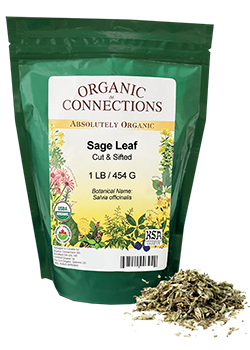
Sage is an aromatic herb native to the Mediterranean and Asia. The sage plant grows purplish flowers and provides an earthy, herbaceous and slightly minty scent, perhaps because it is part of the mint family. The rosmarinic acid content in sage is why it’s been popular in herbal medicine and has historically been used to support healthy weight management and mood. Organic Connections cuts and sifts their organically grown sage to provide a high quality, premium bulk herb that can be used on its own or mixed with other herbs both in the kitchen or as an herbaceous tea blend. [CUT & SIFTED]
Contains:
Organic Sage Leaf
Important Information:
Store in a cool, dry place. Keep out of reach of children.
Dosage
Mix with other herbs both in the kitchen or as an herbaceous tea blend.
Certified Organic Loose Herbal Teas & Remedies
Organic Connections makes quality food supplements including: Organic ground Cinnamon powder, both Ceylon and Cassia and Organic Slippery Elm Bark powder to provide fibre and support intestinal health. Organic Connections believes in quality, natural and organic ingredients to provide the best in natural health.
Sage
By: Naturopathic Doctor (N.D.)
AN ANCIENT TEA USED BY GREEKS, EGYPTIANS AND ROMANS
Sage is a shrub that comes from the Mediterranean region. It's now well known as a culinary herb; raw, cooked or dried, and is used as a
medicinal tea. It's commercially grown in the US, Canada, Argentina, Germany and France.
Wild sage grows almost everywhere in the Greece.
If you've ever traveled the Greek Islands you recognize the aroma of wild sage baking in the hot sun....and the beautiful subtle flavour of wild sage which infuses all Greek honey.
What Is Sage?
Sage is a small perennial evergreen which has been used medicinally by ancient Greeks, Romans and Egyptians for thousands of years. Egyptians used it as a fertility aid, while Greeks used it for its ability to stop bleeding and clean wounds, ulcers and snakebites. Sage was a sacred herb for Romans, harvested for solemn ceremony.
What Is Sage Used For And How Does It Work?
Research has shown that sage possesses astringent properties. As such, it is now widely used to treat
hemorrhoids, blood or phlegm in the urine, excessive breast milk or fluid in the abdomen (ascites). This is because as an astringent Sage dries excess or accumulated mucus and fluid. It is commonly used for colds, nasal congestion and fever to help dry excess mucus your body produces to expel infection.
Research has also shown Sage fights infection by killing bacteria, fungus and viruses. Due to its antibacterial, antifungal and antiviral effects, it can compliment and support the immune system when dealing with any infection. Research using sage for the treatment of Herpes has shown reduction in size, number, severity and time between outbreaks of both genital and oral
cold sores. Studies using sage have also demonstrated a reduction in pain associated with sore throat. This is because Sage also acts as a natural anti-inflammatory.
Sage has been shown to have positive effects on memory and research is showing it has promise in the treatment of mild to moderate Alzheimer's disease.
In North America, sage is taken as a dietary supplement to treat hot flashes, night sweats, and
estrogen
loss, as well as a tonic for fighting fatigue and nervous exhaustion, thus making it a common supplement for women suffering menopausal symptoms.
Sage tea also has an effect on mood. This is helpful in many conditions, especially
menopause
when altered hormones can affect mood. This also applies to teen hormonal changes and hormonal conditions like
PMS. Sage tea also has an effect on boosting your mental alertness and helps reduce anxiety.
Some new research suggests Sage tea may even boost your metabolism which helps with weight loss. For best results drink Sage tea within an hour of waking either on an empty stomach or with your breakfast.
How Do You Use It?
The typical dose for dried sage leaf is 4-6 grams/day in capsule form. As a liquid extract (1:2) 2-5 ml/day is recommended. As a tea, you can mix it with
green tea
for added flavour and health benefits. Sage tea can be drunk as often as you like – either hot or iced. There are no safety issues or contraindications with the use of sage. But due to a lack of research it is not recommended in pregnancy or lactation (unless it is used during weaning period to dry up milk supply).
Sage – Quick Facts
Parts Used
· Leaves And Flowers.
Applications
· Menopause, Pms, Sore Throat, Colds, Fever, Urinary Tract Infections,
Sinus
Infections, Herpes And Other Infections, Mild To Moderate/Early Alzheimer's, Moodiness, Anxiety, Boost Mental Alertness, Boosting Metabolism, Weight Loss
Optimum Dosage
· 4-6 Grams/Day; As A Tea – May Be Consumed As Often You Like
Works Well With
·
Ginkgo
Biloba, Angelica Sinensis, Glycyrrhiza Glabra – For Menopausal Symptoms And Boosting Alertness
Important Information
· No Known Safety Issues Or Side Effects.
Carefully SelectedShips to the U.S.Wellness EssentialsTrusted Brands
Product Details
Sage
By: Naturopathic Doctor (N.D.)
AN ANCIENT TEA USED BY GREEKS, EGYPTIANS AND ROMANS
Sage is a shrub that comes from the Mediterranean region. It's now well known as a culinary herb; raw, cooked or dried, and is used as a
medicinal tea. It's commercially grown in the US, Canada, Argentina, Germany and France.
Wild sage grows almost everywhere in the Greece.
If you've ever traveled the Greek Islands you recognize the aroma of wild sage baking in the hot sun....and the beautiful subtle flavour of wild sage which infuses all Greek honey.
What Is Sage?
Sage is a small perennial evergreen which has been used medicinally by ancient Greeks, Romans and Egyptians for thousands of years. Egyptians used it as a fertility aid, while Greeks used it for its ability to stop bleeding and clean wounds, ulcers and snakebites. Sage was a sacred herb for Romans, harvested for solemn ceremony.
What Is Sage Used For And How Does It Work?
Research has shown that sage possesses astringent properties. As such, it is now widely used to treat
hemorrhoids, blood or phlegm in the urine, excessive breast milk or fluid in the abdomen (ascites). This is because as an astringent Sage dries excess or accumulated mucus and fluid. It is commonly used for colds, nasal congestion and fever to help dry excess mucus your body produces to expel infection.
Research has also shown Sage fights infection by killing bacteria, fungus and viruses. Due to its antibacterial, antifungal and antiviral effects, it can compliment and support the immune system when dealing with any infection. Research using sage for the treatment of Herpes has shown reduction in size, number, severity and time between outbreaks of both genital and oral
cold sores. Studies using sage have also demonstrated a reduction in pain associated with sore throat. This is because Sage also acts as a natural anti-inflammatory.
Sage has been shown to have positive effects on memory and research is showing it has promise in the treatment of mild to moderate Alzheimer's disease.
In North America, sage is taken as a dietary supplement to treat hot flashes, night sweats, and
estrogen
loss, as well as a tonic for fighting fatigue and nervous exhaustion, thus making it a common supplement for women suffering menopausal symptoms.
Sage tea also has an effect on mood. This is helpful in many conditions, especially
menopause
when altered hormones can affect mood. This also applies to teen hormonal changes and hormonal conditions like
PMS. Sage tea also has an effect on boosting your mental alertness and helps reduce anxiety.
Some new research suggests Sage tea may even boost your metabolism which helps with weight loss. For best results drink Sage tea within an hour of waking either on an empty stomach or with your breakfast.
How Do You Use It?
The typical dose for dried sage leaf is 4-6 grams/day in capsule form. As a liquid extract (1:2) 2-5 ml/day is recommended. As a tea, you can mix it with
green tea
for added flavour and health benefits. Sage tea can be drunk as often as you like – either hot or iced. There are no safety issues or contraindications with the use of sage. But due to a lack of research it is not recommended in pregnancy or lactation (unless it is used during weaning period to dry up milk supply).
Sage – Quick Facts
Parts Used
· Leaves And Flowers.
Applications
· Menopause, Pms, Sore Throat, Colds, Fever, Urinary Tract Infections,
Sinus
Infections, Herpes And Other Infections, Mild To Moderate/Early Alzheimer's, Moodiness, Anxiety, Boost Mental Alertness, Boosting Metabolism, Weight Loss
Optimum Dosage
· 4-6 Grams/Day; As A Tea – May Be Consumed As Often You Like
Works Well With
·
Ginkgo
Biloba, Angelica Sinensis, Glycyrrhiza Glabra – For Menopausal Symptoms And Boosting Alertness
Important Information
· No Known Safety Issues Or Side Effects.
🌿
Daily Wellness
Easy to add to your everyday health routine.
✅
Carefully Selected
Chosen with quality and customer needs in mind.
💊
Simple to Use
Designed for convenient daily supplementation.
🚚
Ships to the U.S.
Fast, reliable shipping to U.S. customers.
Choosing a selection results in a full page refresh.