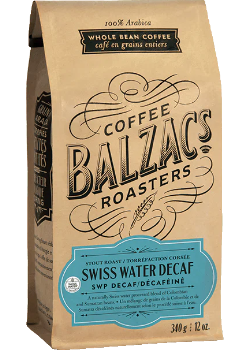
Balzac's Coffee Roasters Swiss Water Decaf (Whole Bean Stout Roast) - 340g is a dietary supplement, intended for adults as part of a daily wellness routine.
This Swiss Water Decaf is a blend of Colombian and Sumatran beans, processed in the 100% chemical free method of Swiss Water. Swiss Water Decaf is a natural way of removing caffeine for a ethical and great tasting coffee. The blends of Colombian and Sumatran beans creates a complex and full-bodied flavour. Going at full throttle, these beans are literally getting “smoked” in the roasting drum, bringing flavourful oils directly to the surface. The richness and fullness of body command your attention and complement any decadent pairing. [WHOLE BEANS]
Ingredients:
100% Arabica Coffee Beans
Important Information:
Health Canada recommends a daily caffeine intake of no more than 400mg daily for healthy adults, which is the equivalent of about three cups of brewed coffee.
Dosage
Brew and enjoy!
Inspired by the Grand Cafés of Paris, Balzac's Coffee Roasters was brought to life by a burning ambition to bring that culture to Canada. Starting as a coffee cart in 1993, we opened our first café in Stratford, Ontario in 1996. Since then, we have grown to 16 distinct locations and can be found on the shelves of grocery stores across the country. From elevation to rainfall, wash process to roast technique, there's so much that goes into a perfect cup of coffee. Our beans and blends are the culmination of our craft and passion for coffee.
WHAT IS COFFEE?
Coffee beans are the seeds of a fruit that grows on the Coffea plant. A wide variety of species of Coffea exist, ranging from shrubs to trees. What are the origins of coffee? Several countries produce coffee beans, though the two most common are Robusta and Arabica. Coffee is prepared from coffee beans roasted at high temperatures to release their rich aroma and complex flavours. They are then cooled and ground for brewing. The flavour and notes of any individual coffee are dictated by numerous factors, including how it’s grown, how it’s processed, how it’s roasted, its variety, and even how it’s brewed.
Origins Of Coffee
The origins of coffee can be traced back hundreds of years to the Ethiopian plateau. The earliest evidence of coffee being drunk as a beverage appears in modern-day Yemen, in Sufi shrines erected in the mid-15th century. The Yemenis are thought to have procured the coffee beans used to make the beverage from the Ethiopian Highlands. By the 20th century, coffee had spread worldwide, creating many distinct coffee cultures. Today, coffee is prepared and presented in a variety of ways (e.g., espresso, French press, caffè latte, and ready-to-drink versions in cans or bottles) and is a mainstay in most households.
Does Coffee Origins Affect Flavour?
Coffee beans can be roasted from light to medium to dark. The lighter the roast, the lighter the colour and roasted flavour, as well as its acidity. Dark roasts, on the other hand, produce a blacker bean with little acidity and a bitter-roasted flavour. Coffee notes are the result of four things: acidity, sweetness, bitterness (or body), and astringency. Some typical coffee notes include sweet citrus, bright citrus, chocolate and nuts, berries, floral and sweet, green fruits, and herbal. Also, the origins of the coffee bean can also be a factor in that roasts flavour profile.
Benefits Of Coffee
- Aids Weight Management
- Boosts Energy
- Decreases Fatigue
- May Reduce Risk Of Neurodegeneration
- Promotes Wakefulness
A Word On Caffeine & It's Origins
Aside from knowing the origins of your chosen coffee, knowing how to consume caffeine is important. In small quantities, caffeine has beneficial effects such as better focus, concentration, learning ability, and retention, as well as improved athletic performance and physical endurance. In large amounts, caffeine can be detrimental to health and cause symptoms such as anxiety, dehydration, digestive issues, dizziness, headaches,
insomnia, and a rapid heartbeat. Consistently high caffeine intake can also result in addiction to the substance and withdrawal symptoms such as
migraine headaches
and fatigue.
Drinking coffee responsibly ensures you can benefit from all of its advantages without any drawbacks. One 8-ounce cup of brewed or drip coffee contains roughly 95 mg of caffeine. A moderate coffee intake is 3-5 cups or 400 mg of caffeine daily. Larger sizes of takeout coffee have far higher caffeine content. For instance, Starbucks brewed coffee has 330 mg of caffeine for the Grande (16 oz) size and 415 mg for the Venti. When selecting a roast and flavour profile, it's important to know the origins of the coffee and their farming pracitices.
Carefully SelectedShips to the U.S.Wellness EssentialsTrusted Brands
Product Details
WHAT IS COFFEE?
Coffee beans are the seeds of a fruit that grows on the Coffea plant. A wide variety of species of Coffea exist, ranging from shrubs to trees. What are the origins of coffee? Several countries produce coffee beans, though the two most common are Robusta and Arabica. Coffee is prepared from coffee beans roasted at high temperatures to release their rich aroma and complex flavours. They are then cooled and ground for brewing. The flavour and notes of any individual coffee are dictated by numerous factors, including how it’s grown, how it’s processed, how it’s roasted, its variety, and even how it’s brewed.
Origins Of Coffee
The origins of coffee can be traced back hundreds of years to the Ethiopian plateau. The earliest evidence of coffee being drunk as a beverage appears in modern-day Yemen, in Sufi shrines erected in the mid-15th century. The Yemenis are thought to have procured the coffee beans used to make the beverage from the Ethiopian Highlands. By the 20th century, coffee had spread worldwide, creating many distinct coffee cultures. Today, coffee is prepared and presented in a variety of ways (e.g., espresso, French press, caffè latte, and ready-to-drink versions in cans or bottles) and is a mainstay in most households.
Does Coffee Origins Affect Flavour?
Coffee beans can be roasted from light to medium to dark. The lighter the roast, the lighter the colour and roasted flavour, as well as its acidity. Dark roasts, on the other hand, produce a blacker bean with little acidity and a bitter-roasted flavour. Coffee notes are the result of four things: acidity, sweetness, bitterness (or body), and astringency. Some typical coffee notes include sweet citrus, bright citrus, chocolate and nuts, berries, floral and sweet, green fruits, and herbal. Also, the origins of the coffee bean can also be a factor in that roasts flavour profile.
Benefits Of Coffee
- Aids Weight Management
- Boosts Energy
- Decreases Fatigue
- May Reduce Risk Of Neurodegeneration
- Promotes Wakefulness
A Word On Caffeine & It's Origins
Aside from knowing the origins of your chosen coffee, knowing how to consume caffeine is important. In small quantities, caffeine has beneficial effects such as better focus, concentration, learning ability, and retention, as well as improved athletic performance and physical endurance. In large amounts, caffeine can be detrimental to health and cause symptoms such as anxiety, dehydration, digestive issues, dizziness, headaches,
insomnia, and a rapid heartbeat. Consistently high caffeine intake can also result in addiction to the substance and withdrawal symptoms such as
migraine headaches
and fatigue.
Drinking coffee responsibly ensures you can benefit from all of its advantages without any drawbacks. One 8-ounce cup of brewed or drip coffee contains roughly 95 mg of caffeine. A moderate coffee intake is 3-5 cups or 400 mg of caffeine daily. Larger sizes of takeout coffee have far higher caffeine content. For instance, Starbucks brewed coffee has 330 mg of caffeine for the Grande (16 oz) size and 415 mg for the Venti. When selecting a roast and flavour profile, it's important to know the origins of the coffee and their farming pracitices.
🌿
Daily Wellness
Easy to add to your everyday health routine.
✅
Carefully Selected
Chosen with quality and customer needs in mind.
💊
Simple to Use
Designed for convenient daily supplementation.
🚚
Ships to the U.S.
Fast, reliable shipping to U.S. customers.
Choosing a selection results in a full page refresh.