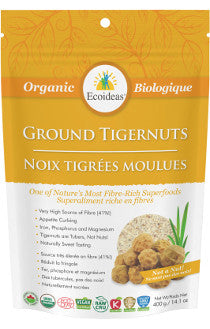
TIGERNUTS BY ECOIDEA'S - NATURE'S RICHEST SOURCE OF FIBREEcoideas's brings you Tigernuts - they are small tubers, not actual nuts an important fact for those with allergies. The ancient Egyptians knew that the fruit of Tigernuts' grass (Cyperus Esculentes) was highly beneficial, both as medicine and nutrition. Its root tubers are distinguished by an unusually high proportion of fibre and a delicious taste. Eco Idea's skinned Tigernuts are nature's richest source of fibre, & curb the appetite. Tigernuts are rich in phosphorous, potassium and Vitamin E and C. They also provide a rich source of high quality fats, with particularly high oleic acid content, perfect for use in smoothies, yogurts, hot cereals, salads, etc,. [STONE GROUND TIGERNUTS]
Ingredients:
Certified Organic Tigernuts (small tubers and not acutal nuts)
Important Information:
*This product is RAW: Refrigerate after opening
Dosage
Enjoy as a healthy snack or with food.
Usually eaten raw, mixed in muesli, yogurt, or as a nut substitute
Beneficial when mixed with baby and children's food for healthy growth
Powdered form can be blended into morning smoothies
2 tsp recommended daily for full advantage of benefits
Organic & Natural Functional Food Products
Eco Ideas, makers of natural health foods, Organic Skinned Tigernuts and Organic Manuka Honey Truffle Bars. Made with top quality natural ingredients, you can now satisfy your food cravings naturally. Get Eco Ideas for delicious, organic natural food products.
ECOIDEAS SKINNED GROUND TIGERNUTS
Ground for use in smoothies, yogurts, hot cereals, salads, etc,.
Tigernuts are small tubers, not actual nuts an important fact for those with allergies. The ancient Egyptians knew that the fruit of Tigernuts' grass (Cyperus Esculentes) was highly beneficial, both as medicine and nutrition. Its root tubers are distinguished by an unusually high proportion of fibre and a delicious taste.
Benefits of our Certified Organic Tigernuts:
-Nature's richest source of FIBRE
-Curbs the appetite (due to high fibre content)
-Rich in phosphorous,
potassium
and Vit E and C
-Positive effect on cholesterol levels due to high Vit E content
-Gluten Free and naturally sweet tasting
-Suitable for diabetics
-Suitable nut alternative
-Helps to maintain a healthy colon
-Supports the heart and activates blood circulation
-Regenerating food for the nervous system
-Performance-enhancing as a high source of energy for work, school and exercise
-Valuable source of easily digested
protein, carbohydrates and essential iron
-Provides high quality fats, with a particularly high oleic acid content
FIBRE
Fibre can be found in bran, fresh fruits, nuts seeds, beans and raw vegetables & Tigernuts!
Fibres can be added to the diet by increasing your intake of whole grains, fresh fruit and vegetables (with skin!) and beans/lentils. If it is still needed, many commercial fibre preparations, each with a unique mix of fibres in tablets, capsules or powder form, are available. Read
fibre supplements
carefully because some may contain laxatives, making those preparations unsuitable for long-term use. The recommended intake of fibre is anywhere from 25-40 g/day, a goal that can be achieved quite easily if you know how to make the most of your diet. 2 pieces of whole-wheat toast or 3/4 cups of cooked oats have about 6 g of dietary fibre. A cup of spinach has 7 g, while 1/2 of cooked black beans have just fewer than 10 g of fibre.
Psyllium
Fibre
A well-known and very commonly used fibre supplement, contains both insoluble and soluble forms of fibre, as do all plant foods. Many people are unfamiliar with what soluble and insoluble fibres really are, and the benefits they have for our health.
Soluble Fibre
Soluble fibre attracts water, dissolves in water and turns into a gel-like substance. The major benefit to soluble fibre is that it slows digestion, thus stabilizing blood sugar by delaying the absorption of glucose. Thus, soluble fibre plays a role in the prevention of diabetes, as well as obesity. By slowing digestion, not only do soluble fibres increase the uptake of minerals and nutrients during digestion, they promote satiety and help to prevent overeating. Psyllium, apples, beans, dried apricots, and oat bran are all excellent sources of soluble fibre.
Insoluble Fibre
Insoluble fibre, in comparison, does not dissolve in water. It acts to increase stool volume, otherwise known as a bulking agent. Insoluble fibre helps to maintain regularity by increasing transit time, promoting regular and healthy bowel contractions. Examples of some sources of insoluble fibre include wheat, corn, rice, vegetables and beans. Insoluble fibre may help to prevent and treat haemorrhoids,
varicose veins, and
constipation. These fibres also help to promote the removal of toxins through the bowel, before they are given a chance to be reabsorbed into the bloodstream, wreaking havoc on the body. It is this action that gives it such an important role in the prevention of unhealthy colon cells, among a myriad of other inflammatory diseases.
Fermentable Fibre
Recently there has been some dispute about the relevance of dividing fibre into soluble and insoluble categories. As an alternative, fibre can be divided in 'viscous' and 'fermentable'. Soluble fibres that are high in inulin or fructo-oligosaccharides, are said to be fermentable. Friendly bacteria in the large intestine ferment these fibres. These fibres can also be called
probiotics. They help to stimulate the selective growth of "good" intestinal bacteria (mainly the lactobacillus and bifidobacterium species), at the expense of "bad" bacteria. Bacteria like e-coli and clostridium species are also normal and necessary as parts of healthy gut flora, but if overgrown or unopposed, are more likely to cause infection. Another advantage of fermentable bacteria is a fatty acids called butyric acid, produced through the fermentation process and the primary fuel of the large intestine. Other short-chained fatty acids produced by the fermentation process are thought to be responsible for some of the cholesterol lowering properties of fibre. Leeks, onion, garlic, asparagus, jeruselum
artichoke
and chicory root are all high in inulin.
Viscous Fibres
Also primarily associated with soluble fibre, viscous fibres are the cholesterol lowering specialists. These fibres complex with bile acids, which are made by the liver from cholesterol and necessary for proper digestion of fats. After complexing with bile acids, these compounds are the removed from circulation and in turn lower cholesterol levels.
Carefully SelectedShips to the U.S.Wellness EssentialsTrusted Brands
Product Details
ECOIDEAS SKINNED GROUND TIGERNUTS
Ground for use in smoothies, yogurts, hot cereals, salads, etc,.
Tigernuts are small tubers, not actual nuts an important fact for those with allergies. The ancient Egyptians knew that the fruit of Tigernuts' grass (Cyperus Esculentes) was highly beneficial, both as medicine and nutrition. Its root tubers are distinguished by an unusually high proportion of fibre and a delicious taste.
Benefits of our Certified Organic Tigernuts:
-Nature's richest source of FIBRE
-Curbs the appetite (due to high fibre content)
-Rich in phosphorous,
potassium
and Vit E and C
-Positive effect on cholesterol levels due to high Vit E content
-Gluten Free and naturally sweet tasting
-Suitable for diabetics
-Suitable nut alternative
-Helps to maintain a healthy colon
-Supports the heart and activates blood circulation
-Regenerating food for the nervous system
-Performance-enhancing as a high source of energy for work, school and exercise
-Valuable source of easily digested
protein, carbohydrates and essential iron
-Provides high quality fats, with a particularly high oleic acid content
FIBRE
Fibre can be found in bran, fresh fruits, nuts seeds, beans and raw vegetables & Tigernuts!
Fibres can be added to the diet by increasing your intake of whole grains, fresh fruit and vegetables (with skin!) and beans/lentils. If it is still needed, many commercial fibre preparations, each with a unique mix of fibres in tablets, capsules or powder form, are available. Read
fibre supplements
carefully because some may contain laxatives, making those preparations unsuitable for long-term use. The recommended intake of fibre is anywhere from 25-40 g/day, a goal that can be achieved quite easily if you know how to make the most of your diet. 2 pieces of whole-wheat toast or 3/4 cups of cooked oats have about 6 g of dietary fibre. A cup of spinach has 7 g, while 1/2 of cooked black beans have just fewer than 10 g of fibre.
Psyllium
Fibre
A well-known and very commonly used fibre supplement, contains both insoluble and soluble forms of fibre, as do all plant foods. Many people are unfamiliar with what soluble and insoluble fibres really are, and the benefits they have for our health.
Soluble Fibre
Soluble fibre attracts water, dissolves in water and turns into a gel-like substance. The major benefit to soluble fibre is that it slows digestion, thus stabilizing blood sugar by delaying the absorption of glucose. Thus, soluble fibre plays a role in the prevention of diabetes, as well as obesity. By slowing digestion, not only do soluble fibres increase the uptake of minerals and nutrients during digestion, they promote satiety and help to prevent overeating. Psyllium, apples, beans, dried apricots, and oat bran are all excellent sources of soluble fibre.
Insoluble Fibre
Insoluble fibre, in comparison, does not dissolve in water. It acts to increase stool volume, otherwise known as a bulking agent. Insoluble fibre helps to maintain regularity by increasing transit time, promoting regular and healthy bowel contractions. Examples of some sources of insoluble fibre include wheat, corn, rice, vegetables and beans. Insoluble fibre may help to prevent and treat haemorrhoids,
varicose veins, and
constipation. These fibres also help to promote the removal of toxins through the bowel, before they are given a chance to be reabsorbed into the bloodstream, wreaking havoc on the body. It is this action that gives it such an important role in the prevention of unhealthy colon cells, among a myriad of other inflammatory diseases.
Fermentable Fibre
Recently there has been some dispute about the relevance of dividing fibre into soluble and insoluble categories. As an alternative, fibre can be divided in 'viscous' and 'fermentable'. Soluble fibres that are high in inulin or fructo-oligosaccharides, are said to be fermentable. Friendly bacteria in the large intestine ferment these fibres. These fibres can also be called
probiotics. They help to stimulate the selective growth of "good" intestinal bacteria (mainly the lactobacillus and bifidobacterium species), at the expense of "bad" bacteria. Bacteria like e-coli and clostridium species are also normal and necessary as parts of healthy gut flora, but if overgrown or unopposed, are more likely to cause infection. Another advantage of fermentable bacteria is a fatty acids called butyric acid, produced through the fermentation process and the primary fuel of the large intestine. Other short-chained fatty acids produced by the fermentation process are thought to be responsible for some of the cholesterol lowering properties of fibre. Leeks, onion, garlic, asparagus, jeruselum
artichoke
and chicory root are all high in inulin.
Viscous Fibres
Also primarily associated with soluble fibre, viscous fibres are the cholesterol lowering specialists. These fibres complex with bile acids, which are made by the liver from cholesterol and necessary for proper digestion of fats. After complexing with bile acids, these compounds are the removed from circulation and in turn lower cholesterol levels.
🌿
Daily Wellness
Easy to add to your everyday health routine.
✅
Carefully Selected
Chosen with quality and customer needs in mind.
💊
Simple to Use
Designed for convenient daily supplementation.
🚚
Ships to the U.S.
Fast, reliable shipping to U.S. customers.
Choosing a selection results in a full page refresh.