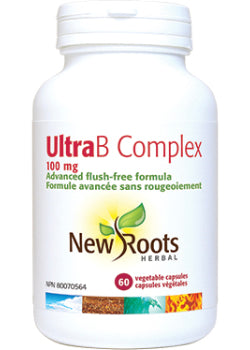
100 MG ULTRA B COMPLEX FROM NEW ROOTS HERBAL.New Roots Ultra B Complex incorporates co-enzyme B's, functional flush-free niacin, and enhanced-absorption choline in a complete B-complex formula. The B complex vitamins are named so because they are found together as a complex in food. They have complementary actions and work together in the body. B vitamins are responsible for a myriad of physiological functions which include the metabolism of fats, carbohydrates, proteins, the formation of red blood cells and factors in the maintenance of good health. Ultra B Complex from New Roots is a fast-acting B complex that does what B's are supposed to do - actively support the mind, mood, nervous, cardiovascular and digestive systems. [VCAPS]
Contains
Thiamine (vitamin B1) (thiamine hydrochloride) 100mg
Riboflavin (vitamin B2) 90mg
Riboflavin (vitamin B2) (riboflavin-5′‑phosphate) 10mg
Inositol hexanicotinate, flush-free (vitamin B3) 100mg
Pantothenic acid (vitamin B5) (calcium ᴅ‑pantothenate) 100mg
Vitamin B6 (pyridoxal-5′‑phosphate) 10mg
Vitamin B6 (pyridoxine hydrochloride) 90mg
Folate (from calcium ʟ‑5‑methyltetrahydrofolate) 1mg
Biotin 75mcg
Vitamin B12 (methylcobalamin) 300mcg
Choline (choline bitartrate) 45mg
Inositol 80mg
para-Aminobenzoic acid (PABA) 50mg
Non-medicinal Ingredients:
Vegetable magnesium stearate, silicon dioxide, and microcrystalline cellulose in a non‑GMO vegetable capsule composed of vegetable carbohydrate gum and purified water.
Important Information:
Consult a health-care practitioner prior to use if you are pregnant or breast-feeding, or if you are taking sulfonamides. Discontinue use if hypersensitivity occurs. This product is very sensitive to humidity. Keep in a dry place. Close cap tightly after opening.
Dosage
Take 1 capsule daily with a meal or as directed by your health-care practitioner.
Proudly Manufactured In Canada & Available
New Roots Herbal offers high-quality natural health products like their best-selling probiotics, digestive enzymes, chill pills, strong bones, acidophilus ultra and black cumin seed oil among hundreds more herbal remedies. Founded in 1985 New Roots Canada delivers formulas that were designed to contribute to the prevention and cure of disease at their core. You can buy all New Roots supplements at ca
VITAMIN B
COENZYME FORMS
Taking B vitamins in their most active form...
What are they?
B vitamins are a large group of molecules involved as cofactors in many of our cellular metabolic processes, particularly cellular respiration, which involves the cellular metabolism of fat,
protein
and carbohydrates into usable energy forms. That means that in order for our bodies to properly: live, grow, heal, and stay healthy, we require B vitamins. For more information on all of the B vitamins, please click here.
Interestingly, each subset of B vitamin comes in a number of different forms, each of which is absorbed and used differently by our bodies. Research has suggested that ingesting some vitamins in their active coenzyme form can help to promote more efficient use in our bodies. In some cases, supplementation with the active coenzyme form of a vitamin has been shown to have completely different effects than supplementation with the vitamin alone.
What do they do, and how do their effects differ?
Each B vitamin is unique in its function and in the difference between the plain vitamin and its active coenzyme form. Please see below for each example.
Vitamin B1: Thiamine, TPP and Benfotiamine:
Thiamine is a water-soluble vitamin that is used in a number of cellular reactions throughout the body. It is an antioxidant that is associated with brain health, blood cell production, and improved cardiovascular and digestive function. Thiamine is absorbed from the digestive tract using transport molecules. These molecules can only absorb a limited amount of thiamine at one time. Once inside the body, thiamine is converted to its active form: thiamine pyrophosphate (TPP). For more information on thiamine, please click here. Interestingly, there is a substance called benfotiamine that is a fat-soluble thiamine precursor that can bypass these absorption transport pathways in the gut. Because of this, its absorption is less limited than that of thiamine alone. Although it is not technically thiamine, once absorbed, benfotiamine is also quickly converted into the active coenzyme TPP. In addition to its conversion to active thiamine, benfotiamine has protective effects against the damage caused by glycosylation from excess blood sugar levels in diabetics. Because of this, it can help to prevent
diabetes
-associated
neuropathy, and cardiovascular disease. For more information on benfotiamine, please click here.
Vitamin B2: Riboflavin, R5P, and FMN/FAD:
Riboflavin is a water-soluble B vitamin that is phosphorylated in the intestines prior to absorption. The phosphorylated riboflavin comes in two different forms: flavin mononucleotide (FMN), and flavin adenine dinucleotide (FAD), both of which are cofactors in the energy production pathways of our cells. Riboflavin is required for cellular reproduction and activity, thus our bodies require this nutrient for growth and repair. Because phosphorylated riboflavin is the form actively absorbed in the intestine, supplementing with them is theorized to improve absorption. The phosphorylated form of riboflavin found in supplements is often FMN which is riboflavin-5'-phosphate, and is also called R5P. It is likely that people with proper enzyme function in their guts would not require pre-phosphorylated riboflavin, and could instead take it plain. For more information on riboflavin and R5P, please click here.
Vitamin B3: Niacin, Niacinamide, IHN, NADH:
Niacin is another water-soluble B vitamin that can be considered non-essential, as the body can produce its own using tryptophan and vitamins B1, B2 and B6. Niacin can be taken in its plain form (as nicotinic acid), or can be taken as niacinamide or
inositol
hexaniacinate (IHN). Each of these forms can be converted into NADH, a major energy production cofactor in the body. Plain niacin causes the blood vessels in the body to dilate, which causes a "flush" response in the skin. The dilatory response of plain niacin has cardiovascular and anti-allergy benefits. Niacinamide and IHN do not cause this response, and are thus called "no-flush" or "flush-free" niacin. These forms of niacin do not have the same cardiovascular, lipid modifying, or anti-allergy effects, although they do still have the positive effects on energy metabolism and mental health. For more information on niacin, please click here.
Vitamin B5: Pantothenic acid, pantothenate, and pantethine:
Pantothenic acid is an essential nutrient that is commonly known as the "anti-stress" vitamin. It is required in the body for the synthesis of coenzyme A (CoA), an active side-group that is used for a wide variety of functions throughout the body. It has a role in nerve signaling, enzyme activation and deactivation, hormone production, and mood neurotransmitter production. In addition to this, B5 increases the rate of wound healing and promotes blood and immune cell formation. It can be used topically to treat skin conditions and internally for
rheumatoid arthritis. Most commonly, vitamin B5 is known for its stress-adaptive functions. For more information on the benefits of vitamin B5, please click here. Interestingly, pantethine is called activated, or coenzyme vitamin B, although it does not actually act as pantothenic acid in the body. Instead, pantethine has unique lipid lowering and cholesterol balancing properties, and is dosed differently from other forms of this vitamin. For more information on pantethine, please click here.
Vitamin B6: Pyridoxine, pyridoxal, pyridoxamine, and P5P/PLP:
Pyridoxine is probably the most widely used B vitamin in the body. It can be taken in a number of different forms, although it is most commonly found as the precursor form pyridoxal, or as pyridoxal-5'-phosphate (P5P / PLP), which is the active coenzyme form. Because P5P is cleaved back to pyridoxal in the intestines prior to absorption, most people can benefit equally from supplementation of pyridoxal or P5P. Those with an enzymatic deficiency in their ability to re-phosphorylate pyridoxal, will benefit from P5P supplementation directly. The active coenzyme form of this water soluble vitamin plays a role in a vast number of chemical processes in the body such as: cardiovascular health, neurotransmitter production, cellular growth, DNA replication, antibody formation, mood regulation, and it can even help to prevent "morning sickness" during pregnancy.
Carefully SelectedShips to the U.S.Wellness EssentialsTrusted Brands
Product Details
VITAMIN B
COENZYME FORMS
Taking B vitamins in their most active form...
What are they?
B vitamins are a large group of molecules involved as cofactors in many of our cellular metabolic processes, particularly cellular respiration, which involves the cellular metabolism of fat,
protein
and carbohydrates into usable energy forms. That means that in order for our bodies to properly: live, grow, heal, and stay healthy, we require B vitamins. For more information on all of the B vitamins, please click here.
Interestingly, each subset of B vitamin comes in a number of different forms, each of which is absorbed and used differently by our bodies. Research has suggested that ingesting some vitamins in their active coenzyme form can help to promote more efficient use in our bodies. In some cases, supplementation with the active coenzyme form of a vitamin has been shown to have completely different effects than supplementation with the vitamin alone.
What do they do, and how do their effects differ?
Each B vitamin is unique in its function and in the difference between the plain vitamin and its active coenzyme form. Please see below for each example.
Vitamin B1: Thiamine, TPP and Benfotiamine:
Thiamine is a water-soluble vitamin that is used in a number of cellular reactions throughout the body. It is an antioxidant that is associated with brain health, blood cell production, and improved cardiovascular and digestive function. Thiamine is absorbed from the digestive tract using transport molecules. These molecules can only absorb a limited amount of thiamine at one time. Once inside the body, thiamine is converted to its active form: thiamine pyrophosphate (TPP). For more information on thiamine, please click here. Interestingly, there is a substance called benfotiamine that is a fat-soluble thiamine precursor that can bypass these absorption transport pathways in the gut. Because of this, its absorption is less limited than that of thiamine alone. Although it is not technically thiamine, once absorbed, benfotiamine is also quickly converted into the active coenzyme TPP. In addition to its conversion to active thiamine, benfotiamine has protective effects against the damage caused by glycosylation from excess blood sugar levels in diabetics. Because of this, it can help to prevent
diabetes
-associated
neuropathy, and cardiovascular disease. For more information on benfotiamine, please click here.
Vitamin B2: Riboflavin, R5P, and FMN/FAD:
Riboflavin is a water-soluble B vitamin that is phosphorylated in the intestines prior to absorption. The phosphorylated riboflavin comes in two different forms: flavin mononucleotide (FMN), and flavin adenine dinucleotide (FAD), both of which are cofactors in the energy production pathways of our cells. Riboflavin is required for cellular reproduction and activity, thus our bodies require this nutrient for growth and repair. Because phosphorylated riboflavin is the form actively absorbed in the intestine, supplementing with them is theorized to improve absorption. The phosphorylated form of riboflavin found in supplements is often FMN which is riboflavin-5'-phosphate, and is also called R5P. It is likely that people with proper enzyme function in their guts would not require pre-phosphorylated riboflavin, and could instead take it plain. For more information on riboflavin and R5P, please click here.
Vitamin B3: Niacin, Niacinamide, IHN, NADH:
Niacin is another water-soluble B vitamin that can be considered non-essential, as the body can produce its own using tryptophan and vitamins B1, B2 and B6. Niacin can be taken in its plain form (as nicotinic acid), or can be taken as niacinamide or
inositol
hexaniacinate (IHN). Each of these forms can be converted into NADH, a major energy production cofactor in the body. Plain niacin causes the blood vessels in the body to dilate, which causes a "flush" response in the skin. The dilatory response of plain niacin has cardiovascular and anti-allergy benefits. Niacinamide and IHN do not cause this response, and are thus called "no-flush" or "flush-free" niacin. These forms of niacin do not have the same cardiovascular, lipid modifying, or anti-allergy effects, although they do still have the positive effects on energy metabolism and mental health. For more information on niacin, please click here.
Vitamin B5: Pantothenic acid, pantothenate, and pantethine:
Pantothenic acid is an essential nutrient that is commonly known as the "anti-stress" vitamin. It is required in the body for the synthesis of coenzyme A (CoA), an active side-group that is used for a wide variety of functions throughout the body. It has a role in nerve signaling, enzyme activation and deactivation, hormone production, and mood neurotransmitter production. In addition to this, B5 increases the rate of wound healing and promotes blood and immune cell formation. It can be used topically to treat skin conditions and internally for
rheumatoid arthritis. Most commonly, vitamin B5 is known for its stress-adaptive functions. For more information on the benefits of vitamin B5, please click here. Interestingly, pantethine is called activated, or coenzyme vitamin B, although it does not actually act as pantothenic acid in the body. Instead, pantethine has unique lipid lowering and cholesterol balancing properties, and is dosed differently from other forms of this vitamin. For more information on pantethine, please click here.
Vitamin B6: Pyridoxine, pyridoxal, pyridoxamine, and P5P/PLP:
Pyridoxine is probably the most widely used B vitamin in the body. It can be taken in a number of different forms, although it is most commonly found as the precursor form pyridoxal, or as pyridoxal-5'-phosphate (P5P / PLP), which is the active coenzyme form. Because P5P is cleaved back to pyridoxal in the intestines prior to absorption, most people can benefit equally from supplementation of pyridoxal or P5P. Those with an enzymatic deficiency in their ability to re-phosphorylate pyridoxal, will benefit from P5P supplementation directly. The active coenzyme form of this water soluble vitamin plays a role in a vast number of chemical processes in the body such as: cardiovascular health, neurotransmitter production, cellular growth, DNA replication, antibody formation, mood regulation, and it can even help to prevent "morning sickness" during pregnancy.
🌿
Daily Wellness
Easy to add to your everyday health routine.
✅
Carefully Selected
Chosen with quality and customer needs in mind.
💊
Simple to Use
Designed for convenient daily supplementation.
🚚
Ships to the U.S.
Fast, reliable shipping to U.S. customers.
Choosing a selection results in a full page refresh.