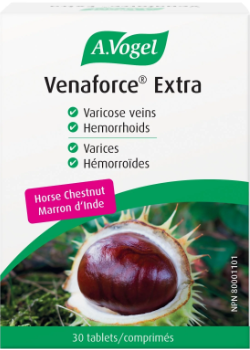
VENAFORCE TABS FROM A. VOGEL FORMULATED TO SUPPORT HEALTHY VENOUS FUNCTION.Venous insufficiencies can develop from poor diet, excess weight, tobacco, alcohol, inactivity and more. Venaforce from A. Vogel is formulated to help relieve symptoms including varicose veins, spider veins, hemorrhoids and swollen legs. Each tablet contains dry extract of fresh Horse Chestnut Seed standardized to contain 50 mg of aescin. Numerous studies have found that horse chestnut seed may be helpful for chronic venous insufficiency working to strengthen fragile capillaries and slow the progression and symptoms of varicose and spider veins or hemorrhoids. [TABLET]
Each tablet contains:
Extract of fresh Horse chestnut (Aesculus hippocastanum L.) seed (ratio 5:1) 191.25 mg
equivalent to 956.25 mg dried seed,standardized to 50 mg (22-32%) aescin per tablet
Non-Medicinal IngredientsMicrocrystalline cellulose, corn starch, methacrylic acid copolymer, copovidone, colloidal silicon dioxyde, soya polysaccharides, talc, triethyl citrate
Important Information:
Free of all common allergens, including: wheat, dairy, eggs, corn, soy, and yeast.
Dosage
Take 1 tablet twice daily, every 12 hours, with water during meals.
Swiss remedies from fresh, organic plants since 1923
A.Vogel, top formulators of Swiss-made herbal health products and Canada’s best-selling Cold & Flu support. A Vogel products include Echinaforce and the best menopausal women's supplement, Menoforce. Now they bring to you A.Vogel Allergy Relief, Pollinosan complex as well as their classic Biostrath Elixir, arnica gel for topical pain relief and natural eye drops. Buy now at
HORSE CHESTNUT
The herb that can protect your veins and help to treat chronic venous insufficiency, hemorrhoids, and varicose veins...
The tree (Aesculus hippocastanum) is commonly known as “horse chestnut” because of its large seeds that resemble chestnuts (although they are not actually related species). Extract from the seeds have been used to treat chronic venous insufficiency.
There are 4 different varieties of chestnuts growing all over the world, the more common one being sweet chestnut. Do not confuse edible chestnuts with horse chestnut because they are completely different plants and horse chestnut's are toxic when eaten raw.
Sweet chestnuts in it's husk is spiny and needle sharp. Out of the husk it is brown and light coloured spot on it and will have a tassel or point on the nut. Horse chestnuts come in a husk that is much smoother with only a few warts. They are commonly found in forests and back yards. The nut itself has no point and is smooth and roundish all over.
What is chronic venous insufficiency?
This condition is caused by a blockage or valve-failure in one or more of the major veins, most commonly in the legs. Since the blood cannot properly return to the heart, it pools in the veins, especially when movement is restricted, as in periods of prolonged standing. Thus, the veins in the legs are constantly filled with blood and can begin to bulge, resulting in a condition known as varicose veins. It can also cause swelling and purple discolouration of the legs, thickened skin on the feet and ankles, and even ulcers of the skin when the stasis is prolonged. This type of venous stasis also causes other venous conditions like hemorrhoids. For more information please see our article about hemorrhoids.
Other uses of horse chestnut
In addition to being effective in the treatment of chronic venous insufficiency, horse chestnut has also long been used in the treatment of:
diarrhea, fever, cough, enlarged prostate, eczema, and menstrual pain. Horse chestnut is also used in
Bach flower remedies, and when the bud is used, it is called “chestnut bud”, whereas when the flowers are used it is called “white chestnut”.
How can I take horse chestnut?
Young, fresh nuts contain some alkaloid saponins and glucosides, which can be poisonous when eaten. Be sure to only supplement with processed extracts from trusted sources. Extracts are standardized to the percentage of the active ingredient called aescin that they contain. Optimal aescin content is considered to be 17% or greater for supplementation at the recommended dose of 300mg two times daily. These extracts are generally found in capsule form either alone or in combination with other vitamins and herbs for vein health.
Horse Chestnut – QUICK FACTS
PARTS USED
· Seed, and leaf. Bach flower: flower, buds.
APPLICATIONS
· Chronic venous insufficiency, fluid retention, blood clotting. Also potentially useful in diarrhea, fever, cough, BPH (enlarged prostate), eczema and menstrual pain.
OPTIMUM DOSAGE
· 300mg twice daily, standardized to at least 17% aescin.
WORKS WELL WITH
·
Multi minerals,
calcium,
magnesium,
boron, essential fatty acids.
IMPORTANT INFORMATION
· Horse chestnut should not be used with blood thinners as it may have additive effects.
· Some people experience dizziness, headache, upset stomach or itching while taking horse chestnut.
· Those with kidney conditions should not use horse chestnut.
· People suffering from a latex allergy may cross react with horse chestnut. Use with caution.
Carefully SelectedShips to the U.S.Wellness EssentialsTrusted Brands
Product Details
HORSE CHESTNUT
The herb that can protect your veins and help to treat chronic venous insufficiency, hemorrhoids, and varicose veins...
The tree (Aesculus hippocastanum) is commonly known as “horse chestnut” because of its large seeds that resemble chestnuts (although they are not actually related species). Extract from the seeds have been used to treat chronic venous insufficiency.
There are 4 different varieties of chestnuts growing all over the world, the more common one being sweet chestnut. Do not confuse edible chestnuts with horse chestnut because they are completely different plants and horse chestnut's are toxic when eaten raw.
Sweet chestnuts in it's husk is spiny and needle sharp. Out of the husk it is brown and light coloured spot on it and will have a tassel or point on the nut. Horse chestnuts come in a husk that is much smoother with only a few warts. They are commonly found in forests and back yards. The nut itself has no point and is smooth and roundish all over.
What is chronic venous insufficiency?
This condition is caused by a blockage or valve-failure in one or more of the major veins, most commonly in the legs. Since the blood cannot properly return to the heart, it pools in the veins, especially when movement is restricted, as in periods of prolonged standing. Thus, the veins in the legs are constantly filled with blood and can begin to bulge, resulting in a condition known as varicose veins. It can also cause swelling and purple discolouration of the legs, thickened skin on the feet and ankles, and even ulcers of the skin when the stasis is prolonged. This type of venous stasis also causes other venous conditions like hemorrhoids. For more information please see our article about hemorrhoids.
Other uses of horse chestnut
In addition to being effective in the treatment of chronic venous insufficiency, horse chestnut has also long been used in the treatment of:
diarrhea, fever, cough, enlarged prostate, eczema, and menstrual pain. Horse chestnut is also used in
Bach flower remedies, and when the bud is used, it is called “chestnut bud”, whereas when the flowers are used it is called “white chestnut”.
How can I take horse chestnut?
Young, fresh nuts contain some alkaloid saponins and glucosides, which can be poisonous when eaten. Be sure to only supplement with processed extracts from trusted sources. Extracts are standardized to the percentage of the active ingredient called aescin that they contain. Optimal aescin content is considered to be 17% or greater for supplementation at the recommended dose of 300mg two times daily. These extracts are generally found in capsule form either alone or in combination with other vitamins and herbs for vein health.
Horse Chestnut – QUICK FACTS
PARTS USED
· Seed, and leaf. Bach flower: flower, buds.
APPLICATIONS
· Chronic venous insufficiency, fluid retention, blood clotting. Also potentially useful in diarrhea, fever, cough, BPH (enlarged prostate), eczema and menstrual pain.
OPTIMUM DOSAGE
· 300mg twice daily, standardized to at least 17% aescin.
WORKS WELL WITH
·
Multi minerals,
calcium,
magnesium,
boron, essential fatty acids.
IMPORTANT INFORMATION
· Horse chestnut should not be used with blood thinners as it may have additive effects.
· Some people experience dizziness, headache, upset stomach or itching while taking horse chestnut.
· Those with kidney conditions should not use horse chestnut.
· People suffering from a latex allergy may cross react with horse chestnut. Use with caution.
🌿
Daily Wellness
Easy to add to your everyday health routine.
✅
Carefully Selected
Chosen with quality and customer needs in mind.
💊
Simple to Use
Designed for convenient daily supplementation.
🚚
Ships to the U.S.
Fast, reliable shipping to U.S. customers.
Choosing a selection results in a full page refresh.