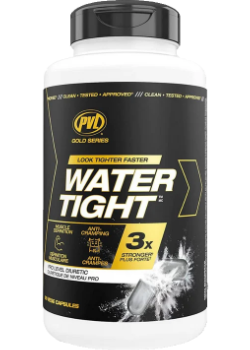
PVL’s WATERTIGHT is the pro-level diuretic designed with all the necessary ingredients to help you look tighter, faster while not sacrificing your hard-earned muscle tissue! Watertight is a 3-in-1 diuretic featuring dandelion root, juniper plus a unique anti-cramping electrolyte bled. Formulated without banned substances, WATERTIGHT has been rigorously tested to help reduce bloating and for athletes who are looking to shed extra water weight for competition, only containing a small amount of caffeine for metabolism and energy. Get into your best shape with PVL WATERTIGHT. [VCAP]
Per 6 v-caps contains:
Watertigh Advanced 3-in-1 Diuretic Formula 3350mg
Pro Definition Diuretic Matrix 1600mg
Premium Dandelion Root Extract (Taraxacum officinale) 20:1 (QCE = 20,000 mg*) 1000mg
Juniper (Juniperus communis) (berry) 4:1 (QCE = 2,000 mg*) 500mg
Vitamin B6 (Pyridoxine HCI) 100mg
Other Ingredients 1750mg
Anti-Cramping Electrolyte Matrix 1000mg
Calcium (Carbonate, Phosphate)(200 mg calcium) 500mg
Potassium (Chloride) (130 mg potassium) 250mg
Magnesium (Oxide) (148 mg magnesium) 250mg
Pro-Tightening Matrix (Green Tea Extract (Camellia sinensis)(leaf), Lemon (Citrus limon), Cranberry (Vaccinium macrocarpon), Celery (Apium graveolens)) 750mg
Capsule Ingredients:
Vegetarian Capsule (Hypromellose), Microcrystalline Cellulose, Magnesium Stearate, Silicon Dioxide.
Important Information:
Do not use if tamper evident security feature is broken or missing. For adult use only.
Consult a health care practitioner prior to use if you are pregnant or breastfeeding, if you have a liver disorder or develop symptoms of liver trouble (such as abdominal pain, dark urine or jaundice) or if you have an iron deficiency; or if you have any health concerns. Keep out of reach of children. For optimal freshness, keep out of direct sunlight and store in a cool, dark place. No artificial preservatives, flavours or sweeteners.
Dosage
Take 3 capsules in the morning and 3 capsules in the afternoon (6 capsules
per day).
Gold Series Sports Nutrition Whey & Gainers
Pure Vita Labs (PVL) takes pride in crafting the highest quality sports supplements. They formulate, manufacture, and distribute their own products, so they know exactly what goes in (and what doesn’t). PVL products are 100% natural, with no artificial flavours, colours, or sweeteners, and their entire line is Informed Choice Certified, tested for banned substances by LGC’s world-class sports anti-doping lab. From Whey Protein to BCAAs, their supplements are to help push you through your workout.
Edema
Have you noticed that your socks are too tight lately? That you can't wear your wedding ring because it no longer fits? Is your face getting puffy? Before you go on an emergency weight loss program, you may want to consider that its not fat at all, but rather fluid retention or Edema...
Edema may be a normal and very treatable symptom for many individuals. But, if it is a persistent problem that seems to be worsening and it is not relieved by elevating the feet, Or, if you are noticing significant edema around the eyes, in the legs, and hands, you many want to speak to your healthcare professional, so they can rule out more serious conditions that may be causing fluid retention.
The (Water) Balancing Act
In order for us to function at our optimal level, the water content of our bodies should be about 70%. This makes the job of regulating our water balance extremely important. The kidneys take on most of this responsibility along with the help of anti-diuretic hormone (ADH), also called vasopressin. Vasopressin is secreted by the pituitary gland to prevent excessive loss of water from the kidneys, basically a message to the kidneys to hold on to water in order to preserve optimal functioning of the body and prevent dehydration. Edema is more or less a symptom of a malfunction in this process. Once the body has enough water and the kidney can begin excreting or flushing water normally, vasopressin should turn off. In the case of edema, this shut off mechanism malfunctions and we continue to retain water in excess and when it is no longer needed.
Pitting versus Non-pitting Edema
Pitting edema can be demonstrated by applying firm pressure to an area of edema. If this pressure causes an indentation that lasts for several seconds to minutes after the pressure is withdrawn, the edema is referred to as pitting. Non-pitting edema will not result in a persistent indentation following pressure. Understanding the difference between the two types of edema is important to our overall understanding of what is causing the problem and potential remedies to the problem. Pitting edema is most commonly bilateral, tender to touch and often harder to treat due to more serious causes. Some patients with hyperthyroidism may experience a type of pitting edema over the shins, known as pretibial myxedema. Non-pitting edema is more likely to be unilateral in nature and is commonly caused by impaired lymphatic drainage (lymphedema).
Common Causes of Edema
Edema can often be a treatable and harmless problem as it is common to experience mild swelling even simply for sitting or standing for prolonged periods of time. Travelling on an airplane for long distances can cause edema as well as hot weather and sweating. What we eat and consume can also play a role in edema; a high salt intake can lead to excess water retention (more on this below). For women, edema can be a common symptom of the menstrual cycle and usually clears up following the beginning of menstruation. Late pregnancy can also bring about edema. Certain medications may also be responsible for excess fluid retention.
Edema As A Symptom Of More Serious Underlying Conditions
Individuals with heart, kidney and often liver pathologies (or with a family history of these problems) are most often at risk for more serious causes of fluid retention. In these individuals, edema could be a sign of increased blood pressure (also increasing risk of stroke), reduced cardiac output (in the case of congestive heart failure), impaired kidney function (as can be seen in kidney disease), or loss of important proteins, like albumin, in the urine (which can be caused by diseases of either the liver or kidney). In these individuals, prolonged edema causes blood circulation to decrease. This reduced circulation can also lead to pain, affecting muscles and joints.
Varicose veins
and thrombophlebitis (inflammation of the veins) are also common causes of edema, caused by a deficient venous return of blood due to venous insufficiency or obstruction. Compression stockings which support the healthy flow of venous blood back to the heart, can be quite useful in treating cases of venous insufficiency.
Dietary and Lifestyle Factors affecting Edema
There are some very simple dietary and lifestyle suggestions that can promote healthy elimination of excess water. Although this may seem backward, one of the most important things you can do is to increase your water intake, both through food and drink. Water encourages regular diuresis (an increase in the production and expulsion of urine). Foods high in water include celery, melons, grapes, carrots, and spinach, or other green leafy vegetables. Similarly, try to limit your intake of sodium in the diet. High sodium can lead to excess water retention. Watch for canned or prepared and processed foods, as these are often high in sodium. Refined foods, such as white breads, pastas, and refined sugars (baked goods, fruit juices, pop), as well as alcohol, can also lead to water retention. Exercise! Movement of any sort that is increasing heart rate is helping to support the movement of fluid from the extremities back to the heart, thereby reducing edema in the extremities.
Nutraceuticals for the relief of Edema
CoQ10
is so important to the cardiovascular system in general, including in the case of congestive heart failure. CoQ10 supplies the heart cells with oxygen for overall improved function. L-
Arginine
is a very effective way to naturally lower blood pressure. It helps to dilate blood vessels, optimizing blood flow both to and from the heart.
Taurine
can also be quite helpful in treating edema due to cardiovascular deficiencies. In terms of healthy liver function, N-Acetyl
cysteine
(NAC),
milk thistle
and curcumin are all potent
antioxidants
with an affinity for the liver, helping to detoxify and in some cases even regenerate liver cells.
Horse chestnut
is a well-known remedy for chronic venous insufficiency, helping to support the integrity of the vein walls. Herbal diuretics, such as Bearberry (
Uva Ursi
), Dandelion, Juniper and
parsley
have also been used to treat and prevent fluid retention leading to edema.
Carefully SelectedShips to the U.S.Wellness EssentialsTrusted Brands
Product Details
Edema
Have you noticed that your socks are too tight lately? That you can't wear your wedding ring because it no longer fits? Is your face getting puffy? Before you go on an emergency weight loss program, you may want to consider that its not fat at all, but rather fluid retention or Edema...
Edema may be a normal and very treatable symptom for many individuals. But, if it is a persistent problem that seems to be worsening and it is not relieved by elevating the feet, Or, if you are noticing significant edema around the eyes, in the legs, and hands, you many want to speak to your healthcare professional, so they can rule out more serious conditions that may be causing fluid retention.
The (Water) Balancing Act
In order for us to function at our optimal level, the water content of our bodies should be about 70%. This makes the job of regulating our water balance extremely important. The kidneys take on most of this responsibility along with the help of anti-diuretic hormone (ADH), also called vasopressin. Vasopressin is secreted by the pituitary gland to prevent excessive loss of water from the kidneys, basically a message to the kidneys to hold on to water in order to preserve optimal functioning of the body and prevent dehydration. Edema is more or less a symptom of a malfunction in this process. Once the body has enough water and the kidney can begin excreting or flushing water normally, vasopressin should turn off. In the case of edema, this shut off mechanism malfunctions and we continue to retain water in excess and when it is no longer needed.
Pitting versus Non-pitting Edema
Pitting edema can be demonstrated by applying firm pressure to an area of edema. If this pressure causes an indentation that lasts for several seconds to minutes after the pressure is withdrawn, the edema is referred to as pitting. Non-pitting edema will not result in a persistent indentation following pressure. Understanding the difference between the two types of edema is important to our overall understanding of what is causing the problem and potential remedies to the problem. Pitting edema is most commonly bilateral, tender to touch and often harder to treat due to more serious causes. Some patients with hyperthyroidism may experience a type of pitting edema over the shins, known as pretibial myxedema. Non-pitting edema is more likely to be unilateral in nature and is commonly caused by impaired lymphatic drainage (lymphedema).
Common Causes of Edema
Edema can often be a treatable and harmless problem as it is common to experience mild swelling even simply for sitting or standing for prolonged periods of time. Travelling on an airplane for long distances can cause edema as well as hot weather and sweating. What we eat and consume can also play a role in edema; a high salt intake can lead to excess water retention (more on this below). For women, edema can be a common symptom of the menstrual cycle and usually clears up following the beginning of menstruation. Late pregnancy can also bring about edema. Certain medications may also be responsible for excess fluid retention.
Edema As A Symptom Of More Serious Underlying Conditions
Individuals with heart, kidney and often liver pathologies (or with a family history of these problems) are most often at risk for more serious causes of fluid retention. In these individuals, edema could be a sign of increased blood pressure (also increasing risk of stroke), reduced cardiac output (in the case of congestive heart failure), impaired kidney function (as can be seen in kidney disease), or loss of important proteins, like albumin, in the urine (which can be caused by diseases of either the liver or kidney). In these individuals, prolonged edema causes blood circulation to decrease. This reduced circulation can also lead to pain, affecting muscles and joints.
Varicose veins
and thrombophlebitis (inflammation of the veins) are also common causes of edema, caused by a deficient venous return of blood due to venous insufficiency or obstruction. Compression stockings which support the healthy flow of venous blood back to the heart, can be quite useful in treating cases of venous insufficiency.
Dietary and Lifestyle Factors affecting Edema
There are some very simple dietary and lifestyle suggestions that can promote healthy elimination of excess water. Although this may seem backward, one of the most important things you can do is to increase your water intake, both through food and drink. Water encourages regular diuresis (an increase in the production and expulsion of urine). Foods high in water include celery, melons, grapes, carrots, and spinach, or other green leafy vegetables. Similarly, try to limit your intake of sodium in the diet. High sodium can lead to excess water retention. Watch for canned or prepared and processed foods, as these are often high in sodium. Refined foods, such as white breads, pastas, and refined sugars (baked goods, fruit juices, pop), as well as alcohol, can also lead to water retention. Exercise! Movement of any sort that is increasing heart rate is helping to support the movement of fluid from the extremities back to the heart, thereby reducing edema in the extremities.
Nutraceuticals for the relief of Edema
CoQ10
is so important to the cardiovascular system in general, including in the case of congestive heart failure. CoQ10 supplies the heart cells with oxygen for overall improved function. L-
Arginine
is a very effective way to naturally lower blood pressure. It helps to dilate blood vessels, optimizing blood flow both to and from the heart.
Taurine
can also be quite helpful in treating edema due to cardiovascular deficiencies. In terms of healthy liver function, N-Acetyl
cysteine
(NAC),
milk thistle
and curcumin are all potent
antioxidants
with an affinity for the liver, helping to detoxify and in some cases even regenerate liver cells.
Horse chestnut
is a well-known remedy for chronic venous insufficiency, helping to support the integrity of the vein walls. Herbal diuretics, such as Bearberry (
Uva Ursi
), Dandelion, Juniper and
parsley
have also been used to treat and prevent fluid retention leading to edema.
🌿
Daily Wellness
Easy to add to your everyday health routine.
✅
Carefully Selected
Chosen with quality and customer needs in mind.
💊
Simple to Use
Designed for convenient daily supplementation.
🚚
Ships to the U.S.
Fast, reliable shipping to U.S. customers.
Choosing a selection results in a full page refresh.