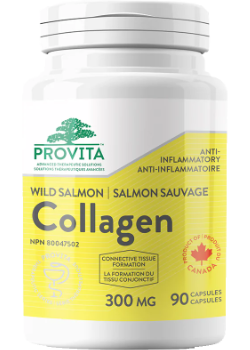
Essential for healthy ligaments and skin, Wild Salmon Collagen from Provita assists in Collagen formation and in connective tissue formation. Collagen is the most important protein in the human body as it represents 30% of total body proteins and 70% of the proteins in the skin. Collagen acts as a buffer that protects cells from stress and thus maintains the elasticity of connective tissue, some of the most important being the ones in the composition of joint cartilage and skin. Fish collagen has a smaller molecule than bovine collagen and therefore can be absorbed and utilized more efficiently. Provita’s Wild Salmon Collagen helps in collagen and connective tissue formation. Collagen is an essential part of joints and skin. Salmon Collagen has been shown to aid in achieving soft, smooth, and beautiful skin and contributes to the health of joint cartilage. [CAPS]
Each capsule contains:
Hydrolyzed Collagen (from wild harvested salmonids and other small marine fish) 200 mg
L-Lysine 50 mg
Vitamin C (ascorbic acid) 50 mg
Non-medicinal Ingredients:
Rice flour, vegetable stearate, gelatin.
Important Information:
For prolonged use, consult a health care practitioner. Consult a healthcare practitioner prior to use if: you are taking prescription medications, are taking anticoagulants (interactions between anticoagulants and Melilotus-containing medicinal products have been reported), if symptoms persist for more than 2 weeks, if symptoms persist or worsen or signs of skin infections occur, if there is skin inflammation, thrombophlebitis, varicose or subcutaneous induration, ulcers, sudden swelling of one or both legs, cardiac or renal insufficiency, if you have or develop abdominal pain, nausea, fever or vomiting, if you have kidney stones, if you have a history of non-melanoma skin cancer or if rectal bleeding occurs.. Laxative effect may occur. Hypersensitivity is known to occur, in which case, discontinue use. Some people may experience headache, dizziness, gastric irritation, or itchiness. Nausea, gastrointestinal complaints, diarrhea, lymphocytic colitis may occur. Discontinue use if diarrhea occurs. Discontinue use and consult a healthcare practitioner if new symptoms develop or if any other adverse reactions occur. Stop use and consult a health care practitioner if you develop gastrointestinal symptoms such as nausea or vomiting or if you develop headache or weakness. Gastrointestinal complaints and allergic reactions have been reported. Do not use if you have liver disease or you are pregnant or breastfeeding. Keep out of reach of children. Sealed for your protection.
Dosage
Adults take 1 to 2 capsules 3 times per day.
High-Potency Herbal Supplements by Provita
Provita offers targeted natural solutions for sleep, stress, and cognitive health with formulas like
Dream-On
for deep, restful sleep without melatonin,
GABA Pro
to support calm and relaxation,
Lion’s Mane 5000
for memory, focus, and brain function, and
PS-100+ With ALC
for cognitive support and mental clarity.
These advanced, non-habit-forming supplements are designed to support neurotransmitter balance, reduce mental fatigue, and promote overall brain health and wellness.
COLLAGEN
By: Articles by a Naturopathic Doctor and a Holistic Nutritionist
Collagen is beneficial for arthritis, skin ulcers due to vascular insufficiency, burns, wounds, and sprains and strains...
Collagen is one of the major proteins found in the soft tissue and connective tissue of humans and other mammals. As a supplement, Collagen acts as a source of
amino acids
for use in making and repairing connective tissue all over the body. Thus collagen is used to repair skin that is damaged by wounds and burns, and it can also help to support healthy cartilage, ligaments and tendons in the body. Natural health practitioners commonly recommend collagen supplementation for joint injury, arthritis, joint inflammation, skin ulcers, burns, wounds, as well as joint strains and sprains.
Cartilage And Joint Support
Cartilage is the connective tissue pad that acts as a cushion and eliminates friction in your joints. It is the cushion in your knees, and other large joints, and it forms the pads that space each vertebra to help protect the spinal cord. Wear-and-tear injuries occur in the joints and cause less support, less cushioning and more friction. Breakdown of cartilage is responsible for erosive conditions, such as osteoarthritis. For more information, please see our Osteoarthritis article. Interestingly, the presence of the stress hormone cortisol in the blood promotes the breakdown of collagen into its amino acid building blocks. To help avoid this, please see our article on Stress.
Skin
Collagen is one of the main building blocks of our skin. The structure of collagen actually draws water into the tissues, resulting in firm, plump, youthful skin. Thus, a lack of sufficient cartilage can result in wrinkles and sagging of skin associated with aging. Collagen is often added to skin care products for topical application against wrinkles and age spots. In addition to keeping our youthful glow, the presence of collagen heals skin ulcers by repairing the skin and increasing the integrity of the arteries and veins. Because collagen provides the building blocks for skin repair, it can speed the healing of most wounds.
TYPES OF COLLAGEN
There are a large number of collagen types in the body, referred to in the health industry by roman numeral. Four of these are the main ones used to form our tissues and organs.
Type I & III Collagen
Type I collagen is the type found in over 90% of the body. It is found in skin, tendon, vascular ligature, organs, bone, and scar tissue. In fact, collagen type I is the main organic component of the bone. Type III collagen is commonly found alongside type I in the human body. These types of collagen can also be used to provide the building blocks to help repair damaged ligaments and tendons. For more information on these uses, please see our Types I & III Collagen article.
Type II Collagen
Over 50% of cartilage protein is made of type II collagen. This type is also commonly called hyaline cartilage. Cartilage is the tissue that eliminates friction in your joints. Because of this, type II collagen is often used as a supplement to provide the building blocks for the protection and repair of cartilage in the body. This allows it to be used to help treat wear-and-tear injuries, and erosive joint conditions like osteoarthritis. For more information, please see our Type II Collagen article.
Type IV Collagen
This particular type of collagen is found in the body's tissues and actually forms the vast majority of the basement membrane. This means that it forms the main connections between the bases of the cells of our tissues. This allows type IV collagen to support proper healing of wounds.
How Can I Take Collagen?
Various types of collagen can be found as encapsulated powder or liquid. They are usually combined with other joint repairing nutrients and vitamins. Sometimes cartilage is directly supplemented to be a source of collagen, particularly type II collagen. When found individually, type II collagen is found as a component of pain relieving and anti-inflammatory formulas. It is often added to anti-aging skin care products. Type I & III collagen are also available and should be used after good results are found with type II to further rebuild damaged joints or tissue. Depending on the severity of joint destruction collagen may need to be taken for a few months before results are seen.
Collagen– Quick Facts
Sources
· Bovine.
Applications
· Arthritis, Skin Ulcers Due To Vascular Insufficiency, Burns, Wounds
Optimum Dosage
· 600-1200 Mg Daily. (Clinical Doses May Be Higher As Recommended By Your Practitioner).
Works Well With
·
Vitamin C,
Chondroitin Sulfate,
Msm,
Glucosamine, Calendula,
Vitamin E
Important Information
· There Is No Toxicity, Side Effects Or Contraindications For The Use Of Collagen.
· Collagen Should Be Taken With A Juice That Is High In
Vitamin C
Or A Vitamin C Tablet.
Carefully SelectedShips to the U.S.Wellness EssentialsTrusted Brands
Product Details
COLLAGEN
By: Articles by a Naturopathic Doctor and a Holistic Nutritionist
Collagen is beneficial for arthritis, skin ulcers due to vascular insufficiency, burns, wounds, and sprains and strains...
Collagen is one of the major proteins found in the soft tissue and connective tissue of humans and other mammals. As a supplement, Collagen acts as a source of
amino acids
for use in making and repairing connective tissue all over the body. Thus collagen is used to repair skin that is damaged by wounds and burns, and it can also help to support healthy cartilage, ligaments and tendons in the body. Natural health practitioners commonly recommend collagen supplementation for joint injury, arthritis, joint inflammation, skin ulcers, burns, wounds, as well as joint strains and sprains.
Cartilage And Joint Support
Cartilage is the connective tissue pad that acts as a cushion and eliminates friction in your joints. It is the cushion in your knees, and other large joints, and it forms the pads that space each vertebra to help protect the spinal cord. Wear-and-tear injuries occur in the joints and cause less support, less cushioning and more friction. Breakdown of cartilage is responsible for erosive conditions, such as osteoarthritis. For more information, please see our Osteoarthritis article. Interestingly, the presence of the stress hormone cortisol in the blood promotes the breakdown of collagen into its amino acid building blocks. To help avoid this, please see our article on Stress.
Skin
Collagen is one of the main building blocks of our skin. The structure of collagen actually draws water into the tissues, resulting in firm, plump, youthful skin. Thus, a lack of sufficient cartilage can result in wrinkles and sagging of skin associated with aging. Collagen is often added to skin care products for topical application against wrinkles and age spots. In addition to keeping our youthful glow, the presence of collagen heals skin ulcers by repairing the skin and increasing the integrity of the arteries and veins. Because collagen provides the building blocks for skin repair, it can speed the healing of most wounds.
TYPES OF COLLAGEN
There are a large number of collagen types in the body, referred to in the health industry by roman numeral. Four of these are the main ones used to form our tissues and organs.
Type I & III Collagen
Type I collagen is the type found in over 90% of the body. It is found in skin, tendon, vascular ligature, organs, bone, and scar tissue. In fact, collagen type I is the main organic component of the bone. Type III collagen is commonly found alongside type I in the human body. These types of collagen can also be used to provide the building blocks to help repair damaged ligaments and tendons. For more information on these uses, please see our Types I & III Collagen article.
Type II Collagen
Over 50% of cartilage protein is made of type II collagen. This type is also commonly called hyaline cartilage. Cartilage is the tissue that eliminates friction in your joints. Because of this, type II collagen is often used as a supplement to provide the building blocks for the protection and repair of cartilage in the body. This allows it to be used to help treat wear-and-tear injuries, and erosive joint conditions like osteoarthritis. For more information, please see our Type II Collagen article.
Type IV Collagen
This particular type of collagen is found in the body's tissues and actually forms the vast majority of the basement membrane. This means that it forms the main connections between the bases of the cells of our tissues. This allows type IV collagen to support proper healing of wounds.
How Can I Take Collagen?
Various types of collagen can be found as encapsulated powder or liquid. They are usually combined with other joint repairing nutrients and vitamins. Sometimes cartilage is directly supplemented to be a source of collagen, particularly type II collagen. When found individually, type II collagen is found as a component of pain relieving and anti-inflammatory formulas. It is often added to anti-aging skin care products. Type I & III collagen are also available and should be used after good results are found with type II to further rebuild damaged joints or tissue. Depending on the severity of joint destruction collagen may need to be taken for a few months before results are seen.
Collagen– Quick Facts
Sources
· Bovine.
Applications
· Arthritis, Skin Ulcers Due To Vascular Insufficiency, Burns, Wounds
Optimum Dosage
· 600-1200 Mg Daily. (Clinical Doses May Be Higher As Recommended By Your Practitioner).
Works Well With
·
Vitamin C,
Chondroitin Sulfate,
Msm,
Glucosamine, Calendula,
Vitamin E
Important Information
· There Is No Toxicity, Side Effects Or Contraindications For The Use Of Collagen.
· Collagen Should Be Taken With A Juice That Is High In
Vitamin C
Or A Vitamin C Tablet.
🌿
Daily Wellness
Easy to add to your everyday health routine.
✅
Carefully Selected
Chosen with quality and customer needs in mind.
💊
Simple to Use
Designed for convenient daily supplementation.
🚚
Ships to the U.S.
Fast, reliable shipping to U.S. customers.
Choosing a selection results in a full page refresh.