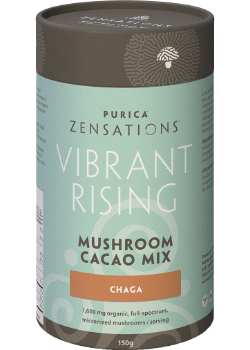
Purica Zensations Vibrant Rising - 150g + BONUS - Purica is a dietary supplement in powder form, intended for adults as part of a daily wellness routine.
Made by Purica, Zensations Vibrant Rising is an organic blend of chaga and cacao. chaga is an antioxidant powerhouse associated with vibrant health and increase vitality and focus. Featuring 1600mg of Chaga mushroom powder per serving, plus organic coconut palm sugar, organic cacao powder, organic stevia leaf extract, Zensations Vibrant Rising is easy to take and tastes great. [POWDER]
Per 1 tsp (5g):
Calories 15
Fat 0g
Saturated fat 0g
Cholesterol 0mg
Sodium 0mg
Carbohydrate 4g
Fibre 1g
Sugars 2g
Protein 0.5g
Vitamin A 0%
Vitamin C 2%
Calcium 4%
Iron 6%
Ingredients: Organic coconut palm sugar, organic chaga mushroom powder, organic cacao powder, organic stevia leaf extract.
Important Information:
Store in a cool dry place and keep out of reach of children & pets.
Dosage
DIRECTIONS: Add 1 teaspoon (5g) to 50ml hot water (taken like a shot of espresso) or mix in smoothies, coffee or other hot beverages.
Premium Functional Mushrooms for Immune & Cognitive Support
Purica offers a premium range of medicinal mushroom supplements designed to support immunity, cognitive function, energy, and overall wellness. Core functional mushrooms include
Chaga,
Cordyceps,
Lion’s Mane,
Red Reishi,
and
Turkey Tail, available in high-potency capsule formats to support antioxidant defence, stamina, brain health, stress balance, and immune resilience. Advanced formulations like
Complete 360
and
Immune 7
combine multiple mushrooms for broad-spectrum daily support. The collection is further enhanced by the Zensations line, featuring blends such as
Chilled Vibe,
Clear Mind,
Mindful Breath,
Universal Harmony,
and
Vibrant Rising, crafted to promote relaxation, mental clarity, emotional balance, and overall vitality through synergistic botanical and functional ingredients.
Chaga
What is Chaga?
Inonotus obliquus, commonly known as chaga mushroom, is a black fungus that grows parasitically on
birch
trees. There are records going as far back as the 16th century for the use of chaga in Eastern European folk medicine and botanical medicine as a treatment for
cancer, ulcers, and some infections. Chaga is rich in polysaccharides (particularly ß-glucan polysaccharides) as well as betulinic acid, and has a bitter flavour similar to coffee. It is an excellent source of superoxide dismutase (SOD – a powerful antioxidant) and is the mushroom with the highest antioxidant (ORAC) level known. For more information on ORAC, see our article on superfruits.
Chaga and Immunity
Initial research on chaga examined the ability of its ß-glucan polysaccharides to prevent a wide range of infectious diseases. Further research found that these polysaccharides have strong anti-inflammatory and immune balancing properties. The immune balancing property of chaga has also been studied as a successful treatment for
psoriasis
(an immune mediated skin condition). As research continued on chaga's role in immunity, it was discovered that compounds from chaga did not attack pathogens directly, but instead stimulated the body to fight the infections itself. The ß-glucan polysaccharides in chaga increase the production of natural killer (NK) cells, the cells in the body responsible for cellular mediated attack against disease.
Chaga and Cancer
The ß-glucan polysaccharides that are found in Chaga and some other mushrooms are currently used around the world as anti-cancer medicinal supplements. Further examination indicated that chaga's ß-glucan polysaccharides have strong anti-inflammatory and immune balancing properties, which include stimulating the body to produce more NK cells. Thus, in much the same way chaga helps the body to fight infection, it can aid in tumour destruction. This process of tumour destruction is in contrast to chemotherapy, a type of cancer treatment that can harm healthy cells and results in a vast number of side effects. Instead, chaga promotes the body destroying the cancer itself in a process natural to the body. Recent scientific research has showed the anti-tumour effect of these specific polysaccharides to be comparable to treatment with chemotherapy and radiation, but without the side effects.
In addition to promoting NK cell development, the anti-tumor effects of chaga can be attributed to altered biochemical mechanisms, such as: inhibition of proliferation, induction of cell cycle arrest, enhanced apoptosis, and regulation of signal transduction pathways, which are related to altered expressions of key
enzymes. In 1958, scientific studies in Finland and Russia found Chaga supplementation provided a potent beneficial effect in breast cancer, liver cancer, uterine cancer, and gastric cancer. In addition to the ß-glucan polysaccharides, the constituents betulin and betulinic acid from chaga are now being studied for use as a chemotherapeutic agent. For more information on betulin and betulinic acid, see below.
Chaga and Metabolic Syndrome
In the 1950's, scientific studies found Chaga provided an extremely beneficial effect in hypertension and
diabetes. Birch trees naturally contain betulin and betulinic acid, compounds that are absorbed by chaga as it grows on the tree. Betulin as it is found in birch bark is indigestible by humans, but the Chaga mushroom converts it into a form that can be digested orally. Recent research has found that betulin from birch bark lowered cholesterol, obesity and improved insulin resistance.
How is chaga extracted?
There are three ways that mushrooms are extracted, only two of which are considered reliable. These methods are: hot water extraction, alcohol extraction, and fermentation. Fermentation is considered an unreliable means of extraction due to variations in microbes used. Hot water extraction is the most common and cheapest purification option, and allows all water-soluble components (including polysaccharides) to be extracted. Alcohol (ethanol) extraction isolates the non-water soluble components, like betulinic acid, betulin and phyto-sterols.
In order to obtain maximum therapeutic value, many manufacturers will usually combine two methods, in general hot water extraction and alcohol / ethanol extraction allow for extraction of the most valuable components. Cheap, mass-produced, extracts tend to be hot water based low percentage (4-20%) polysaccharide extracts with limited therapeutic value. Be sure to read the constituents on the label of your supplement to ensure you will get the medicinal effects you seek.
How can I take chaga?
Chaga can be supplemented as dried mushroom powder, liquid, powdered extract, capsule, or tea. It can be found alone or in combination formulas for
liver support
and inflammation relief. Solid extracts of chaga can be dosed between 200 and 1000mg per day. If making a tea you can dissolve one teaspoon dried mushroom in one cup of hot water several times per day.
Important Information
Chaga mushroom is generally regarded as safe when taken in the recommended doses. Safety in young children, pregnant or nursing women, or those with severe liver or kidney disease is not known, so caution should be used. Due to the hypoglycemic activity of polysaccarides, blood sugar monitoring in diabetics is important.
Carefully SelectedShips to the U.S.Wellness EssentialsTrusted Brands
Product Details
Chaga
What is Chaga?
Inonotus obliquus, commonly known as chaga mushroom, is a black fungus that grows parasitically on
birch
trees. There are records going as far back as the 16th century for the use of chaga in Eastern European folk medicine and botanical medicine as a treatment for
cancer, ulcers, and some infections. Chaga is rich in polysaccharides (particularly ß-glucan polysaccharides) as well as betulinic acid, and has a bitter flavour similar to coffee. It is an excellent source of superoxide dismutase (SOD – a powerful antioxidant) and is the mushroom with the highest antioxidant (ORAC) level known. For more information on ORAC, see our article on superfruits.
Chaga and Immunity
Initial research on chaga examined the ability of its ß-glucan polysaccharides to prevent a wide range of infectious diseases. Further research found that these polysaccharides have strong anti-inflammatory and immune balancing properties. The immune balancing property of chaga has also been studied as a successful treatment for
psoriasis
(an immune mediated skin condition). As research continued on chaga's role in immunity, it was discovered that compounds from chaga did not attack pathogens directly, but instead stimulated the body to fight the infections itself. The ß-glucan polysaccharides in chaga increase the production of natural killer (NK) cells, the cells in the body responsible for cellular mediated attack against disease.
Chaga and Cancer
The ß-glucan polysaccharides that are found in Chaga and some other mushrooms are currently used around the world as anti-cancer medicinal supplements. Further examination indicated that chaga's ß-glucan polysaccharides have strong anti-inflammatory and immune balancing properties, which include stimulating the body to produce more NK cells. Thus, in much the same way chaga helps the body to fight infection, it can aid in tumour destruction. This process of tumour destruction is in contrast to chemotherapy, a type of cancer treatment that can harm healthy cells and results in a vast number of side effects. Instead, chaga promotes the body destroying the cancer itself in a process natural to the body. Recent scientific research has showed the anti-tumour effect of these specific polysaccharides to be comparable to treatment with chemotherapy and radiation, but without the side effects.
In addition to promoting NK cell development, the anti-tumor effects of chaga can be attributed to altered biochemical mechanisms, such as: inhibition of proliferation, induction of cell cycle arrest, enhanced apoptosis, and regulation of signal transduction pathways, which are related to altered expressions of key
enzymes. In 1958, scientific studies in Finland and Russia found Chaga supplementation provided a potent beneficial effect in breast cancer, liver cancer, uterine cancer, and gastric cancer. In addition to the ß-glucan polysaccharides, the constituents betulin and betulinic acid from chaga are now being studied for use as a chemotherapeutic agent. For more information on betulin and betulinic acid, see below.
Chaga and Metabolic Syndrome
In the 1950's, scientific studies found Chaga provided an extremely beneficial effect in hypertension and
diabetes. Birch trees naturally contain betulin and betulinic acid, compounds that are absorbed by chaga as it grows on the tree. Betulin as it is found in birch bark is indigestible by humans, but the Chaga mushroom converts it into a form that can be digested orally. Recent research has found that betulin from birch bark lowered cholesterol, obesity and improved insulin resistance.
How is chaga extracted?
There are three ways that mushrooms are extracted, only two of which are considered reliable. These methods are: hot water extraction, alcohol extraction, and fermentation. Fermentation is considered an unreliable means of extraction due to variations in microbes used. Hot water extraction is the most common and cheapest purification option, and allows all water-soluble components (including polysaccharides) to be extracted. Alcohol (ethanol) extraction isolates the non-water soluble components, like betulinic acid, betulin and phyto-sterols.
In order to obtain maximum therapeutic value, many manufacturers will usually combine two methods, in general hot water extraction and alcohol / ethanol extraction allow for extraction of the most valuable components. Cheap, mass-produced, extracts tend to be hot water based low percentage (4-20%) polysaccharide extracts with limited therapeutic value. Be sure to read the constituents on the label of your supplement to ensure you will get the medicinal effects you seek.
How can I take chaga?
Chaga can be supplemented as dried mushroom powder, liquid, powdered extract, capsule, or tea. It can be found alone or in combination formulas for
liver support
and inflammation relief. Solid extracts of chaga can be dosed between 200 and 1000mg per day. If making a tea you can dissolve one teaspoon dried mushroom in one cup of hot water several times per day.
Important Information
Chaga mushroom is generally regarded as safe when taken in the recommended doses. Safety in young children, pregnant or nursing women, or those with severe liver or kidney disease is not known, so caution should be used. Due to the hypoglycemic activity of polysaccarides, blood sugar monitoring in diabetics is important.
🌿
Daily Wellness
Easy to add to your everyday health routine.
✅
Carefully Selected
Chosen with quality and customer needs in mind.
💊
Simple to Use
Designed for convenient daily supplementation.
🚚
Ships to the U.S.
Fast, reliable shipping to U.S. customers.
Choosing a selection results in a full page refresh.